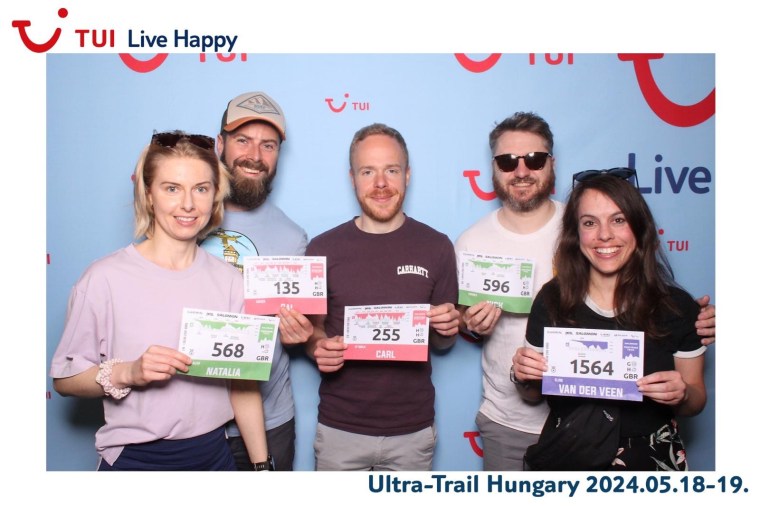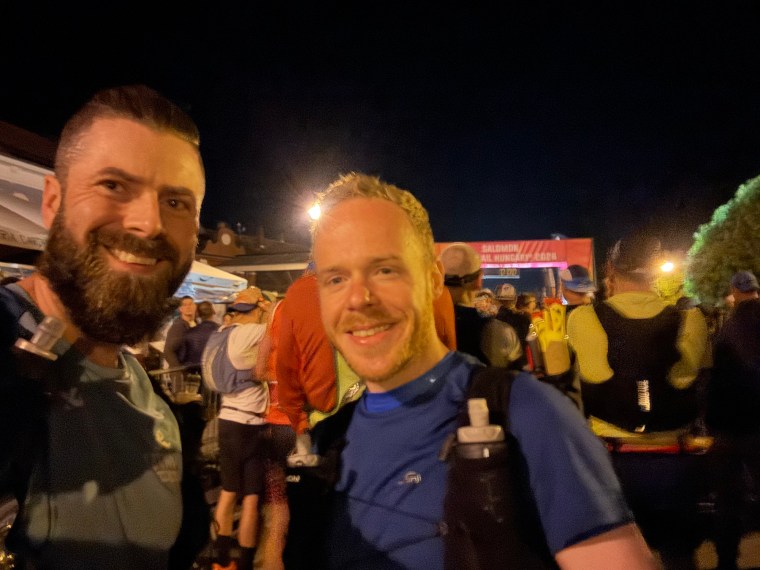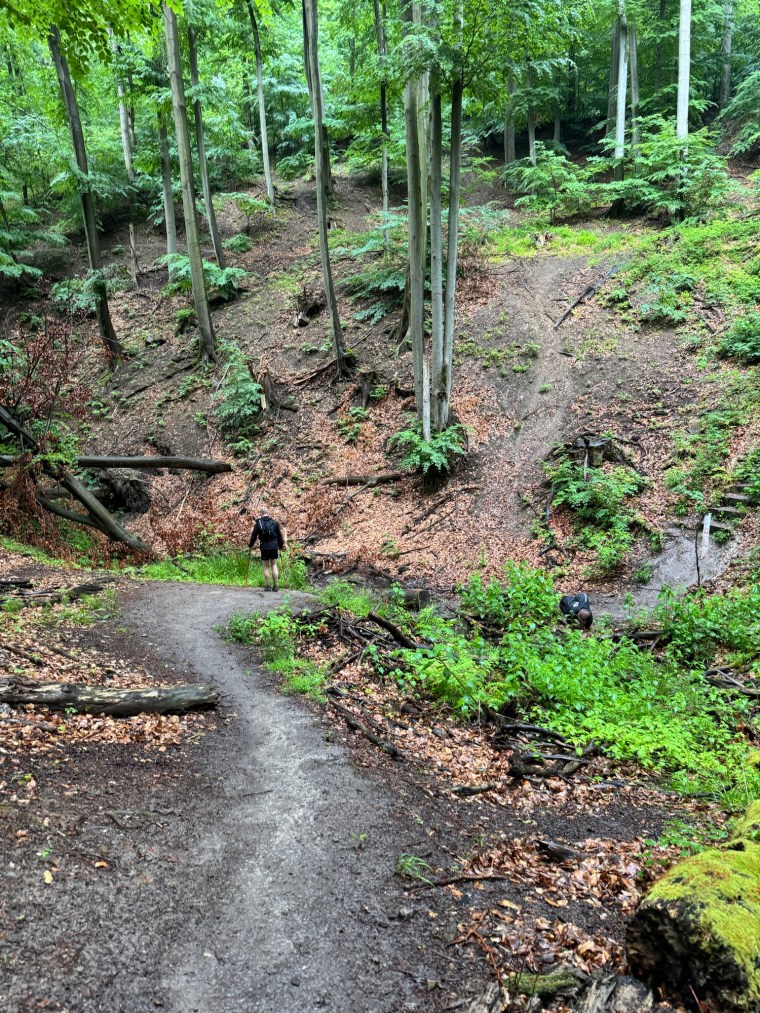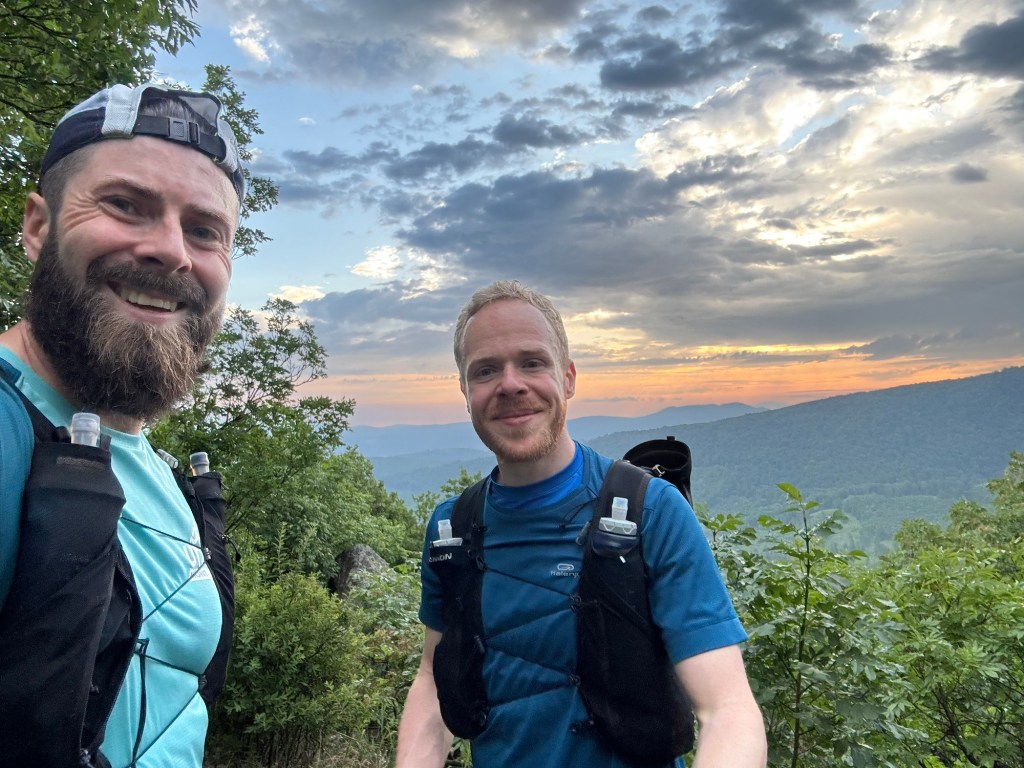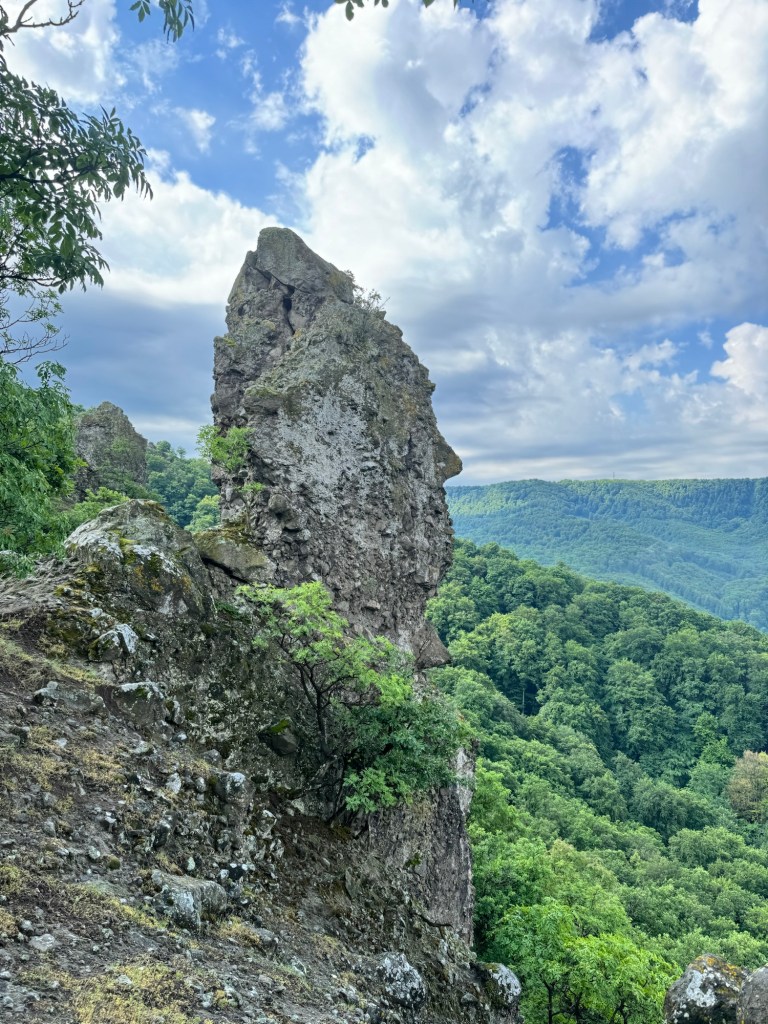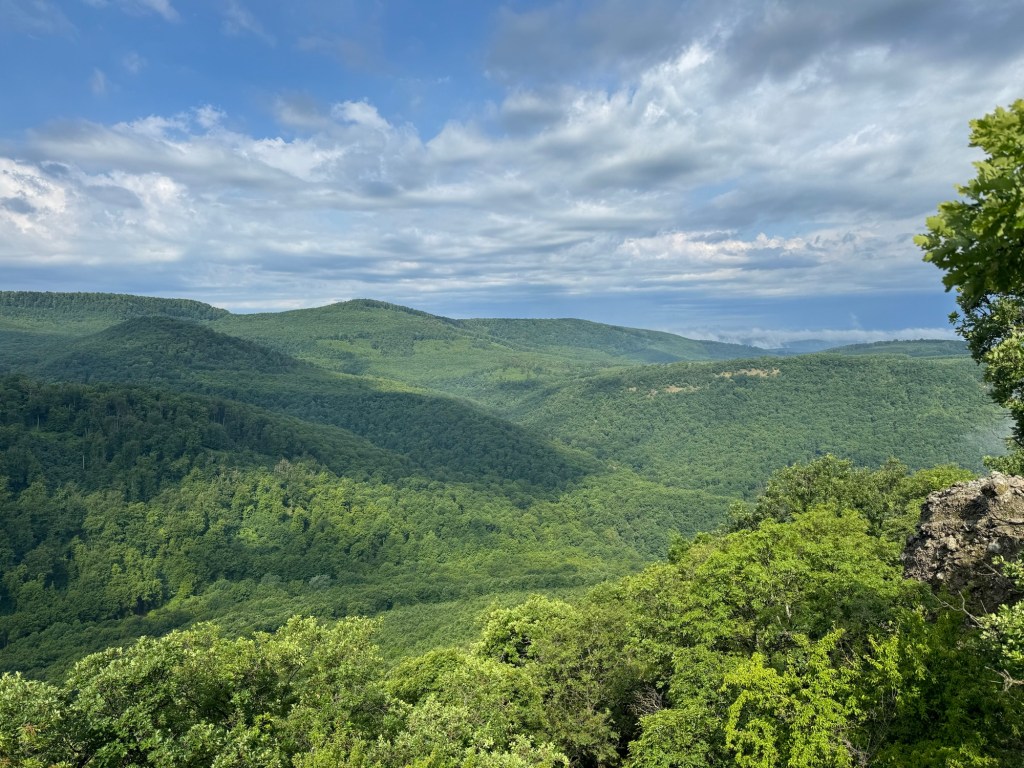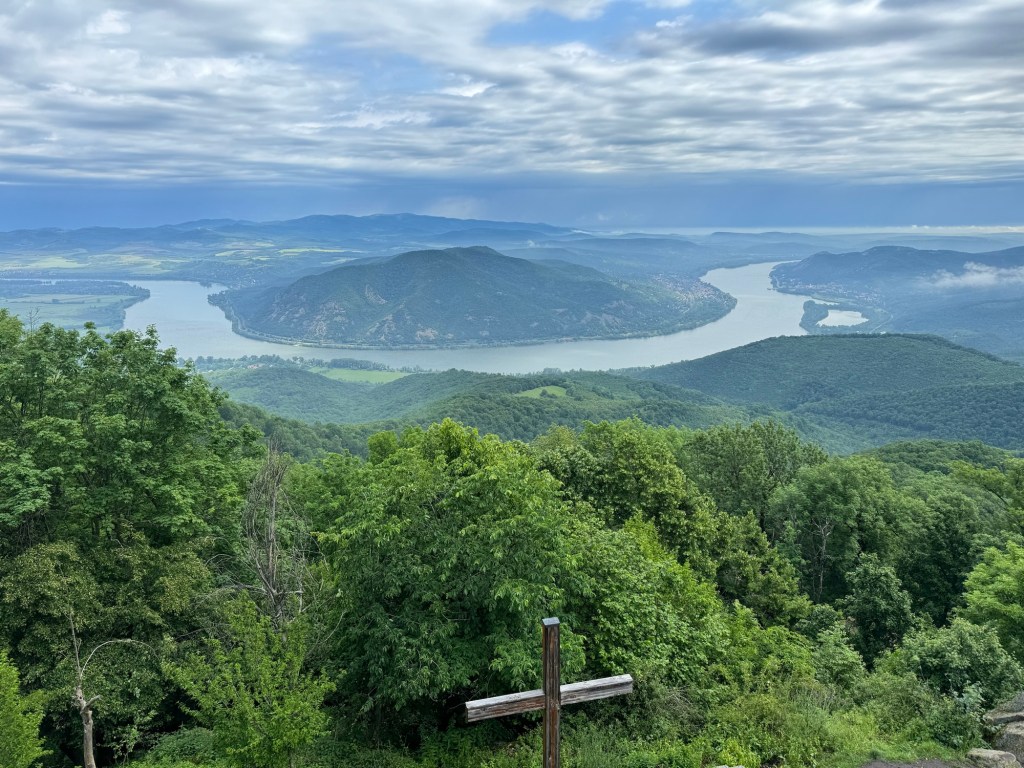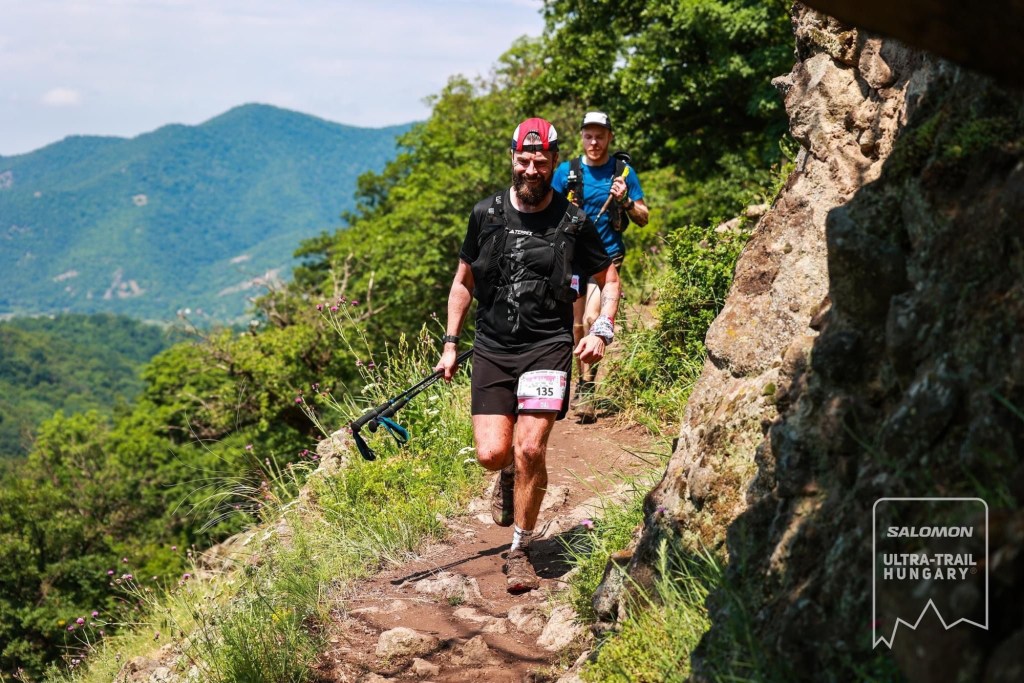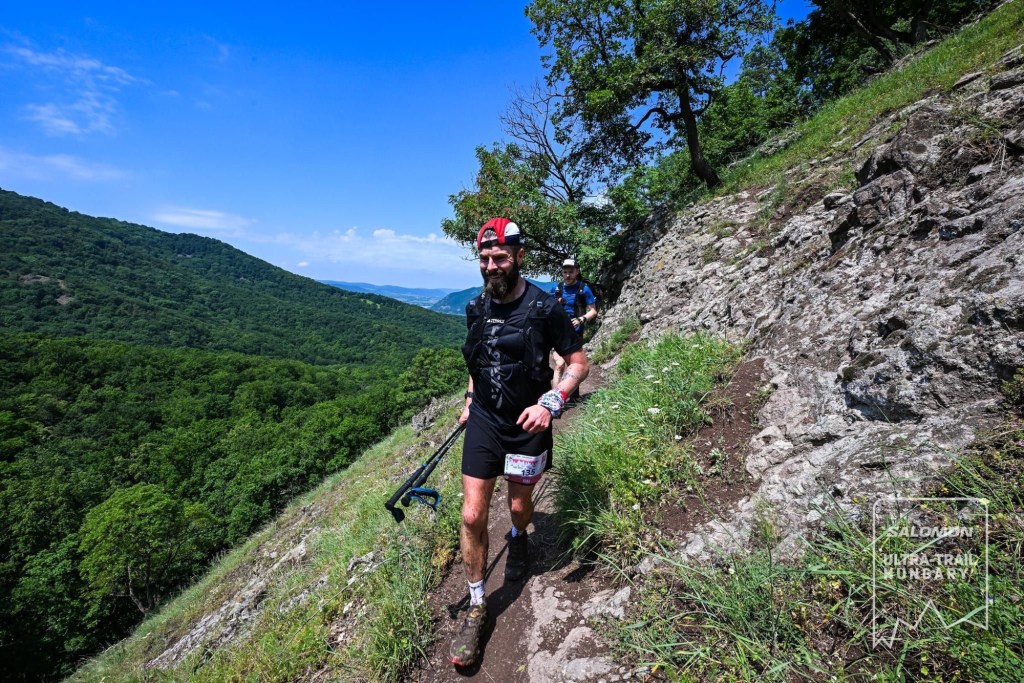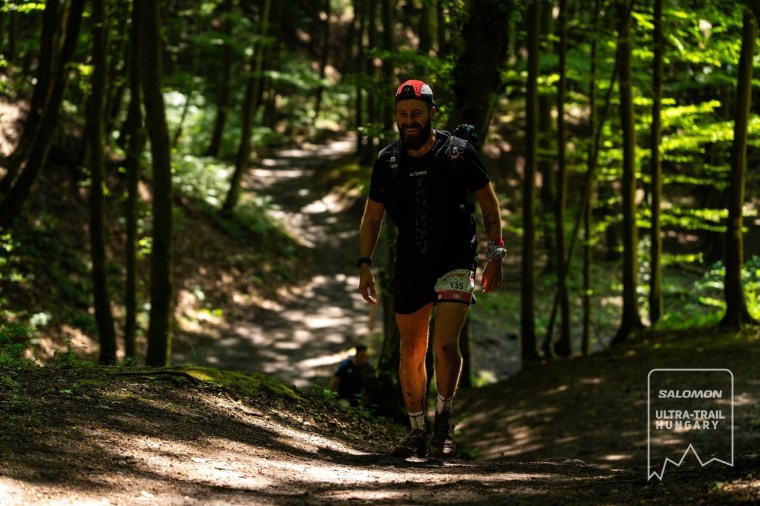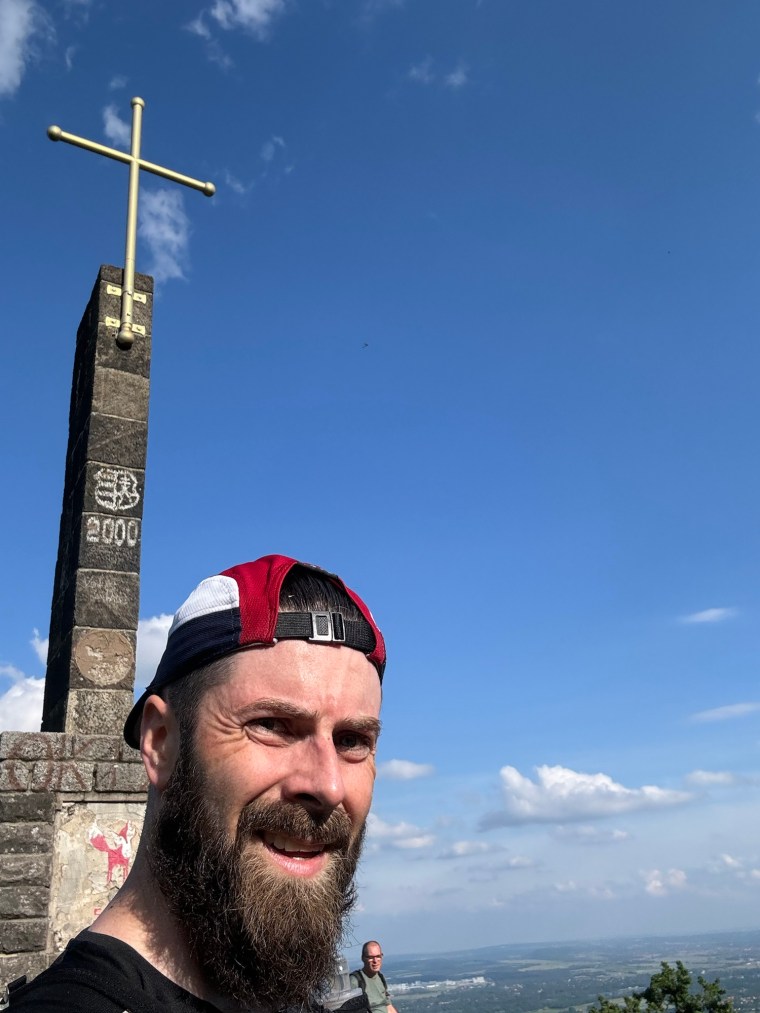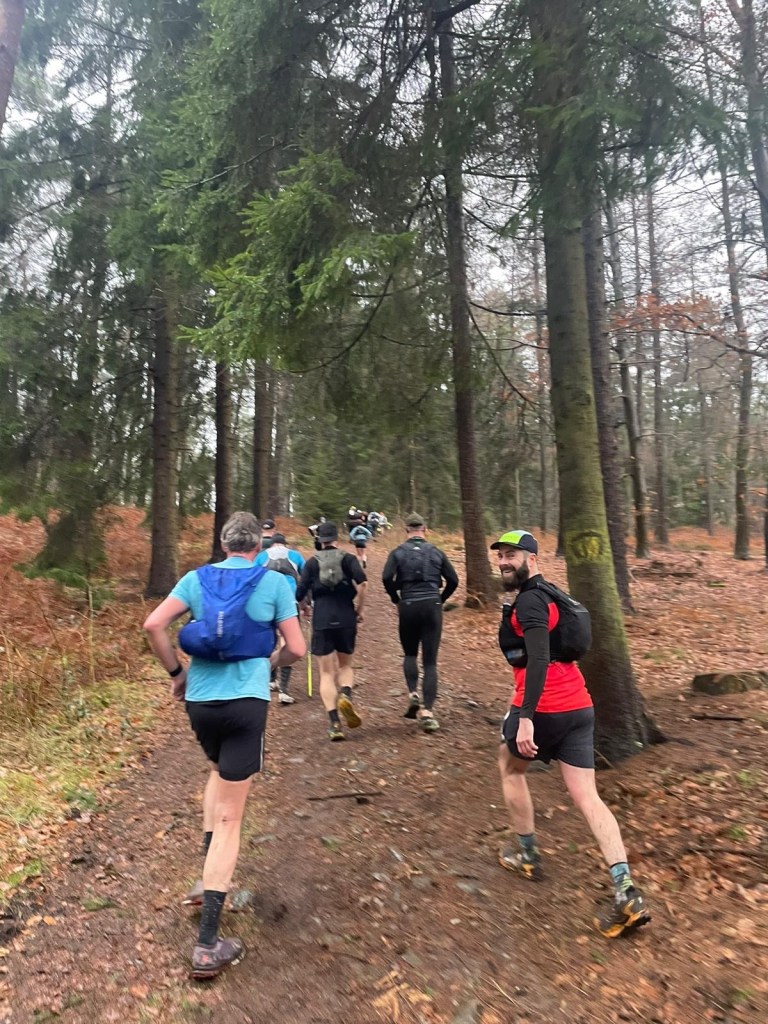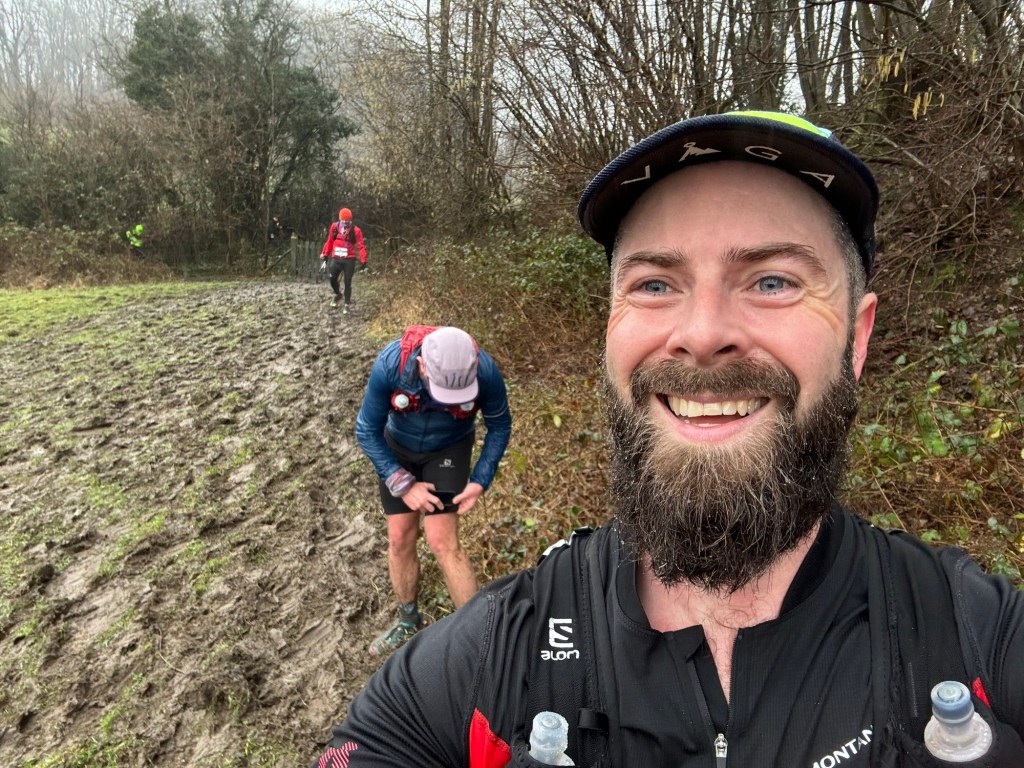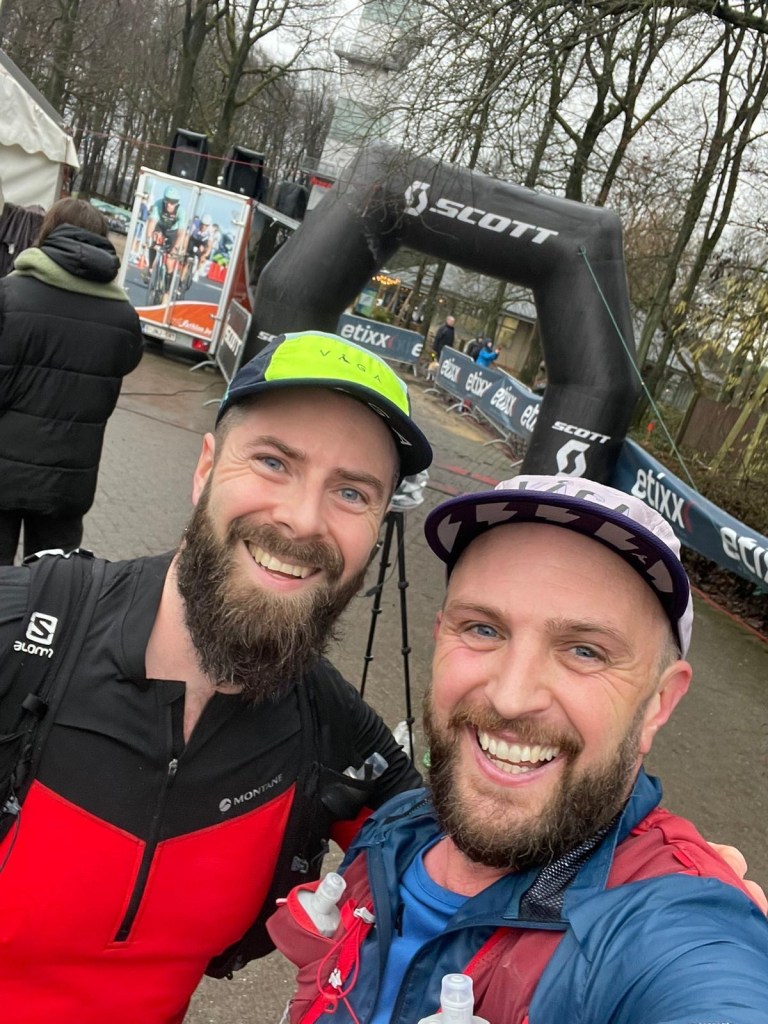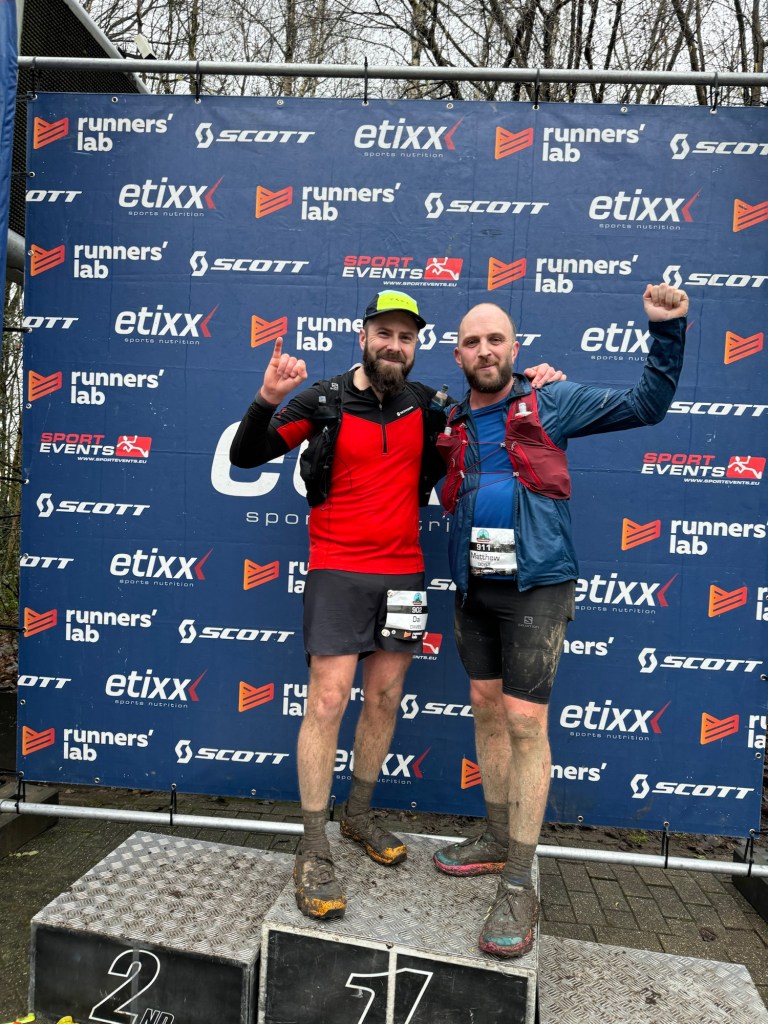
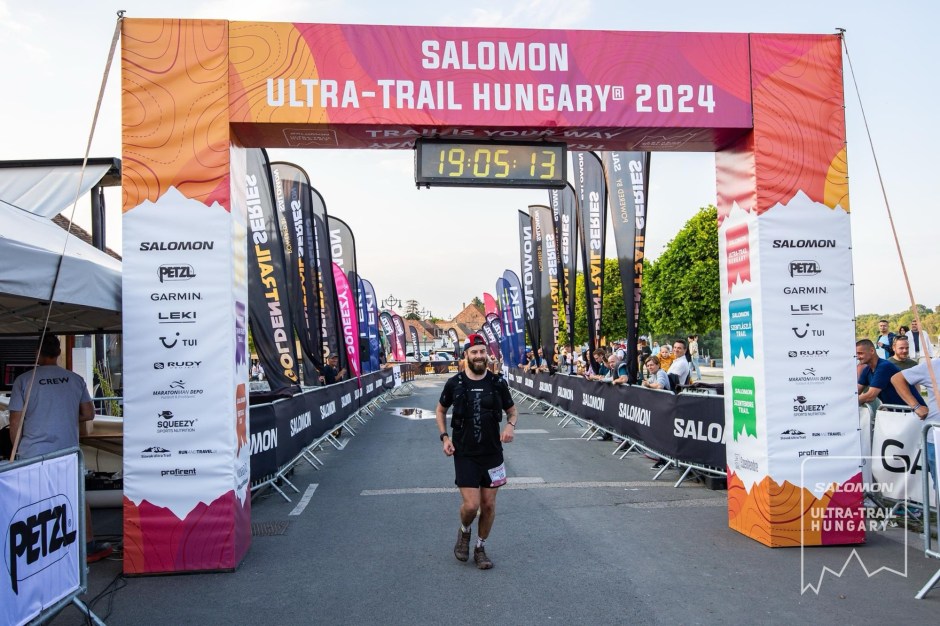
Giraffe, Frog!

Istria100, a 100mile course on the Istrian peninsula in north west Croatia. A race I heard about shortly after I got into trail running and which peaked my curiosity. There are several distances on offer as part of the event, but it was only the 100 mile race that I wanted to do. I’d contemplated the race a few times in previous years but it seemed to never work out with other plans. Thankfully Matt was keen to do a 100 mile event in 2024 and liked the sound of Istria, so we signed up.

Leading up to the race I was starting to feel more confident and optimistic. My persistent leg injury seemed to be under control (probably thanks to the Physio I’d been seeing and being more consistent with some rehab and strengthening!). Running Letecka Stovka a few weeks earlier was a huge confidence boost and the planning for Istria was complete, so all was good. Then, a week before the race I rolled my ankle (on the other leg – the one I broke back in UTMB 2022!) badly at the end of a simple run just as I was approaching home. It hurt like hell at the time and continued to ache for the rest of the day. It wasn’t one of those ‘it hurts but is instantly fine a few moments later’ kind of rolls. So the injury anxiety and worries came back along with the constant ice pack. Trying a run a few days later it was still achy and although I was concerned, I wasn’t going to stop now. I’d do the usual hope for the best and ‘deal with it later’.

I met Matt at Venice airport and we drove over to Umag in Croatia by passing through Slovenia. Thankfully for me Matt is super organised and had sorted all the race logistics. We were staying in a hotel affiliated to the event in Umag not far from the finish line. The hotel also had a regular shuttle bus to the sports hall (where bib collection and drop bags would be) and would also be the venue for the post race meal for runners. We’d planned to be running for over 35 hours so made two separate bookings for just the night before the race and the night after. Trying to be smart and not pay for accommodation for the two nights we’d be running through. Given the time of our flights landing, we didn’t make it to Umag in time to collect the bib the night before the race, so we checked in to the hotel and went for food and then straight to sleep.

Registered and ready

The next morning we checked out and used the shuttle service to go collect our bibs before returning to the hotel and getting ready for the race in the hotel grounds near the tennis courts (tennis is big in Umag! They host an ATP tournament don’t you know!). The start of the race is in a town called Labin on the eastern side of the peninsula. There was a transport bus from Umag at 16:00 so we had plenty of time to spare. When we were ready we took the shuttle service back to the sports hall and made our way into the town centre to get some lunch. We forgot the race centre was closed over lunch so couldn’t drop our bags off until we went back for the bus to Labin after we’d eaten.

A few hours later we’d completed the bus journey and arrived at the little medieval town of Labin perched high up on the hill above the city of Rabac. There was an initial mad rush to the toilets as all 7 buses unloaded and then a short time of hanging around waiting for the race to start. Thankfully it went quickly and there was a good atmosphere as the host shared information over the loud speaker, a samba band provided entertainment and the organisers arranged a group photograph of all the female participants. Scott, another runner from Wales who I met on an UltraX event years ago, found me and said hello. Then, Before we knew it, Thunderstruck by AC/DC was pumping out and the countdown began. We were off…

Start line smiles

Section 1

For the first section we left Labin on the main road, leaving the old town through the archway and down hill. Naturally people bombed passed us from all directions. We we cautious and knew we couldn’t get caught up with speeding through the first downhill section so ran sensibly, even as we saw runners chasing each other up the initial little climb straight out of town before we turned off for the trails. The first trail was a narrow, single track trail that led down to the coast and towards Rabac. It was scattered with very loose rocks for most of the way. At the bottom we ran along the promenade of a the beautiful coastal city of Rabac (with its humongous resort perched on the side of the hill) and enjoyed the gentle sea breeze. We then turned off the sea front and up a lot of steps as we found the single tracks of the forest and wide, gravel roads that made up the first incline. It was rocky.

The climb was fairly short and didn’t take long to ascend. There was a brief peak with a view point (one of those random man made picture frames you’re supposed to take a photo with?!). But I was more fascinated by the massive chimney from a nearby industrial site in the the valley below. Despite being about 450m high at the view point, this chimney looked like it towered almost all the way to the same height as us.

From the peak we began the descent. It was a very long down hill on loose rock and gravel tracks, following large swooping switch backs down to sea level. The whole way the towering chimney occupied my thoughts. I know now that this is from the Plomin coal-fired power station. At the bottom we crossed a water channel connecting to the sea and made our way into a massive car park and the first aid station – Plomin Luka. Here we did a quick stop, the highlight being paprika flavoured crisps. I love paprika flavoured crisps. We checked out the profile of the next section and Matt set the strategy noting this was an important section to get right. It was the longest section of the race and also had the second largest of the climbs. It was about 7pm so we took out our head torches ready for sunset.

Leaving the coast behind

Section 2

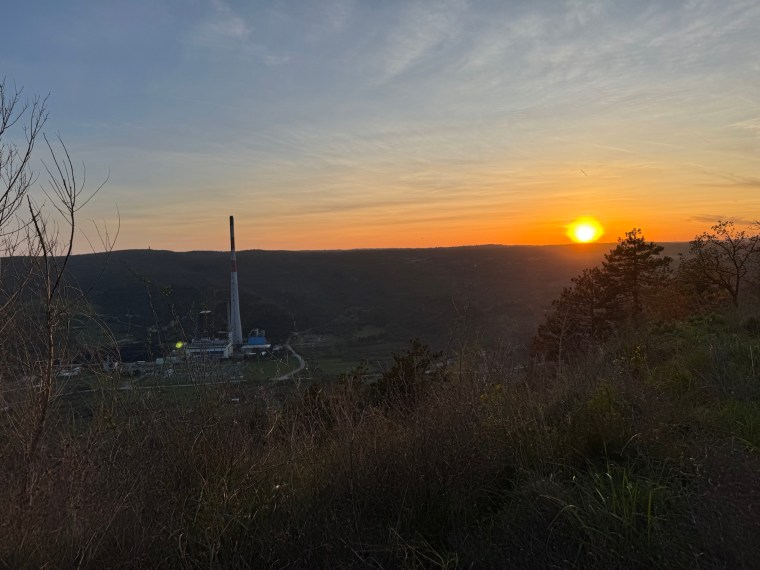
We set off from the carpark and began the ascent of the big climb of almost 800m. It started ‘off track’ with lumpy, rocky ‘steps’ as we climbed a short way to the old village of Plomin situated on the hill. Here there were lots of enthusiastic supporters cheering. They were particularly vocal in cheering on the ‘chica’ who was in front of us. It was great to feel the support. The climb then took us onto some very steep, wide gravel tracks. It wasn’t known at the time, but this would be the most prominent of surfaces we’d run the whole race on – wide tracks for vehicle access that weren’t anything more than just loose rock and steep gradients. As we climbed the sun set rapidly. We were treated to a fantastic orange sky with the power station chimney getting smaller and smaller in the valley below us.

Sunset over the Plomin power station

The climb eventually levelled out. At the top was a very short but steep downhill on the same terrain then a few kilometres of undulating tracks. Already I was conscious of the terrain and my ankle and verbalising (moaning) to Matt. I’d rolled both my ankles numerous times already. I was a little concerned the impact this might have on my increasingly fragile body over the rest of the race. For the last few kilometres we descended sharply for about 500m back down to sea level again. It was a little quad buster but we tried to descend sensibly. Toward the bottom we ran alongside a river and crossed the water. Here the rock was very slippery and we were glad it wasn’t raining. The course would be infinitely harder in wet conditions like the previous year. The next aid station was in the old town of Mošćenička Draga – a small fishing port of the town of Mošćenice – and we could hear the atmosphere from the pumping music. The vibes and volunteers were excellent here. After more fuelling (paprika crisps!) we studied the next section’s route profile. Up next was the biggest climb of the race. We had about 1300m of elevation to climb in one go, roughly split up into a 900m and then a 400m climb, as we’d make our way towards Poklon.

Section 3

After leaving the town, the first part of the climb was steep gravel tracks (it’s becoming a theme now isn’t it.) with the terrain being very loose underfoot. The gravel tracks were intermittently broken up by steeper, more rocky climbs. We powered through with a nice consistent pace taking it steady. The darkness of the night helped not being able to see the trails and summits ahead. Occasionally I’d try second guessing our direction, pointing out the silhouette outlines of mountains looming around us in the night sky.

We conquered the first 900m without any concerns and had a long, surprising flat and down hill wide trails to enjoy for a a little section before climbing again. Now we climbed steep trails deep in the forest before a rather exposed section to the summit after we left the shelter of the trees. We could see the blurred glow of head torches disappearing into the darkness above us. We followed them into the unknown. With the exposed mountain the icy cold temperatures were initially refreshing after a tough climb but soon we realised how cold it was as the mist and clag of the summit set in. It was so misty that it was difficult to see as we traversed the final section to the summit along a short but very rocky ridge. Without being able to see more than a few metres ahead, we were shocked when a brick building of some sort of building appeared next to us out of nowhere. We were at the top of the trail, it was the Vojak Tower at Vojak – the highest peak on the Istrian peninsula – which then instantly turned to a pathed, stone pathway. It was glorious. A few hundred meters of rest bite from the rocks.

We began descending pretty soon and we kept moving to keep warm. With the moisture of the night we found the (now) rocky descent hard going as it was slippery. We followed the tracks down as the switch backs took us quickly down a few hundred metres to Poklon and the next aid station. This was the 50km mark and the first cut off point. We arrived about 2 hours ahead of our estimate. We were happy but both acknowledged how sore and achy we were. After 50km it felt like we’d run a lot further than what we had. My lower hamstrings were surprisingly tight and our quads ached. This was a significant milestone in the race though as we’d now completed the three biggest climbs, the first cut off and almost half of the total race elevation. Looking back, it’s a challenging 50km!

Long gradual gravel climbs

Section 4

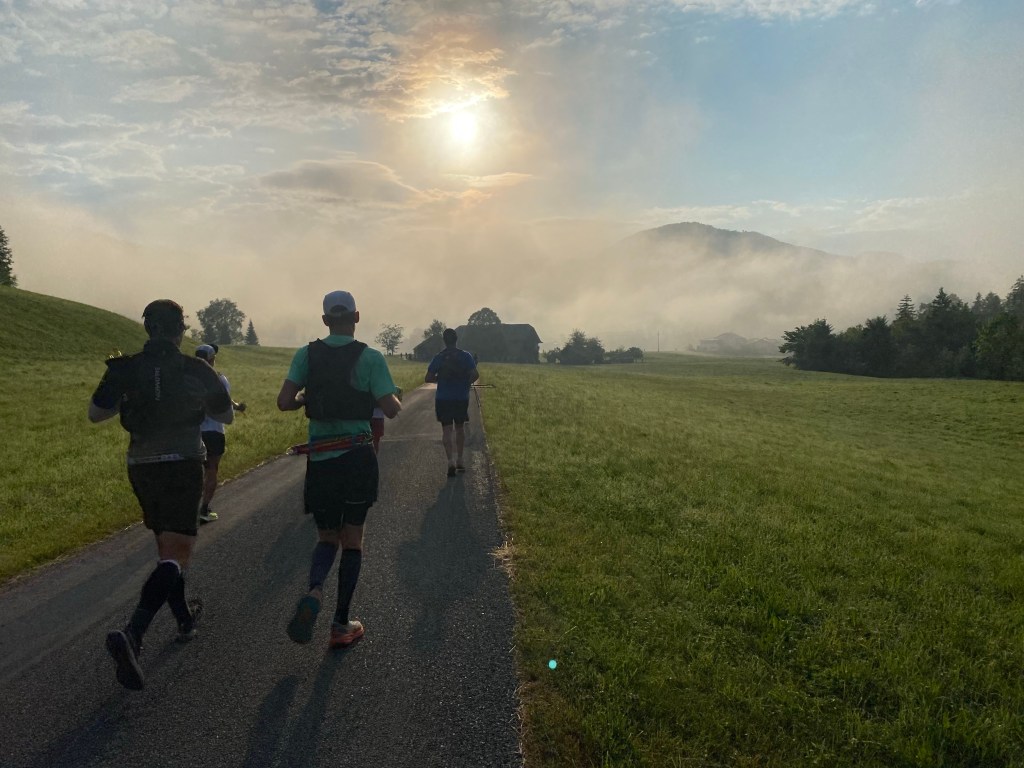
From Poklon to Brgudac the section was fairly straight forward. There was a Little climb on road and trail (yeah it was mostly rocky). Then pretty much all long wide gravel tracks with mostly gentle downs and gentle ups for the undulating terrain. It was pretty slow going though and fatigue was definitely kicking in. Our feet were sore and we were seriously starting to dislike these gravel trails. We left Poklon about 3am and we were tired now and holding on to the thought that it would start to get lighter from around 6am. Whilst I moaned about the rocks, my ankles and feet, Matt started to get very sleepy and was weighing up the thought of a quick trail nap. He fought through the tiredness though and we got to the aid station just before 6am. As we were leaving the sun started to rise and the trails were visible enough without our head torches. We were starting to get excited about the day ahead and seeing some views after the darkness of the night.

Section 5

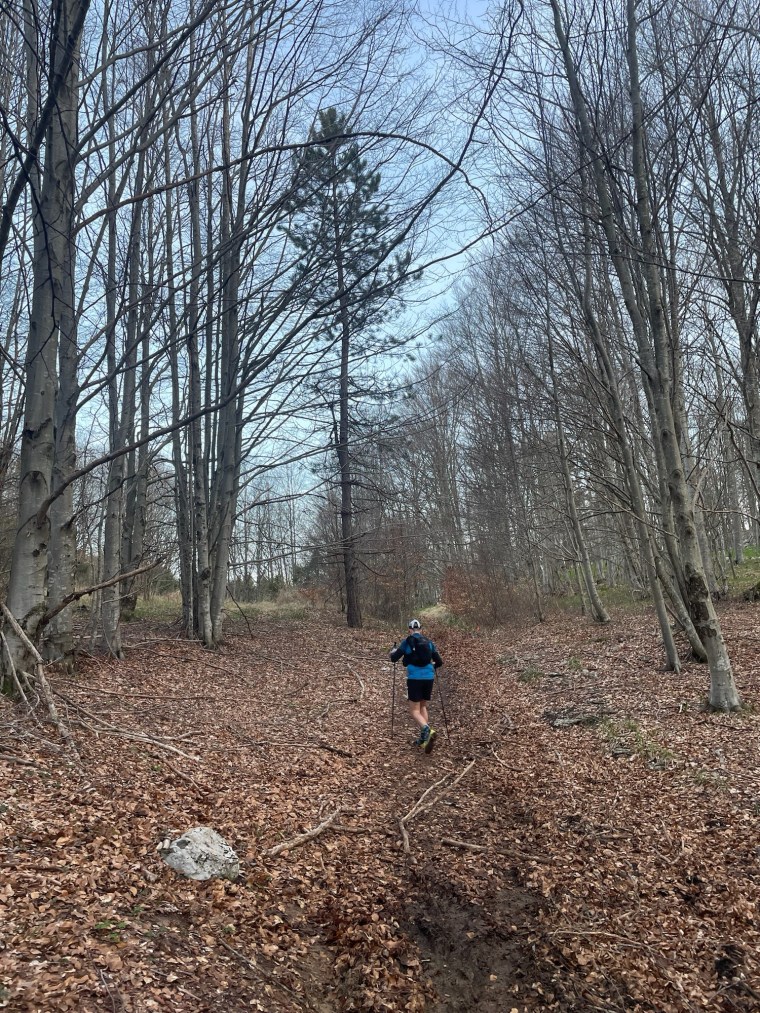
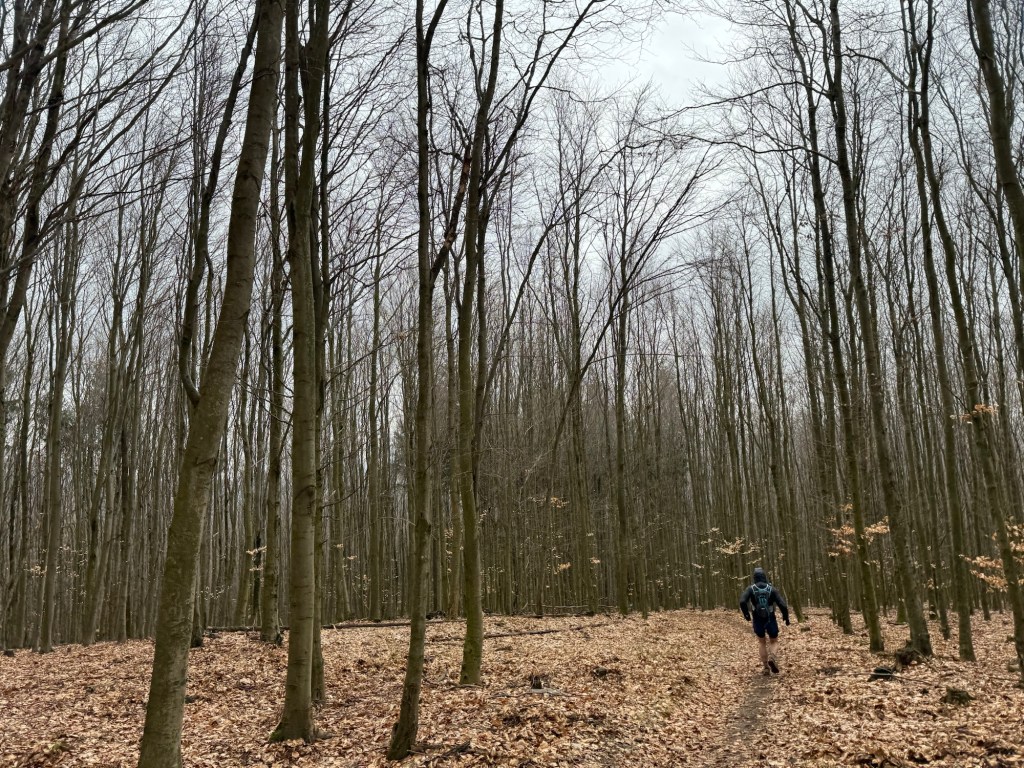
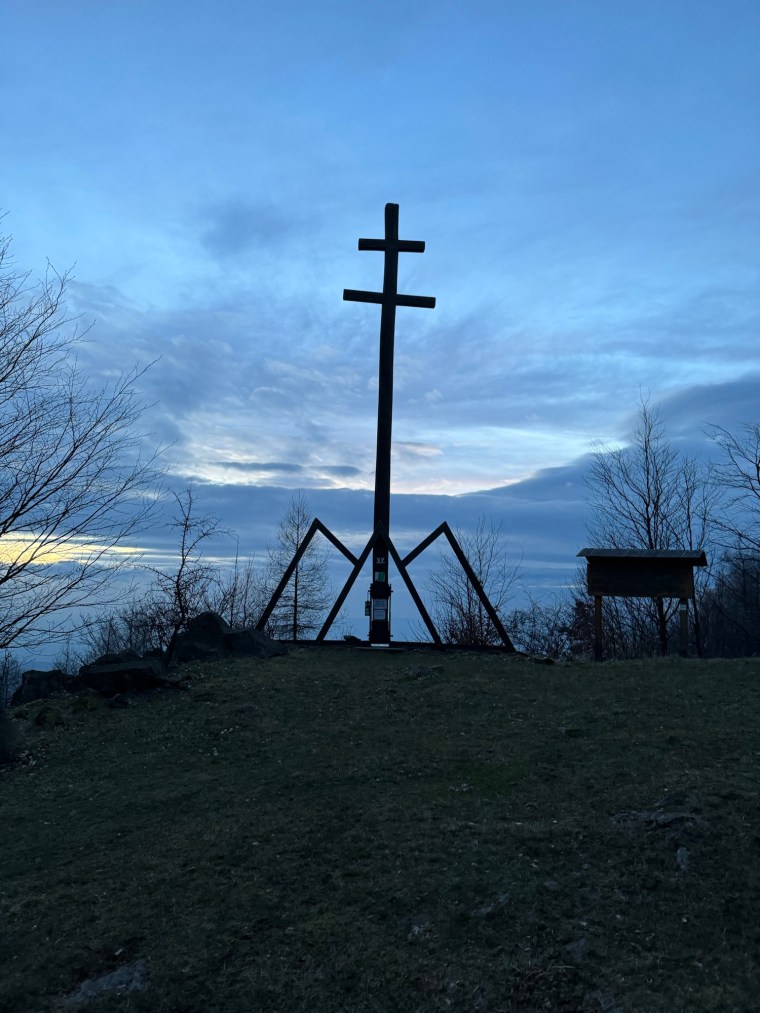
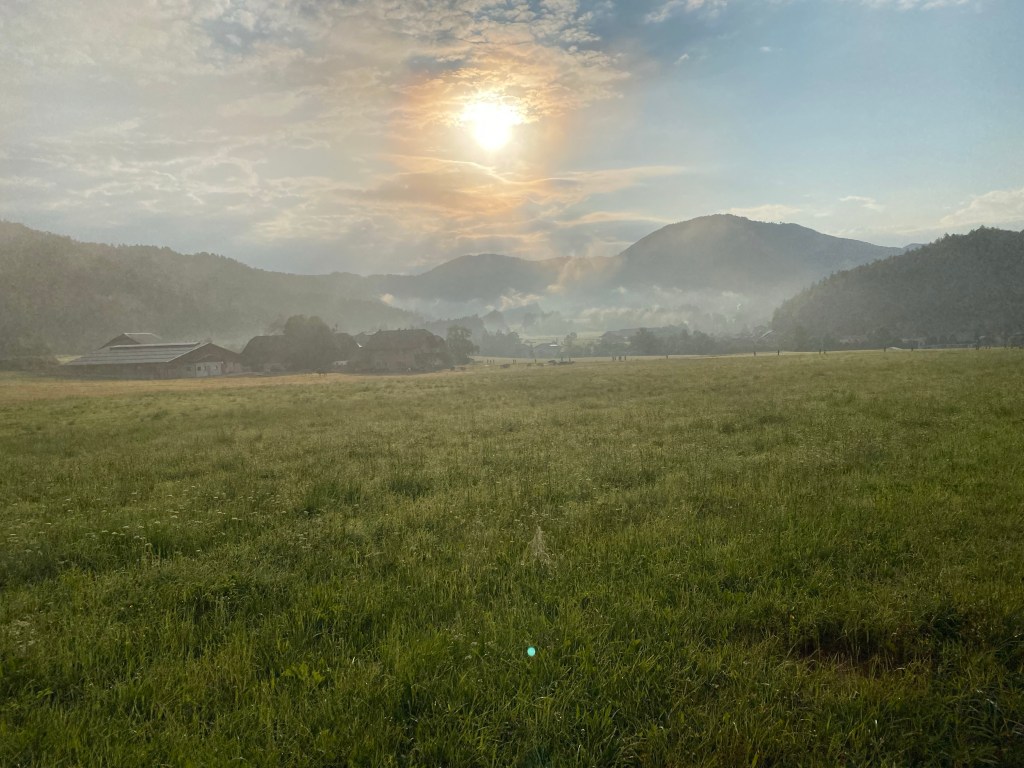
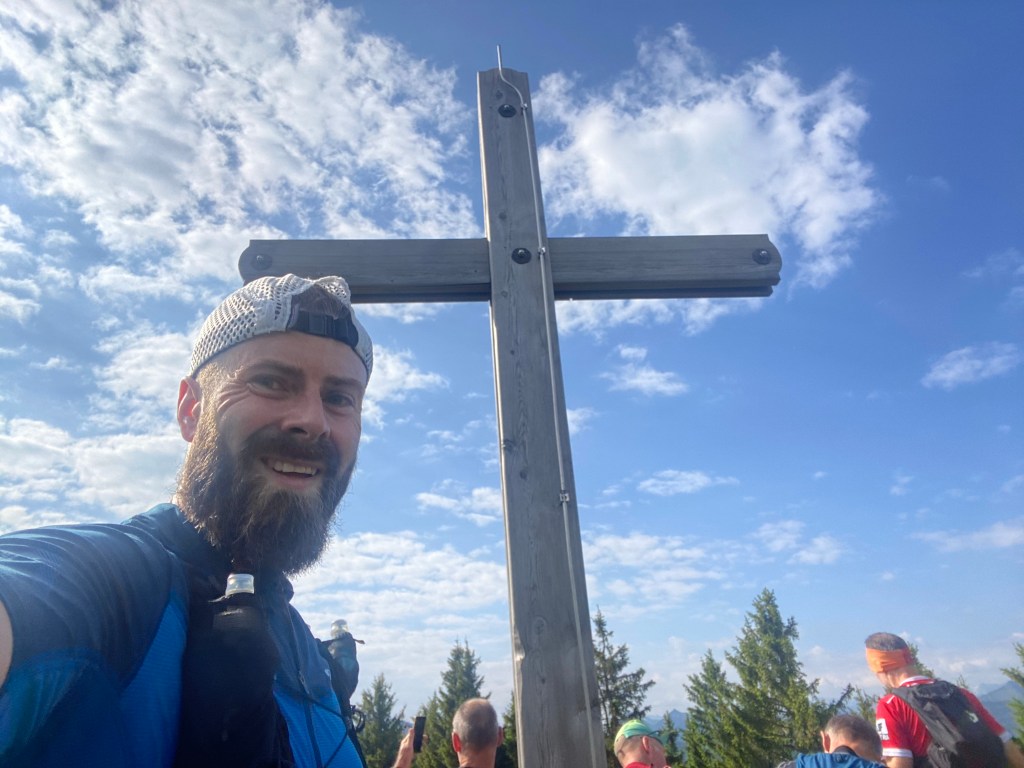
We left the aid station and followed the gravel tracks for a few kilometres before reaching some forests. It was a refreshing change of scenery. We crossed dried up old streams and passed a man made fountain(?) collecting water from the mountain side. The sunrise fully completed as we went deeper into the forest and the sun shone through the dense woodland. It created beautiful patterns of light and enjoyed the serenity of the moment. The field of runners had spread out and we enjoyed the peace and quiet of the forest. The climbs took us to a summit marked with a big Red Cross on it. We took a moment to enjoy the views which were panoramic. The trails then took us down through the forests with short sharp steep descents on loose soil. We enjoyed it despite the increasing quad fatigue we began to feel. We were 70-80km into the race now and had missed a nights sleep so fatigue was to be expected.

We were trying to keep each other entertained and were playing word games. We took turns naming countries beginning with the letter that the last country finished with. Matt was kicking my ass, badly. He kept hitting me with double ‘A’s and I was useless. So the game didn’t last long and he wasn’t having any of my excuse of “but we have another 25 hours of the race to play” as I attempted to stall. We switched the game to naming animals and I faired equally badly. Actually, worse because I kept replying “frog” to Matt’s play of “giraffe”. He kindly put it down to tiredness and not me being stupid. It did however give birth to the “giraffe, frog! game. A simple game of naming different animals, but any time someone says giraffe, the next person must say frog, if not they lose. Simple. It popped up a few times throughout the rest of the run.

Thankfully I was spared any further embarrassment as a new distraction soon graced us – the 100km runners. We knew the courses joined but weren’t expecting to reach the join before the majority of the 100km runners. We thought we’d maybe get the mid/back of the pack. Out of nowhere Matt heard a noise and turned to find the leading pack of 5 males (and not far behind them the leading lady!) right behind us. We stepped aside and cheered them through. One of the pack was Pau Capel (a big name in trail running) and we had fun cheering him.

The excitement soon subsided though as it made the next few kilometres a little frustrating as we carried on through the forests. For a few climbs and descents we had to constantly step aside to let all the speedy runners passed. It’s not needed, but it always feels the right thing to do (to give way and step aside). But it does mess with your momentum. And momentum is so important on long distance endurance runs. Thankfully most runners acknowledge and thank you for the consideration. Many however don’t. It was amusing how my ‘trail humour’ and attempts at heckling the runners falls so flat. Dad jokes like “don’t let us catch you up” and “you can beat him” just didn’t hit the mark. They never do but I can’t stop myself.

Panoramic views

When we reached the next aid station we took a bit of a longer rest to give more of the pack a chance to pass us (as this aid station was about 40km in to their race, many of the 100km runners didn’t hang around for long). We also saw Kaito, who we briefly met at registration the day before. He was flying on his first 100km event. We sat down and enjoyed another course of paprika crisp sandwiches (the best combination) which had been our primary fuel at each aid station. We were loving it.

Section 6

The next section was the final bit that would take us to the 100km mark and our drop bags. We’d pretty much done half the race now and gave ourselves a hi five as we left Trstenik . We had more, long roads/gravel tracks and forest to overcome as more 100km runners passed us. We were aligned with the mid pack of the race now which gives a different vibe. The elites and faster runners are so focused that they fly passed you and from most you get a simple thanks or acknowledgement. Further back in the pack the runners speak to you a bit more as they pass and many go out of their way to acknowledge the 100miles and express a little bit of awe at your achievement. It’s a a real confidence and morale boost. It spurs you on as you converse with these strangers and encourage each other. Something I really like about the sport.

In this section I recall a road crossing that led to a short steep climb as we reached another summit. This was the last climb we’d do at the higher altitudes. For the last 40km or so we’d been fluctuating around the 700-1100 m of altitude. After this summit we would descend and would not climb to more than about 400m again for the rest of the race. After the climb the descent was pretty straight and direct for a few hundred metres of elevation loss as we passed near Brest before a short undulating section through Slum. We then dropped the last 500m or so on rocky forest trails to Buzet. We could see the town from the trails and were second guessing where the aid station might be. We could see little dots of runners crossing roads and roundabouts and then disappearing into the town. Eventually, after passing over the train line, it was our turn to be the guiding dots for the runners behind us.

Heading into Buzet

Here we grabbed our drop bags and put our race strategy into action. We’d spent the last few kilometres adjusting and refining our plan – We’d get our bags and grab some food. Start charging our devices and sorting our kit as we ate. Then get changed into fresh clothes before going for a sleep (there were camp beds and planned sleeping areas at this aid station). After which we’d finish preparing our kit for the next section. This plan was based on our previous experiences. Firstly we thought it best to sleep where there was space to do so rather than waiting until we were more tired / later in the day. So despite it being around 1pm we decided a quick sleep now would be beneficial and hopefully postpone any tiredness deeper into the second night. We’ve also decided that it’s best to not go straight to sleep when we arrive at an aid station. We’ve done this before and we think the downsides outweigh the positives. Firstly you are normally wet with sweat and warm through adrenaline. As soon as you stop your temperature starts to plummet. It can be hard to get to sleep if cold and shivering. So always change clothes before sleeping. Secondly, eating first gives your body a brief rest from trying to process the food whilst on the go. And sometimes after you wake up you actually want to eat again!

So we did just that. We ate pasta with beef stew and sides of fried chicken. Istria100 is known for its great food and aid stations. Whilst I wouldn’t say any of this was great, the beef stew and fried chicken was definitely improvements on the options available at most other races! We then went for 30 mins of sleep. We were 2 hours ahead of our schedule and had plenty of time before the cut off. Plus, we’d planned on finishing early in the morning on Sunday and didn’t have anywhere to go as our hotel booking meant we couldn’t check in until about 2pm. So we didn’t care what time we actually finished. We had all day Sunday to do nothing and if we finished earlier we’d just have to sleep in the sports hall somewhere. We went upstairs to the sleeping area and found camp beds with no one else about. Perfect peace and quiet. We set an alarm and went to sleep. Before we knew it the alarm was waking us. I don’t think I really slept. I dozed but felt I was conscious the whole time. Matt did sleep though which was good as he’d been carrying that tiredness through from the early hours.

We had a few more snacks and decided to take a bit more time before leaving. I think in the end we rested for about 1.5 hours which is loads of time, even by my standards. There was another benefit here which came into our thinking. It was now very, very hot outside. The more time inside at Buzet meant the less time we spent outside in the heat. Not that it helped that much…

Section 7

As soon as we left Buzet we trotted down a road section towards the trail. I was pumped with energy from the rest and we moved quicker than we had for who knows how many hours. As we hit the start of the first climb, a muddy forest trail, the lack of shelter from the heat hit hard. Matt particular felt the heat as we started climbing and we made the decision to slow down. It’s good Matt recognised the impact of the heat as I think I would have pushed on and exhausted myself on the climb. The first climb was maybe a 150m section then a brief flatter bit before a final 100m push. We started to climb in the forests before we encountered some vineyards and wonderful little villages and farms on the hillsides. As we reached the top, a farmer directed us to a tap outside the house we could use. We wet our hats and faces and were so glad of his gesture. We then continued along a short road and more gravel tracks connecting the different vineyards which we followed as they took us back to the forests.

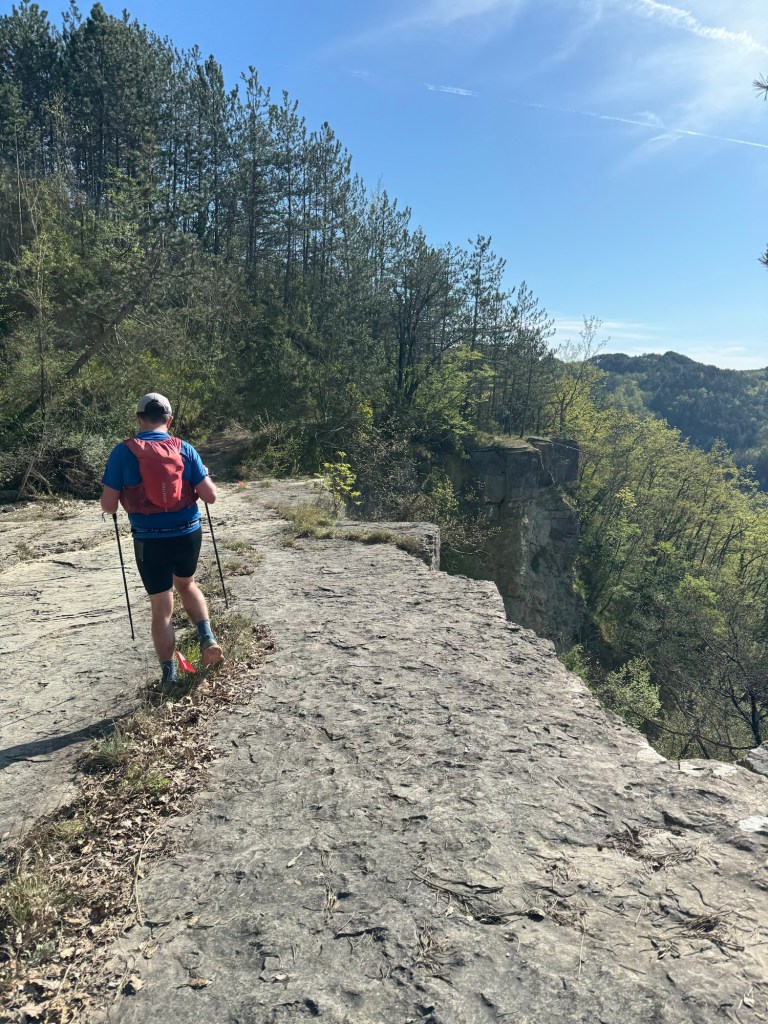
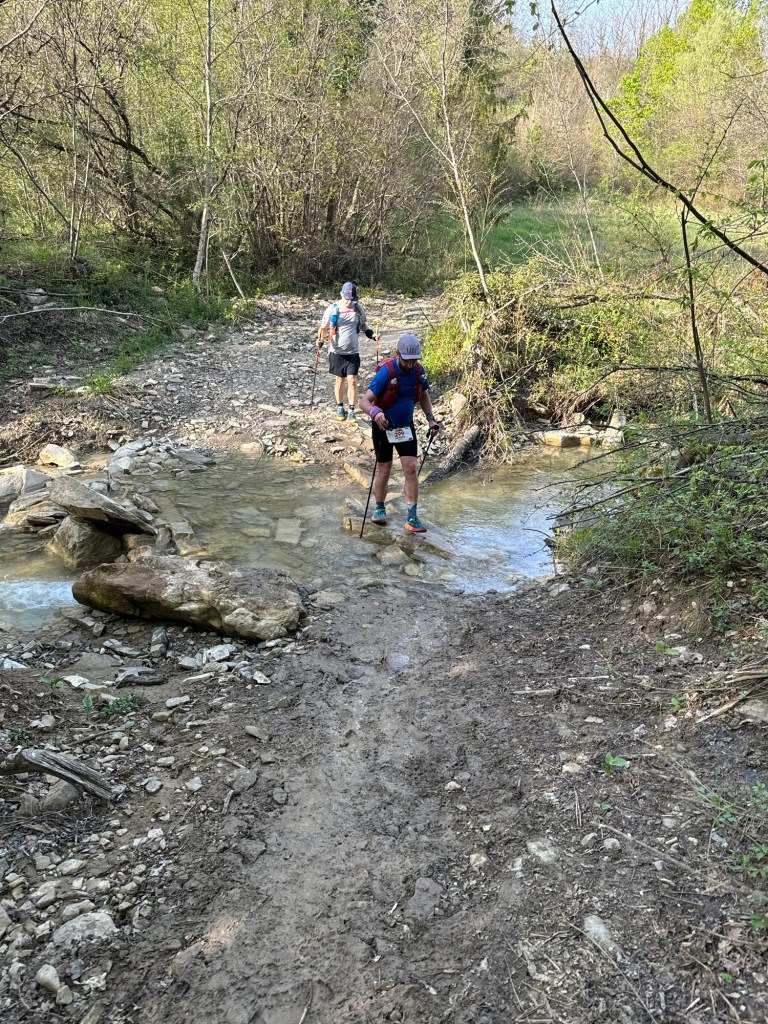
Somewhere around here we crossed a huge cliff with a drop off on the side of the hill before hitting the forest. The down hill took us deep into a forest that was wet and muddy. We were surprised. We’d heard how muddy the course could be but didn’t expect this would be the case with the warm weather. Yet here we were trouncing through mud. We navigated down and followed the sound of water as we joined up to a river and then crossed it numerous times in a short distance. It was fun at first then annoying as it happened so often. The stones crossing the water we slippery from all the runners before us. Further down though the river was fascinating as it carved incredible shapes and formations in the rock.

Once we completed the descent we were greeted with our favourite gravel tracks again. These were steep and we started to climb back up. I think it was about 300m or so. It was dull and we were hating the rocky gravel tracks by now and it was so warm. We were both running low on water and still had a long way to go before the next aid station as it wasn’t until a few kilometres after we descended the other side of this hill. So it was another slow and steady climb of using momentum to keep heading forward. Very few people passed us now but occasionally we’d overtake runners from both races. Everyone was feeling the heat. After a while the gravel track gave way to solid hard stone. It was marginally more enjoyable but the heat seemed to reflect back up at us off the ground. We sought out every inch of shade we could find as it was so exposed.

We were talking about different races and the types of support you get at villages. Commenting that on this race we’d seen very little from locals/the villages in terms of people being outside and cheering/helping runners. We also commented that sometimes races acknowledge the warmer than expected weather and pop up extra water stations. We wished that was the case here. Then, like some sort of mind reading miracle, as we reached the top of the climb in the village of Vrh a local welcomed us to his house to use his outside tap. There was already a collection of runners outside sitting in the shade and drinking. We both drank a 500ml of water and I refilled both bottles and encouraged Matt to do the same. A wise decision as I drank the extra litre before we got to next aid station!! All hail the water king of Vrh!

More rocky trails on the descent before Butoniga

From the town we had another rocky forest decent into muddy trails leading towards a lake. We could see the aid station (Butoniga) way off in the distance on the other side of the lake. First we had to descend, then climb again passing through the small village of Sculci before crossing /round the lake. The muddy trails made the climb a little hard at first as it was slippery. After passing through the village we then headed down a long road to reach the lake. Here we walked the whole length on the flat footpath. We simply refused to run on anymore gravel track. My feet were on fire now and despite being only the first aid station since the big stop at Buzet it felt like it took us an age to reach it and we had been moving for over 4 hours again. I told Matt I was worried about some soreness in my feet so wanted to spend some time trying to patch them up a little. Thankfully I didn’t have blisters but I felt the soreness and redness of hotspots around my heals. I put blister plasters and tape on the affected area and immediately felt better knowing I might have prevented some bigger issues and made my feet more comfortable. I was pleased with my decision making! As we left Butoniga it was 7pm. So we had our head torches at the ready…

Heading to the lake/reservoir

Section 8

We left the aid station and had a 2km stretch along a river before re-joining the trails and starting to climb again. Like before the trail was surprisingly muddy and steep. It was slow going as we climbed through the forest and left the sticky mud behind. Before long we emerged on what seemed like a very new tarmac road. It just appeared out of nowhere and kept climbing. It was very steep. A long old slog as we kept plodding along. As we looked up in the darkness we saw a few head torches descending quickly. We tried to figure out the route and where we’d go. It was confusing (looking back I’m wondering if we even saw headtorches!). We seemed to circumnavigate in the opposite direction around the town on the hill and then back into the forest. A short and steep shortcut up to the village at the top. Despite it being dark and cold again the climb meant our temperatures rocketed. We were hot. A small group of runners had formed around us and I could see we weren’t the only ones who felt that climb!

From the village we went along a long straight track that confused me so much. It felt like a bridge sticking out from the side of the hill. My mind couldn’t process how the long path existed where it did. Must have been some sort of ridge or saddle in the hills. We led the pack of runners as the trail started to descend and become increasingly more narrow. Immediately I caused Matt to almost fall into me as I slowed down as the trail became saturated with deep sticky mud and large rocks buried in them. It was so slippery and we carefully had to navigate. Matt tried to get the next runner behind him to go first but he was not having any of it. I joked that we wanted to watch him fall over but the truth was he was right up Matt’s backside and breathing annoyingly loud. So instead we moved a little quicker, well as much as the terrain aloud us too. We were twisting in different directions on the descent and we lost all sense of orientation. I had no idea where we were heading and in which direction Umag was from here.

As the mud gave way to gravel we had resorted to walking again. It’s all we’d been doing pretty much since we left Buzet many hours ago. We walked along a few roads as we tried to figure out where we were going and which of the few villages/towns lit up on the different hills we’d be climbing too. Then the next hill then came again as we started out in more forests. Matt was very tired now and struggling to keep his eyes open and decided he couldn’t wait to the next aid station which was over the other side of the next climb, maybe close to 2 hours away. He wanted a trail nap so laid down on the side of the trail and gave me a strict instruction to give him just 2 minutes. I don’t no how he can get such energy/recovery from just 2 mins of sleep, but it works for him. As he laid there I bent over my poles and confirmed everything was ok to the other runners who passed us and checked that we were all ok.

2 mins later I resisted the urge to kick him and instead gave him a gentle shake from the shoulder. He sprang up on his feet, he was back, he was energised. We made good progress up the rest of the hill as we climbed to Motovun. We caught up and passed some of the runners before the trails turned to road and then to cobblestones. The cobbles hurt as we made our way through the historic old town. There were loads of them and the climb to the town was very steep. At the top we caught the rest of the runners who passed us when Matt slept and we fast walked away from them as we began the descent to Livade. Thankfully this descent was less steep than the ones before. But it didn’t make it any easier. We were just too tired and sore to make use of the gentle terrain. I think it was here that was the last time another runner went passed us running.

Before approaching the town there was a long flat gravel section alongside a major road. The sound of our poles tapping on the stone and stones crunching and rubbing each other was, for the first time, drowned out by another noise. The swooshing of cars passing. It was kind of nice to hear something different. At the end of the track we needed to cross the road. Thankfully nothing was coming because it was wide and we were slow. What faced us now was about 1km of straight road to Livade. It felt like 10km as we slowly walked the road. We’d already agreed that we’d sleep here again. We were both tired and it was 11pm. There was a long night ahead of us and still over a marathon to go. We believed there were more camp beds at this aid station so agreed to sleep for 20 mins if there were.

Once we entered the aid station I couldn’t see anything so I was getting ready for a ‘head on the table’ nap. But Matt being more authoritive just asked the volunteers and there were indeed beds for us, situated in a room next to the tent. We went in and had a slight wait for a bed to be freed up. There was probably less than ten beds cramped into a small room and the medics were treating other runners in the main room. fortunately we both got beds at the same time and asked to be woken in 20 mins. Matt slept through it all and woke naturally just about 20 mins later. He woke me but I think I just dozed and didn’t fall sleep again. I was a bit spaced out now. We went and had some warm soup and spent another ten mins composing ourselves and warming up under a heater. When we left the aid station we were very cold. We expected the second night to be warmer than the first as we were at much lower altitude. But it wasn’t. It wasn’t consistently cold but every now and then we’d get these icy blasts that would shock us.

Section 9

Leaving Livade I was moaning about how we still had so far to go. Matt however was the ever optimistic and sensible one. He verbalised the profile and put it into perspective to keep me focused. We had one climb of maybe 400m then a more gradual descent and gradual shorter climb of about 200m, the final proper climb. Once through this section it was pretty much down hill to the finish.

It was just as he described. We did a long climb in the forest in the cold. I think it passed rather quickly considering we were now over 130km into the race. We began the gentle descent that then felt never ending and the stones irritated our sore feet as we progressed along the long winding switchbacks. There was a short, steep and muddy descent as we then crossed a river before starting the final climb. It had it all. Gravel and stones, steep sections, twisting and turning tracks. Matt was talking away to me but I wasn’t talking back. I was drifting and struggling to keep my eyes open. He was using his experience and asking me questions. Loaded questions to make me talk and describe things. He’s wise like that. But I wasn’t helping. I wasn’t responding in the way that was needed. I wasn’t giving conversation, just grunting. It was having an impact on him too and he was starting to get sleepy also. A troublesome situation to be in and I wasn’t helping with my lack of communication. We managed it through a few micro trail naps. The 2 minute timer was back. It worked and sharpened us up a little. And I certainly slept this time. I had some vivid dream of Matt and his wife managing their laundry with some super fancy and advanced smart washing machine they operated from anywhere in the world. No idea where that came from.

We got to the next aid station Groznjan and it was stereotypical of the sort of aid stations you see towards the end of big races. The buzz and excitement has gone. The music and upbeat vibes are no more. It’s replaced with a sombre dark mood. A few runners spread out, some sleeping, some lost in thought, some just emotionless. Everyone exhausted. We needed sleep. We found a bench, got out our phones and set a timer for 10 mins. We placed our heads down on the table and tried to to get more sleep…

This was the one for me. This one worked and I got some rest. That and knowing it was 3 am and the sun was start bringing new life to us in around 3 hours and, as Matt said, we’d broken the race now. We just had the last 20 or so kms to go so were looking at 6-7 hours left. We’d probably finish about 2 hours later than we first thought. So not bad.

Section 10

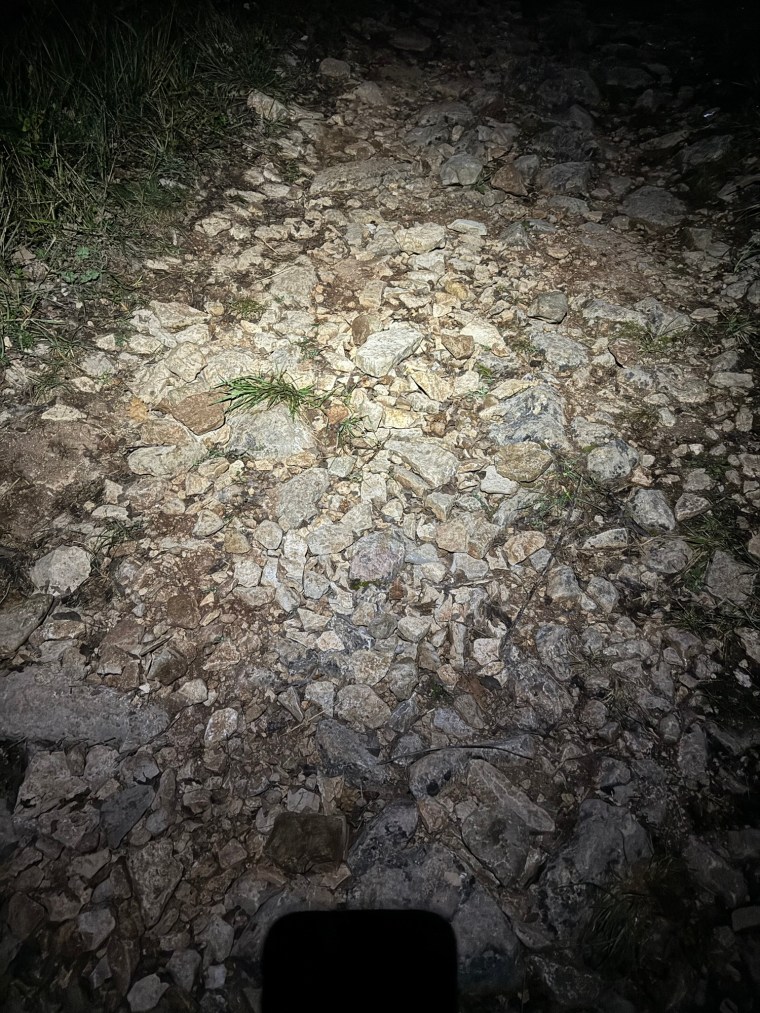
From the aid station we found ourselves on a very long straight horrible gravel road. We passed through a number of tunnels. Matt commented that it must have been some old railway perhaps. I looked it up and we were on the ‘Parenzana Trail’ – it was indeed an old narrow-gauge railway that closed in 1935. It stretches for about 130km from Porec in Croatia, through Slovenia to Muggia in Italy. And yes, I’ve already found there is an ultra (various distances including an 88km one) held in February each year. And no, I’ve absolutely no interest in that. We didn’t enjoy this section – It was so straight, frustratingly so. We hated it in fact as it was so boring and the gravel wasn’t enjoyable to run on. Matt made a point of how crappy the 20km race must be if this is the route. After an eternity (yeah I know, it was only about 3 kms) we turned off the Parenzana trail. But what was to come was somehow worse. The trail became rockier with larger loose rocks. I had memories of Trans Gran Canaria (on a smaller scale).

The rocky track after leaving the Parenzana Trail

Sometime later we entered some forest tracks. The path was very twisty and narrow. I was now kicking my own ankles trying to avoid the rocks, but it was a very gradual downhill and I was speeding up though much to Matt’s frustration. I wasn’t trying to get a faster time but I really did want it (all of it, the race!) to end as soon as possible. Thankfully this was the shortest section of the whole course and we were soon breaking through the rocky forest as dawn started to break on our approach to Buje as we found ourselves ascending a road section to the final aid station. We sat under a heater and ate a little, lost in contemplation that we now had one final section left, 13km all of which was down hill apparently. But we knew that wasn’t the case…

Section 11

Of course we climbed in the town as soon as we left the aid station. Yeah not anything to really moan about but it’s just obvious and amusing when the aid station signs show and elevation profile with climbs and also state ‘0m’ of elevation gain. Sack the artist I said. Anyway, we passed through the town to the other side and had a little down hill on roads as we made our way to some fields.

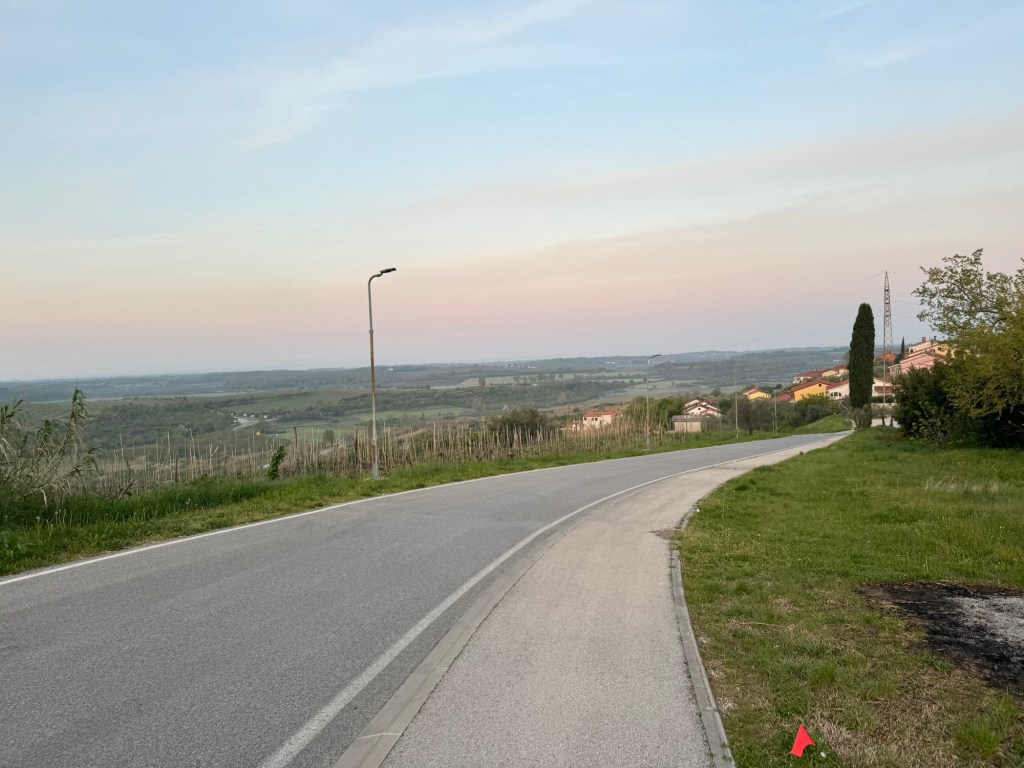
From here we spent some time with some slight climbs in farmland which was again surprisingly very muddy. Eventually we left the farms and found ourselves running a few km along a river. This is where we were lucky as the weather meant the fields were dry and compact with just a thin sticky layer of surface mud. More fields and riversides tracks awaited us as the sunrise gave way to morning and we got progressively hotter again. The fields felt endless as we could see so far ahead and the outskirts of Umag started to become visible way off in the distance. Still so far away, it was a long time before we reached it. We left the fields and found ourselves on a cycle path leading to the centre of town.

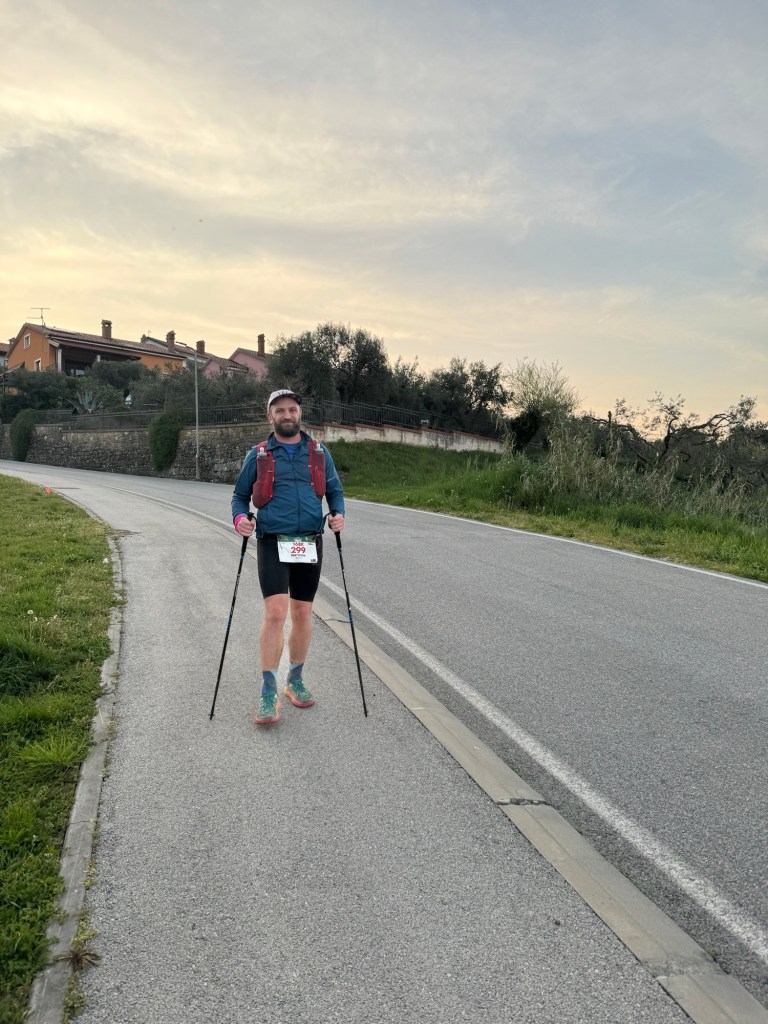
Leaving the farmland and removing stones from my shoes

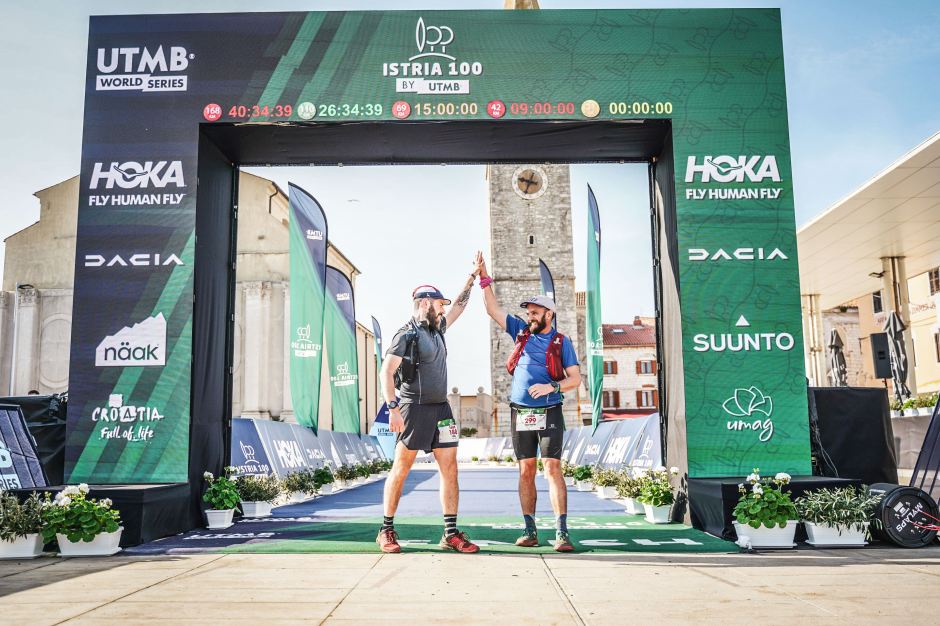
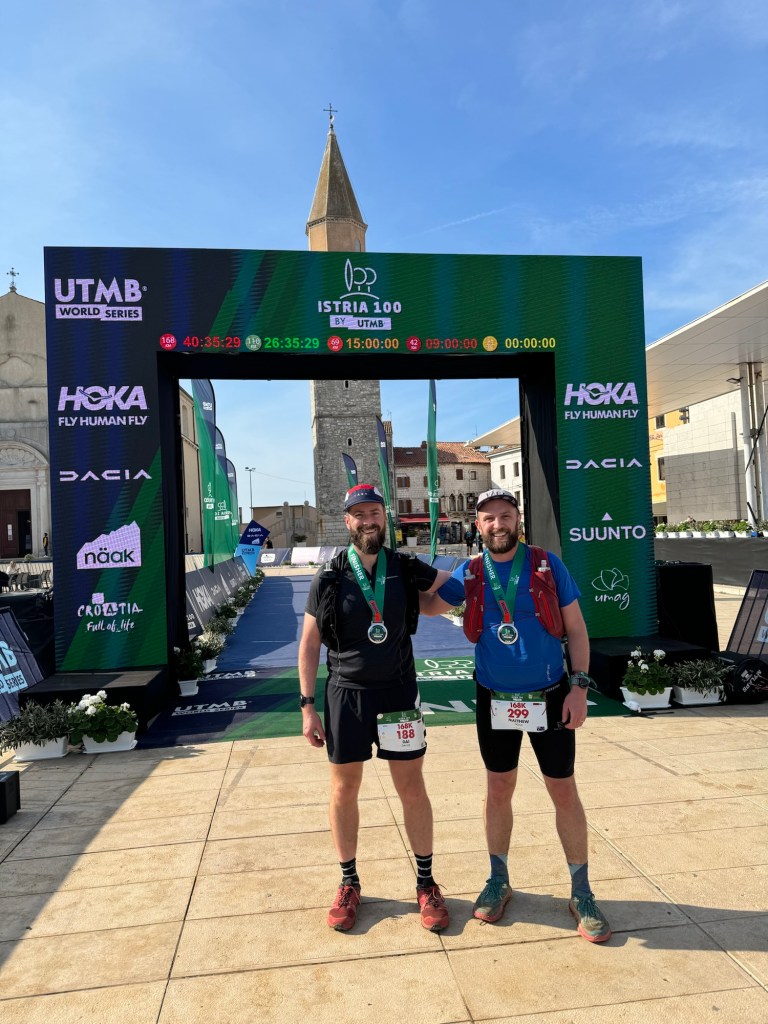
We slowly reached the seafront and small gatherings of people clapped and cheered us over their morning coffees (and beers for some!). I pushed back on Matt’s urge to run the final stretch. I gave in when we were just a few metres away. We walked across the finish line and turned for a big hi-five for the cameras. Relief set in and amusement followed as the MC announced our names followed by “oh you’ve done a lot of these” clearly seeing our UTMB accounts flash up with all our details. A lovely lady then gave us our medals (which are quite significant and weighty!) and took our photos for us. It was over. We were so glad that there were no more gravel tracks to be run!

Post race we walked back to the sports hall, had a shower and used all our free time to relax. We went to the massage area and had a complimentary massage and I sure got the works. A ‘four hands’ full body massage. The two guys worked my legs great, easing out all the tightness that had accumulated over the last two days. I was worried about how tender I was but the massage was great. The shoulders and back too, very relaxing. They even massaged my glutes and stretched me out. I really hit the jackpot!

We then caught the shuttle bus back to the hotel. It was still too early to check in but we took advantage of the post race meal which was a full buffet that we could help ourselves too. So much better than the usual post-race offerings. I filled up on Potatoes, fried chicken, beef stew and vegetables on repeat . After which we headed outside to the seafront and lay on the lounge beds and went to sleep. A timer set to wake us up ready for check in. Before we knew it we’d recovered a little, checked in and went about the next step of our pamper treatment – the spa. Swimming pool, saunas, steam rooms and Jacuzzis. We had a great few hours before it was time to eat again. Post race done well.

On reflection/ looking back…

Something I’ve not mentioned that surprised us was that there was so much rubbish on the route. It was clearly from runners and far too much to be accidental. From early on and more so in the later stages (which would have had all the races/event participants) there was discarded sports food wrappers everywhere. I’ve not seen so much dropped litter on a race before. Not sure why this would be the case. Oddly, we also saw a load of clothes discard on the trails. Not from runners though. But generic waste. It was a constant stream across the whole 100 miles and we noted enough to get fully kitted out at least twice over include rucksacks and hats and all. We thought it was odd as the trails are all quite isolated and don’t really go anywhere unless you cover a fair ol’ distance. Odd.

In terms of the race itself, for me it didn’t live up to my expectations and the hype. It’s clearly a lovely area and place to visit. But the nature of the 100miles meant it was all a bit meh really. Firstly we spent more time in the darkness of night than the day. So I assume we missed out on some probably excellent views, particularly the first night when we would have been at higher elevation. Secondly, there was a a real lack of variation in the trail. As I’ve moaned – the vast majority of trail is just gravel road. It’s far from enjoyable or interesting. The bit we enjoyed the most was the lush forest section after Brgudac. You also hear a lot about the amazing food at the event, but we didn’t think it was anything that special. All the aid stations were the same generic UTMB aid stations setups with bread, crisps, chocolate, pretzels, cheese, meat and sponsored sports stuff from naak. The hot food offering at Buzet was certainly better than most races provide but hardly anything worth raving to your mates about. That said, the volunteers were excellent and the event was exceptionally well organised. There was more than enough food for everyone, the link with the hotel with the shuttle bus service and post race meal was very good. It’s certainly a great exemplar for organisation and would be excellent for a experience for a relative newcomer to such events. The course markings were also some of the best I’ve experienced. No chance of going wrong on this course.

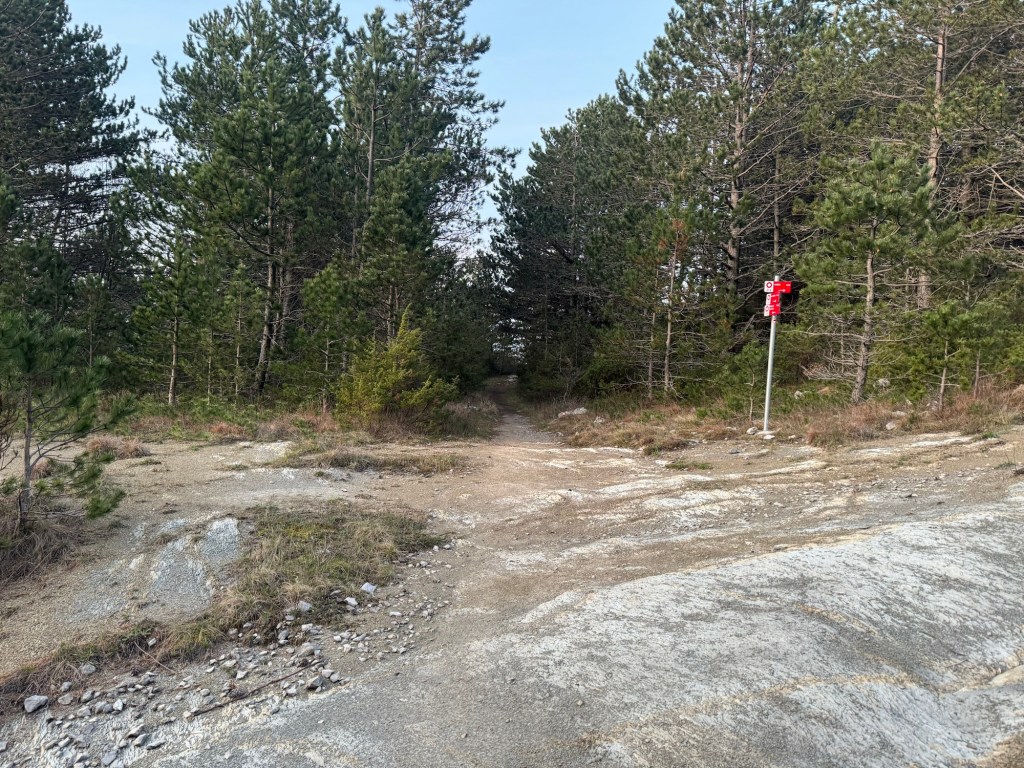
Course markings were obvious and plentiful

Overall though, as it goes for me, if I were to try and rank all the ‘milers’ I’ve done (which I’ve clearly gone and ranked) then it’s probably down as 4th in the list of 5 ‘milers’ I’ve completed (and I broke my ankle on one of the higher ranking ones and another gave about 900 runners the shits afterwards!). I just didn’t think the route and the trails are that enjoyable.

Other than that, I am quite pleased with how we came out on the other side. Neither of us had any problems, and after the massage were both walking fine. My ankles also seem to have held up ok, so my initial worries are no more and although my feet are very raw, I’ve only a few tiny blisters. Taking time to stop and empty stones from my shoes and apply plasters and tape definitely helped! So I’m pleased with my decision making mid run!

As Busy As It Gets

For the last few years a couple of us have always met up on the second weekend in March to go running in Snowdonia. It’s become a bit of a tradition. This our plans complicated it and only Paul and I were able to do the weekend. I also wanted to go somewhere new, as much as I love Snowdonia and have so much more to explore there, I crave travel and adventure in places I haven’t been too. When looking at races for the year I came across this event in Slovakia that offered just the 100km distance and coincidently landed on the second weekend in March. From the pictures it looked like a tough winter event with plenty of snow covered mountains to enjoy. It didn’t take much to persuade Paul to sign up (side note, the race is limited to approximately 200 people and sold out within the first day!). Slovakia here we came…

The race started and finished in a town called Trencin. It seemed like a peaceful little town, located about an 95km outside of Bratislava. It was very quiet and is not a tourist destination. Shortly after arriving, we sat in a restaurant with one other table even though Google indicated this place was “as busy as it gets”. It made us chuckle and set the scene for the weekend – a nice lowkey event with just over 200 participants. I believe there were just 6 runners who were not Slovak or Czech.

A few hours later we experienced the most efficient and straight forward of race check in / registration at the sports hall near the stadium. It was pleasing to see the mandatory kit being checked, in full, for all runners. A refreshing change from the more mainstream events where kit checks now seem to take place less and less often. Armed with a sturdy race bib and multiple free drinks we headed back to the hotel to sleep ahead of our Slovakian adventure.

The start of the race with Trencin Castle in the background (Official photographer: Peter Sobek)

At 6am we were back at the sports hall and ready to start. After not paying attention we found ourselves standing at the front of the race as the countdown began and the sun started to rise. We quickly shuffled to the back where we belonged. The start of the race featured a Long 18km flat (marginally downhill even!) section as we ran along the Váh, passed the local airport and towards the town of Beckov. It didn’t take long for the field to spread out into a few bigger groups based on pace. As nice as it was to see and run alongside the river, it quickly became tedious. The path started as a pathed cycle path and then become narrower trail tracks and an embankment which were solid under foot, far better than the conditions the week before when they were soaked following rain. The weather was fantastic and couldn’t be any different from the snowy winter weather we expected to encounter. These were great conditions to run, but that’s not something you get used to in these sort of ultras and we didn’t want to ruin ourselves completely early on. We were able to keep a decent pace and tick off all the distance in a good time of approximately 2 hours. As we reached Beckov we had the first aid station on the side of the track. It had a good view of Beckov Castle standing prominently on the hill which we’d seen on the drive in the day before.

Running alongside the Váh as we approach Beckov

We ran through the small town and then had the first variation of terrain as we left Beckov with a short climb through some fields and woodlands. There was a photographer cheering us on with a photo opportunity of the castle in the distance. We popped down the other side of the hill and had a short road section before arriving at the second checkpoint in a community hall. The atmosphere here was bouncing as volunteers and supporters cheered us in. We took a few minutes to fuel and compose ourselves, satisfied that just under a quarter of the race was already run. We were feeling good but knew from here the elevation would start to come. We were in good condition though and ready for what came next.

Beckov Castle below in the distance

From the aid station we now had just over 20 kms to go before our next stop. It pretty much started with a 600m climb. The climb started through a mountain bike park before continuing further up into the mountains. On the climb we could see many hills in the distance and one with a tower which we believed we’d reach at some point in the race (I believe this was Inovec). It was like a game as we kept guessing ‘are we going over there’ (we were wrong each time). It was a very gentle incline and weaved up through long woodland trails. The forests were special. The Trees were leafless, the floors covered in a blanket of golden brown leaves which our poles collected like litter pickers. The sun was shining through creating beautiful light patterns on the leafy floor. It didn’t take long before the climb was levelling out. There was no ‘summit’ on this climb but rather the route took us skirting the sides of mountains as we continued in the forest. As we reached the highest point the route was undulating for a few kms before we began descending. Again it was a very gentle and runnable descent and we made great progress on the initial descent before another few kms of undulating woodlands.

We arrived at the 3rd aid station in the Sport Chata mountain chalet at about 43km in. This was a small aid station that was a little cramped inside with runners taking a break. It was obvious why people were hanging around – there was a fire burning and pizzas had been delivered. Lots and lots of pizza! It was midday and the perfect lunch in a party atmosphere. We had a few slices and rested as we prepared for the next section which was also around 20ish km.

Mouth full of pizza at Sport Chata

This one included more undulating trails before a smallish climb of about 300m and subsequent descent. I remember there were parts here that were slightly muddier and the ground wetter as we crossed more fields and weaved through more forests. We also got chatting with a local runner who shared information with us on the trail running community in Slovakia and the other races they have (I’ve read about one further north called the Big Bear which intrigues me). She told us how the race organisers (who form the Slovak Ultra Trail) all help and support each other which I think is a fantastic thing. I also remember running through a long field where there was a guy on a scrabble bike doing loops in the field. The noisy bike momentarily broke the peaceful atmosphere of the race. After leaving the forests we had a short road section (that felt like a very long road section!) on a gentle decline as we approached the 4th aid station where we’d have access to our drop bags.

We’d now covered around 3/5 of the course and were glad to have a rest. As we set about rummaging through our drop bags the volunteers brought us warm dumpling soup (yeah ok I thought it was cheese soup at first!). It was delicious. We were so very well looked after here, and everywhere else on the course – the volunteers were so helpful and friendly. The aid station had so much on offer. There was a huge range of drinks (this aid station had Coke, Pepsi, water, isotonic, bottled fruit juices/squash, magnesium/vitamin water, energy drinks, beer, non alcoholic beer, Radler…) and loads of food options. The warm soup was perfect and we washed it down with a Radler as I talked with another local runner enjoying a beer. We put on some warmer clothes for the next 40 odd kms. It was a very cold day, despite being dry, and we figured it would only be about 2 hours before it started getting dark. After about 40 minutes we went back out and began the long , fairly flat pathed section before we tackling the next climb.

We were now faced with the biggest/longest climb on the course as we’d head up towards Inovec. It was another 600m climb but this time we’d reach and altitude of just over 1,000m. Similar in height to Yr Wyddfa, but very, very different trails. Like before, this was a climb we found fairly easy going as it was another gentle ascent (admittedly we didn’t find it as easy going as some runners around us who ran off up the climb!). For us, we were pleased, there was no ‘huffing and puffing’ or elevated heart rate. It was a nice change to be able to enjoy the inclines and maintain a steady climbing pace. We were also back climbing through the forests and leave covered woodland paths.

As we climbed we completely switched off by reminiscing about movies from the 80s and 90s. All the good ol’ fashioned action movies. Paul was making a mental list of films to watch again. As the climb started to level out there was a short section where we ran back along the course we covered earlier in the day (if we weren’t paying attention here we could have carried on and probably followed the course markings from 50km earlier! I think if you did you would have ended up back at the Sport Chata we passed around 40km in!). This time though we’d turn off in a different direction and towards a ‘ridge’ that everyone kept mentioning.

Approaching Inovec Lookout Tower

We weren’t quite at the highest point yet and had around 10km of undulating trails as we climbed further up. This section seemed to drag a little. Every climb felt like it should be the last one. The daylight was starting to fade and the wind was picking up as the evening began to get colder and colder. As we reached Inovec it was just about light enough to see the Inovec lookout tower. After this it went dark pretty quickly. We were tiring a bit now (fair seeing as we had covered over 80 km) and the terrain became ever so slightly rockier compared to the previous sections. This coupled with the very cold wind made it harder going. I was aware of how cold I was getting now as I trudged through the thinnest layer of snow on the ground. Most of the day I’d had my gloves on but had resisted a windproof jacket up until we reached Inovec. Now I wanted my thicker jacket and warmer gloves! Thankfully the descent finally came and we made our way into the next aid station. Again another mountain hut with fires burning inside. It was warm. It was welcomed. I stuffed my face with apples, crisp, salami and chocolate before warming up and layering up with a beanie hat, my warmer gloves and thermal jacket. We shivered as we left.
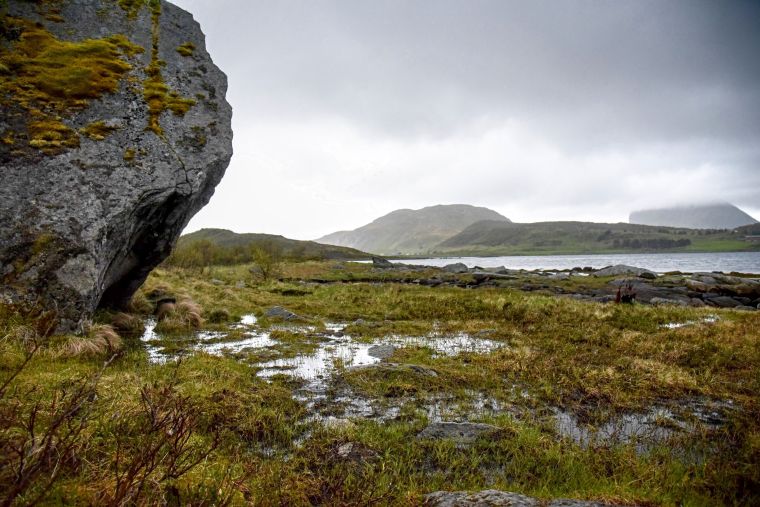
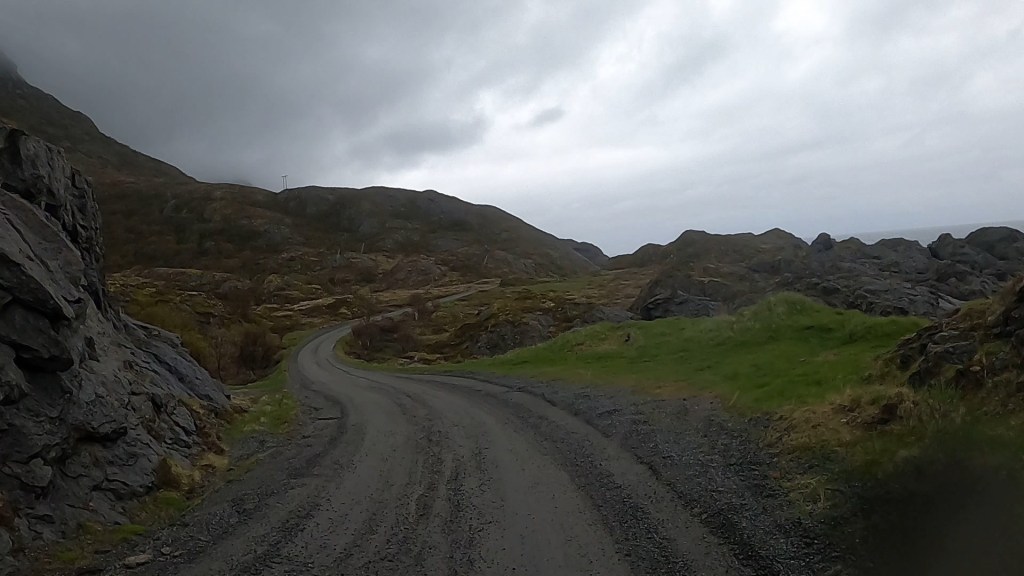
Somewhere up high after Inovec

Leaving the aid station we continued on some more road before completing the rest of the descent, probably about 400m downhill in the dark forests. We were toasty and warm again now. After this came a short climb of about 300m. Thankfully this one wasn’t undulating and we started descending pretty much straight away. This final section was nicely split up by one last aid station. We were glad it wasn’t another 20km section straight to the finish. The aid station was another chalet and was lit up with lights and reflective signs. We made a quick stop as it was set up outside (probably a good thing to keep us moving!). Paul knocked back a coffee and we set off before we started shivering again. Stupidly we walked the wrong way for about 50m. It was stupid as we’d even talked about this section and it was incredibly well marked as we approached the aid station. It was clear we were tired, cold and distracted. Back on the right track we finished the descent and got excited as the kms started to tick down.

We’d mentally accepted that it was pretty flat to the finish now, but despite the simple appearance of route profiles, it was broadly uphill, albeit at gentle undulations. The deception of our thoughts messed with our heads a little, but it wasn’t far to go and the climbs were no worse than walking around the hillier parts of London! So really it was mostly runnable and we made good progress. We were impressed by our undertrained body’s ability to keep running during this race. Before we knew it we were arriving back in Trencin, just below the castle. As we approached I remembered some massive luxury houses and how one resembled a yacht. We then made the final descent, down the cobbled path through into the church courtyard, then down into town and along the pedestrianised streets, through the subway and back to start, the way we’d walked to the registration the evening before. Arriving back at the sports hall we had a great reception from the volunteers and race director.

Trencin at night from the church

After finishing I spent a little time chatting with the race director who was so friendly and accommodating. The organisation really was excellent, we were well looked after, supported by loads of friendly volunteers, had ridiculous amounts of high quality foods and drinks and enjoyed a great atmosphere and vibe from the Slovak trail community. I couldn’t recommend this race enough and really want to try some more of the Slovak Ultra Trail events now!

On a personal note this race was a real confidence booster after recent injuries and lack of consistent running. I was expecting a slog (I’m sure it would have been in worse weather!) but seemed to get through with no issues or problems. Even afterwards my body felt ok and didn’t ache too much. Overall we were happy. Undertrained but over performed. With a 17.5 hr finish we were well under the cut off of 25 hours and the WSER qualifier time of 22 hours. Now I can look forward to what is to come next, roll on Istria100 in April…

Drielandenpunt Trail

It has taken far too long, but finally I got around to visiting Matt out in the Netherlands for a run on trails more local to him. Over the weekend Matt and Lara treated us like royalty, putting us up for the night, feeding us, driving us to the race and putting up with our tourist commentary.

The race was the 50km Drielandenpunt Trail in Vaals, in the southern part of the Netherlands, in a park area known as Drielandenpunt, which is the three country point. This is where the three borders of the Netherlands, Belgium and Germany meet. The race is mostly in the Netherlands but the course twists and weaves its way into Belgium at several points and also tracks along the border with Germany.

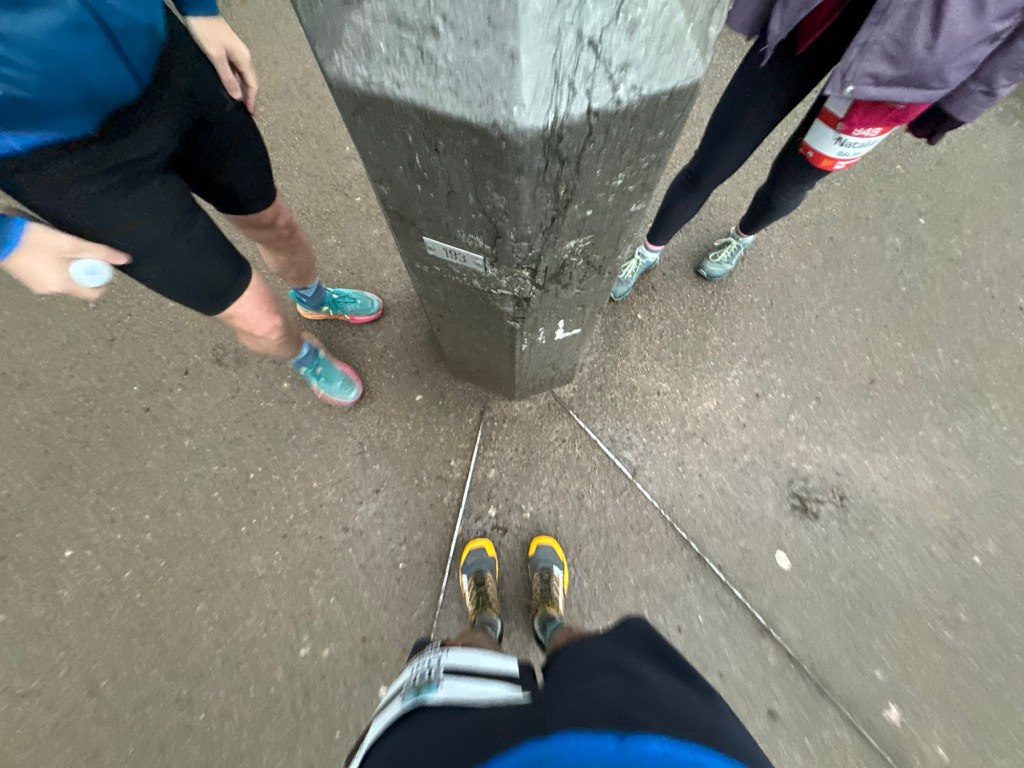
The night before we stayed nearby and had the shittest risotto known to man. It was a real talking point that someone is capable of making such a bad risotto. Alas, being the non confrontational type we ate it and kept our mouths shut. After all it did serve the purpose of a meal and it’s not like we need high quality food before running an ultra. In the morning we made the short drive up the ‘hill’ to Vaalserbeg which is the highest point in the Netherlands at about 322m, near the three country point. Here is where the race would start and finish. I suppose not many running races will both start and finish at the highest point in a country! We registered and messed around taking pictures on the tri-point where the borders of the three countries meet, crossing between the countries and back in a matter of seconds. We then said goodbye to Natalia who’d start her 30km race an hour later. After the quickest starting line up ever, Matt and I set off.

Within minutes of starting the run I was overheating. It was a wet day with a constant drizzle of rain, but, with just the wind jacket on I was too hot, so opted to continue the run in just the t-shirt and sleeves (I probably gave myself a cold as a result, but it was very stuffy in the forests). It was instantly noticeable how, muddy the trails were, how narrow the forest paths were and how surprisingly hilly it was. With a total elevation of 1400m elevation across the course, it was very much a series of short steep climbs and descents with very few flat bits in between. The course, mud aside, is rather runnable although my fitness levels meant I didn’t run a single one of the hills! The first part of the course was a 14km loop to the south. We had some great views of some very grey, overcast skies (‘m sure on a better day there are views to be enjoyed) and made the first of numerous dips into Belgium. This was my first time visiting Belgium. I think it counts as a visit!

Towards the end of the loop we left the forest and ran (trudged!) through some very muddy fields. I laughed as the person ahead kept falling over whilst my Inov8 X-Talons were excellent for ensuring I stayed on two feet, I was so glad with my choice of shoe! We then had a one of the bigger climbs (at just shy of 100m) back up to Vaalserbeg and the start line which would now serve as our first aid station.

From here it was more of the same with forest trails undulating as we ran alongside Germany. Drielandenpunt is a beautiful area with many, many intersecting trails for hiking and biking. It reminded me of the Surrey Hills area with endless twists, turns, short sharp descents and muddy climbs. Overtime the trails all blurred into one and it wasn’t long before I was completely disorientated and had no idea where we’d come from or which direction we were heading in.

After another 13km or so we arrived at the second check point where we were spoilt with ham and/or cheese sandwiches. These went down a treat and we both stuffed our faces and enjoyed a few moments of rest (although standing around we got very cold very quickly). By now we had been passed by a lot of runners. It felt like nearly the whole field had passed us as well as many of the 3okm runners. We were enjoying the day though, chatting our way round the whole course and catching up (some how it had already had been 8 months since our last run together in Lofoten).

Throughout the day Matt was sharing all his knowledge and facts, particularly at key points on the course like when we ran through the vineyards and he gave me a crash course in the history of Dutch wine production. It was a welcome distraction from the muddy trails! Throughout the run I recall the course being fantastically marked and sign posted, the aid stations being well stocked and the ground being a slushy mud fest – there were several more fields that were really muddy and a few little picturesque towns that we weaved through connecting the trails together. After another 15km or so we’d made our way back to the second aid station location for our final stop. With a quick top up and refuel we set back out.

King of Facts

We were on the home stretch now and had finally stopped being overtaken by runners. We commented that we didn’t think that we overtook a single person in the race. Towards the end of the course that changed with a steep muddy descent causing a few other runners to have trouble descending. We sped and slid our way down and claimed about 4 places in one short movement. From here it was a gentle jog into the finish line where we passed with an American we’d shared a few moments with earlier in the day. The ‘international finish’ as the MC dubbed it as an Aussie, American and Welshman crossed the line together.

We opted to skip the ‘city wash’ showers and just throw on dry clothes to start the long journey back to Amsterdam as quickly as possible. This was hindered a little bit by the inaccessible finance system in the Netherlands where many stores don’t accept Visa or credit cards as a payment method. To buy a portion of chips we needed to call Matt and have him come pay for us!

Overall a thoroughly enjoyable weekend in the Netherlands and a great adventure in the forests. Drielandenpunt is worth a visit! Personally, after a few months of inactivity it was good to finally be back out and running long distances. Now I just need to find the fitness before the bigger events that are fast approaching….

Mozart 100

This feels like a diary now, writing about races so frequently in a short time. It’s almost as exhausting as the runs themselves!

Last time I wrote about how my feet had recovered in rapid time between Transylvania and Lofoten. Well miracles don’t happen twice. After Lofoten it was a slow recovery. I’d done nothing except sit at my work desk and move from there to the sofa. Despite the little bit of rest, flying out to Salzburg for the Mozart 100 I had three health issues on my mind. My feet – delayered and with fresh, raw baby-like pink skin on the pads and around my heels on both feet. My right knee after the twisting pain from Lofoten. And my left big toe/metatarsal – I hadn’t been able to bend the big toe for two weeks. These weren’t going to stop me though. Mozart 100 has been one of my bucket list events for a while and I wanted it. I was out here with Natalia and she was running the Mozart marathon which was the last 40km of the route I’d be doing (a sort of figure of 8 route from Salzburg through St Gilgen and back).

Just like Lofoten I prepared the feet before the race with a combination of Duo Derm (hydrocolloid dressings) and KT tape I. The hope of substituting for the missing skin layers. The knee and toe would just have to be dealt with mentally if they caused me issues. I was quite casual in the morning and had less than 5 mins to the start of the race after I dropped off the drop bag for St Gilgen. By the time I walked back to the start line, I found myself right at the back. I couldn’t even fit in the starting pen!

Arriving with minutes to spare

The plus side was that, within minutes of arriving, the race had started and I was running under the start arch. I made a decision to try and gain some places whilst I could and whilst it was flat. This was a good, but questionable decision. It turns out that the first 7km of the race was flat road and gravel tracks. The route took us through the old town, out and along the river. I kept running. Speeding passed people until I was only keeping pace with those around me. I was gassed. I wasn’t expecting to be running so fast for so long. Thankfully though, 8km in we hit the single track climb into the forest and the pack of runners came to a complete stand still at the bottleneck. People were moaning and trying to push passed around the sides. I was glad though. I needed the breather!

After a few short minutes we were on the move with gentle trails in the forest and smooth roads taking us up little climbs on switch backs. In no time at all we arrived into the first aid station. From here we’d head to the town of Hof. We’d visit Hof later in the day on our way back to Salzburg too.

This section was more of the same really with the route following smooth roads and wide gravel tracks. The small climbs were gentle switch backs and the downhill sections were sweeping tracks at a pleasing gradient that was pleasant to run. I was feeling good. My feet stung a little bit from all the pounding on hard ground when running the downhills. But I couldn’t feel any knee issues and my toe was only mildly uncomfortable when running downhill. This was good.

We crossed little villages and a few streams over small wooden bridges. We ran Into forests that had that fresh damp smell (there were thunder storms the day before) and it smelt divine. After a few small climbs and descents with plenty more running, I arrived at the aid station in Hof. It felt quick and my average pace over this first 22km was close to 7mins per km. Plenty fast for a 100km ultra! I hadn’t really eaten much and wasn’t endeared by the offerings at the aid stations, so I took a Naak energy bar. It was quite nice. Different to what I’m used to eating.

Leaving Hof I recalled two ‘lumps’ in the course. The first on road up through a little village and down as we left it. Then the second taking us back up this time through grass and fields behind houses and we passed a little farm and across a main road. I remember a volunteer / marshal sitting outside a house directing us. An old man with a big smile on his face.

From here the climbing began… the first of three chunky ascents in the first half of the race was upon us. It was a steep climb. It seemed to go Just straight up. No switch backs or winding trails to ease us up. Just a straight line through the forest packed with runners. It was fairly Technical in the sense that it was was very rooty. I thought to myself that this could make my tender feet very sore so tried to be consistent with my foot placement to minimise any rolling movements. I was glad we were ascending and not descending on this trail. Every now and then the trees would open up and present amazing views of the surrounding mountains and towns.

Once we reached the top it was rocky. We had a short traverse before beginning our descent. It was similar in that we pretty much ran straight down with few twists in the trail. It was steep and rocky at first before becoming more steady underfoot with smaller loose rocks and then gravel tracks. It was a long descent and I could feel my quads starting to burn. My legs were understandably tired after recent adventures and I was feeling it in my body now. We bottomed out and arrived at the next aid station. I treated myself to some Coke (Red Bull cola) as I felt I’d been running well up to now. Just under 4:45 hours and 32km distance covered.

Cows enjoying the views

From here we climbed again. The course was very similar now and followed the pattern of long sweeping roads and wide dirt tracks on gentle climbs. This one we covered about 600m over about 5km. It was tiring but not too taxing. Up top was another aid station and a chance to take on more water. There were plenty of cows chilling at the aid station and a café with hikers sitting outside it. I wet my hat in a mountain trough and made the short, single track descent before the next climb where we’d continue up to Zwölferhorn. This was another big climb to Zwölferhorn . It started the same manner as the others – on roads and gravel tracks. Then became steeper as we hiked up in the forest. Once more the tree line breaking to provide amazing views of the lakes way down below on either side.

Eventually up top we broke out of the forest to a peak with a cross marking its summit. Loads of hikers were sitting enjoying the views. I started taking pictures then realised the real summit was further along passed the next aid station, the flags flapping in the distance. I carried on and ran over into the aid station. I made a short stop to refill water knowing that St Gilgen and my drop bag awaited after the descent the other side. The descent to St Gilgen was the longest and steepest yet. We ran along a mixture of rocks and rooty forest paths. Some very steep as we traced a path down under the cable cars. The views during the descent were beautiful with constant panoramas of the lakeside town. My quads were on fire now from all the steep down hills but I kept on running until we stopped descending. A young boy was cheering runners with a loud cowbell. He then ran passed me with his mother and the cowbell cheering her all the way into the aid station.

Beginning the descent to St Gilgen

The aid station was a bit chaotic. It served both the 100km and the 80km races and also acted as an aid station at two different points on the course (we’d now run a loop out of St Gilgen and then back). So there were a lot of runners coming and going. The benefit was we could access our drop bag twice. First here around 50km and then again around 67km. My plan was for a quick stop now and a longer stop on the way back. I grabbed a can of Coke and my drop bag and sat down. I gave myself 10 minutes to refill my tailwind. Eat some of my bars and drink the Coke. I also rubbed some cold gel on my quads and calves. As I left I saw some noodle soup and wished I’d seen it on my way in!

Leaving St Gilgen we ran along the Lake Wolfgang (great name!). It was absolutely beautiful, if a little busy. Loads of tourists out walking but also runners running back against us towards their second pass at the aid station. It was a little demoralising seeing so many 100km runners that we 17km ahead of us.

The incredible Lake Wolfgang, looking back at St Gilgen

I started talking to Marie, a Swedish lady living in Cork I’d met earlier on. We were both enjoying the stunning views that the course had to offer. As we talked we began climbing. I remember thinking how good the trails were. Typical well maintained Western European trails. You know you’re on ‘princess trails’ when there are families with small kids and prams walking the same route!

The climb was broken with a short down hill. I was running again and passing some runners on the 80km route. This was a little buzz and mental pick me up. My toe started hurting from something underneath. It felt like a thorn or something. I was running awkwardly to avoid putting pressure on my toe. After a while I blocked it out. (The next day I found a sizeable splinter stuck deep in my toe through the tape!).

After the down hill we began the big climb. This 10km section (including the last climb and descent) had 1000m of elevation to climb. Most of it now lay ahead. It was a big and slow climb. It was just straight and rocky underfoot. I powered on and hiked steadily. Runners were stopping and resting. I challenged myself to not rest until the aid station at the top. It was very tiring and felt like it would go on for ages. I could here some runners were asking hikers ‘how long to the top’. They were clearly feeling it too. Nearer the top it was rocky and the tired legs had a bit more work to do. I was craving some more coke now and sugar (there wasn’t anything sweet besides chocolate at the aid stations). Every now and then I could hear a mechanical roar further up. Some sort of cable car I thought (it was a tourist train up the mountain). At the top my heart sank when I saw a building way off several hundred metres further up a peak way off in the distance. Thankfully though an aid station was hidden just around the corner and we were not heading all the way up there!

I was glad the climb didn’t continue up to the real summit!

Here the aid station was shit. Perhaps I’m being harsh (it’s 1300m up a mountain, although a very accessible one). But when we arrived it was decimated. There was no coke. Just water or isotonic. And very little food. Just gels and tomatoes left amongst the crumbs of other fruits and biscuits. It was shit. I needed something so took a gel. I then just left in frustration and planned a good raid and feed back at St Gilgen.

It was about 7km down hill back to St Gilgen. It was hard at first with the rocky terrain and gradient but soon the trails became less steep as we ran into the forests and on to switch backs. It was quite quick and I covered the descent and trail back around the lake from st gilgen in around 1 hour 15 mins. I was pleased with how I ran and kept running, passing many runners here.

Back into St Gilgen my frustrations continued. There was no coke here either. I couldn’t believe it. I was nowhere near the back of the pack. So many runners were being deprived of the expected levels of support with food and (non water) drink. I could hear everyone around me asking the same. I reluctantly took a red bull I was offered. I needed something sweet. I also went to get the noodle soup which I had to scrape the barrel for. Hardly any noodles, just the broth water.

I grabbed my drop bag, changed my t shirt, ate some food, refilled my Tailwind and got ready to leave. Maybe 20mins rested. I didn’t want to hang around now. I’d messaged Natalia and saw she’d completed her run in 6 hours! She was hoping for 7 so I was proud of how fast she’d run. It lifted me too at the thought that trails would be good – there were no more big climbs to go now. And I had 10 hours to the cut off. I was confident that 8 should be feasible. The cut off times seemed to be so skewed. I left with 45 mins to the cut off!!

I walked out from St Gilgen as the route took us through the town and up some back streets behind some impressively big houses. There was a steep up hill that was just a few hundred metres along a narrow dirt track skirting the side of a mountain. It led into some beautiful trails that were nice and wide and gently easing us down into some forests and along through beautiful little mountain villages. In no time at all I arrived at the next aid station and to my delight finally they had both coke and soup. I took a cup of both. It was real Coke out of small bottles. Not the sponsored red bull cola. Clearly they’d been out shopping! I was satisfied and energised now.

Leaving here a little more refreshed and buoyed on by the thought of maybe a little over 30km to go. I ran along some roads as the course took us towards the lake. Here scenic undulating gravel tracks took us for a few km around the beautiful lake with its clear water of different shades of blue and green. I wanted nothing more than to stop and dive in to cool off on the evening heat. This feeling intensified at the far end when we reached a popular café/swimming spot with loads of people in the water. Without tempting the dip it had been a consistent section of running and walking when it was slightly uphill.

Lake side trails

Evening was starting to set in and the sunlight was dipping as we reached a road crossing. Just after the crossing, a family were outside their house with a hose pipe filling up runners bottles. I took the extra water gladly as despite the evening drawing in it was still very hot. Shortly after we reached another road crossing and began a climb onto a grassy hill. I recalled it from the section maybe 60km earlier after Hof. Hof must be the next stop now! I Remembered the grassy incline, passing through the farm and forests. Then long roads through villages. The old man volunteering was still sitting in the same spot he was many, many hours earlier and still smiling away. I thanked him once more. Shortly afterwards I arrived back into Hof with the now familiar ‘sorry, no coke, just red bull’ response to my request for coke. I moaned silently into another cup of soup. Satisfied I was at least getting some warm food into me. I took my head torch out ready and carried on. 20km to go…

Amazing sunset!

What followed I had ran before. Much of it I don’t remember. Whatever I previously described as wide roads and gravel tracks through forests is probably about as descriptive as my mind would remember anyway! Somewhere in the forest we went differently though. I don’t remember the river crossing over a small grid platform balancing on a barrel from before. It was all very similar from here though with (yep, you guessed it) more forests and roads. We then started climbing again. My run had become a hike as we continued a long climb as darkness set in and the torch light came out.

Up on the hill a glow of an Aid station signalled the next break and the marker for the final 10km. Here at Koppl it was the same old story. The sugar I was craving wasn’t there. I did get a cup of alcohol free Steigel though. That was good enough for a bit of fizz and change in flavour. More soup too. I took ten minutes. The atmosphere was good and the soup piping hot! I steadied myself for the next section knowing there were a few sneaky climbs and descents still to go. I made sure to leave though before I got cold though as, all around me, runners were layering up. But I knew I’d be warm as soon as I started climbing again.

The 10km was split roughly into a 6k and a 4K section. It started with a 150m climb. It was fairly tough going. Single tracks and rocky in parts. We were climbing towards a tower on top of the mountain but wouldn’t get that high, peeling off around the side of the summit. We had incredible views of Salzburg bellow with the orange street lights shining brightly. I led another runner on and we chatted briefly before we started descending. It was steep in the forest and I used gravity to stumble forward slightly quicker than walking pace, excusing myself passed other runners. It was a long rooty down hill that was a little awkward and painful. I was feeling my toe/foot issue now with the constant pain ringing clear. The lower we got the harder it became as the trails became stairs. Steep steps made of wood at uneven angles. It was uncomfortable to traverse at pace. They kept going one after the other. Like death by a hundred steps. I hobbled on, out of the forest and over the train tracks. A small water station marked the end of the first 6km section. It was the home stretch now.

The Glow of Salzburg way down below

I knew what came next from both the route profile and Paul’s wisdom from his experience 4 years earlier. Now back in Salzburg, the route climbs another 200m up to a building on a hill. Then descends into the heart of town before we cross the river to the finish in old town. I had 30mins to cover the 4km to get a sub 19hour finish. I knew with the climb this wasn’t possible. But I was pleased to now be so close to the end.

I still couldn’t quite understand how/where a 200m hill existed in the city! It was very steep and mostly steps to climb. A right pain and torture after already covering 100km. It was frustrating more so because of the groups of teenagers hanging around up there and smoking. The fresh air smells polluted by the stench.

I reached the castle on the hill and began the slow descent. The trails of rocks and tree roots soon turned into stairs. Of course. The stairs became shallow angled steps closer to the old town and my foot placement became more pronounced. Reaching the bottom we came out onto a street of bars and pubs bustling with Saturday night vibes with loads of people out drinking and enjoying themselves. I walked around the corner and pressed the button to cross the main road onto the bridge and over the river. The green man signalling my safety. I walked the few hundred metres along the river promising myself I’d run what’s left through the old town. One more road crossing and I started jogging again. I was catching people with less than a few hundred metres to go. They were walking through the old town but then started running when I neared them. I’d either have to run faster or drop back to avoid finishing alongside or right behind them. I dropped back and got a clear pass at the finish line.

Printed finishers photo!

At the finish I got another alcohol free beer (no coke still) and was given a printed finish line photo. That was a nice touch. I was then directed back to the race office around the corner in the adjacent square to get my drop bag and finishers medal. Here I was also given a frame for the photo. That’s a new one for me! Never had a frame and a photo at a finish line before! I drank the beer then walked back to the hotel. Ready to wash and climb into bed…

I loved this event. Salzburg is a beautiful town and one I’ve wanted to visit for a while. The trails and scenery is beautiful. Overall the organisation was good but if you haven’t sensed it yet, there was a sour taste in my mouth from the aid stations. They were grossly under stocked. Only one aid station in the last 60km had coke and the food was scraps at many. And I was mid pack. With 5 different distances and thousands of runners, they really hadn’t enough food. Given the race is now under the UTMB banner, this isn’t good enough. For fully supported races, they have to provide enough food and water.

You’re Late!

The Arctic Triple 100 mile ultra trail in Lofoten, Norway. An event I eagerly looked forward to but one for which my preparation was screwed before I even signed up. Back in 2022 I’d already signed up to Transylvania 100 and Mozart 100 for 2023. When Matt floated the idea for this race in Norway, and him and Paul signed up, I was torn. It ticked every box on our criteria for an adventure. Trouble was, it was a week after Transylvania (we’d actually start 4.5 days after the finish time of Transylvania!) and two weeks before Mozart. This was not an ideal time to squeeze a 100 mile event into my year. But I did, of course I did! I signed up. My plan was simply to survive and enjoy Transylvania without wrecking myself before Lofoten. That didn’t quite go to plan and the race in Romania was far harder and more damaging to my body than I’d hoped for. Come Monday, I could barely walk. Besides bruising to my right quad, my feet were in pieces. They were so sore and covered in blisters. It was 3 days of soaking them in salt water, applying creams and ointments and hoping for miracles.

By Thursday, miracles had happened. Somehow my feet had healed pretty well, well enough that I wasn’t in any discomfort, maybe still missing a few important layers of skin, but after a self inflicted stressful few days I was confident again. All that was left was the day-long journey to Svolvaer where the race headquarters and finish line was based. That night, I wrapped my feet as best I could in hypercolloid dressings and KT tape. I hoped this would buy me a bit more time during the race before further damage was suffered. I also opted to wear waterproof socks to start the race (which turned out to be the best decision I’d made that week!).

The next day the journey to the start line began, this was like an ultra in itself – it involved a 2 hour bus from Svolvaer to Reine and then a 30 minute boat ride to Kirkefjord. The bus journey to Reine was scenic and gave a good first insight into the stunning scenery and terrain of the peninsula. We drove around the islands and mountains making up the landscape and crossed bridges and went through tunnels that connected all the islands. The mountains were quite a sight and dominate the skyline.

Suited and booted for the boat ride

At Reine we left the bus to get a boat across the fjord to Kirkefjord where the race would start. Due to some logistical issues, the planned ferry boat wasn’t available, therefore smaller boats would complete the transfer. This worked out amazingly for us as we were stopped before boarding the boat that was waiting when our bus arrived as it was full. Instead we were directed to a smaller speed boat/dingy. This meant donning a life/body suit. I made sure we were first in line to get suited and booted. This boat looked so much fun! Straddling the seats we held on as the boat sped off. Wow. What a way to start a race and what an experience bouncing along the water, the wind and rain battering our faces. The attempts to disembark were then hilarious as we tried to climb up the jetty and needed pulling up from the marshals directing us in.

We had about 45 mins before the start and spent it sitting in a wood cabin on the ‘pier’ to take shelter from the rain and exploring a vacant building. At midday, as we made our way to the start line, we found ourselves at the front of the runners. This made us giggle as we did not belong there, but we embraced it as we set off, momentarily leading the other 70 or so runners into the adventure that awaited…

The race starts with two steep climbs. The first about 100m and the second a bit more punchy at around 350m. Straight away I was huffing and puffing. The terrain was mountainous, rocky and wet with water streaming down the slopes. The incline was sharp and the gradient reached a good 30 degrees in places. Runners inevitably started passing us as we climbed. As we reached the top the of the first climb the fun began. Groups of runners started passing us at speed as we tried to navigate the slippery, rocky terrain. In some parts small remnants of snow made the rocks extra slippery. I wasn’t ready for more snow after last weeks fun in Romania. I was making my way tentatively.

Leading the way. Bunch of clowns

I cautiously crossed the trails connecting down to the second, steeper climb. I fell a few times along the way, slipping off the large boulders we had to traverse. As we began climbing again the story repeated itself. After reaching the top another tranche of runners went passed. We were now near the back of the field already. We’d barely been running an hour and already couldn’t keep pace with everyone!

The race description and briefing did indicate that the first 20km or so made up some of the harder sections of the race, so we weren’t disheartened just yet (even if we were only about 6km in!). Besides, from here we began the route towards the beach at Kvalvika as we descended again. We had a short road section and the first checkpoint with refreshments before we were heading off track again towards the beach with a short climb and descent along the way. Here we started to be caught by some of the relay runners who started after us. You can also cover the 100 miles in a team of up to ten people. In 2024 they are also offering the 100 mile event as a multi day adventure. The views, despite the wind and rain were incredibly pleasing on the eye. We knew about this beach after watching the short film ‘Nordfor Sola’. It’s about two young men who embark on an adventure and spend 9 months living on the remote beach, building a ‘cabin’ out of materials that wash up on the shore and that they salvage.

The beach is split into two sandy bays. As we reached the first, the trails took us right to the coast. By now Matt had fallen numerous times, the last one spraining his wrist. He was in pain, but masked the pain with his excitement of reaching the beach. The descent to the beach itself was very challenging. We clambered over large boulders and loose rocks, lowered ourselves down cracks and used ropes and chains to reach the beach. It took a little navigating for us to find our way down and the rope descent was tough going, even if it wasn’t very high! We immediately then had to climb and clamber back up and over the wet rocks to work our way around the coast.

The ropes and boulders connecting the beaches made for slow going

Eventually we reached the second beach. The one made famous from the film. In the distance we thought we could see the the makeshift chimney from the cabin. A surfer was preparing himself for a dip in the vast Atlantic ocean as we began the long, wet climb away from the beach. Again, barely a 200m climb, but the incline was steep and the soggy wet ground made for slow going. This would be the theme for the climbs in the course. None were particularly long or high. But they were steep and always sapped the energy and reduced us to a snails pace. At the top a Photographer waited patiently and snapped the runners as we made our way onto the boardwalk planks installed over the boggy ground. They kept our wet feet from getting even wetter. The solid ground was greatly appreciated. The descend took us back along some gravel tracks and boggy downhills towards the next checkpoint, 20km in at Fredvang. We stopped for a short rest here having some warm soup and plenty of the ‘Triple Buns’ (kind of like a fruit loaf bun) which were excellent. We studied the route for the next section and made some mental notes of the runners around us. We were conscious that there was a new cut off (noted during the race briefing) at the 56km mark at Napp. We had 14 hours to get there but had already taken 5 hours to cover the 20km to this point. It didn’t make for good thinking, but we held on to the belief that the trails would soon get ‘easier’ and we’d reclaim a little time.

Leaving the Check point we carried on for a few kms along the road, crossing two bridges connecting the islands. There would be plenty of bridges along the course and these first two gave the initial impression, with steep inclines and descents either side (the steep shape allows for the passage of boats underneath!).

The roads then gave way to gravel tracks and, as we neared the southern edge of the island, we were back into the boggy marshland and forests near the coast. The wind and rain was continually battering us and we found this section particularly cold with the head-on wind. The coastal section was tough going and we were all over the place trying to follow other runners and navigate our own way through the bogs, sometimes slipping knee deep in the stinky mud. I was so thankful for the waterproof socks at this stage!

Professional photographer’s image of some of the wetter terrain and bogs

We were very wet now with the heavy rain pelting us from all angles and the ground soaking us from below with every step along the spongy ground. It took us about an hour and a half to cover the 7 or so kms here and emerge back onto some beautiful coastal roads making our way to the next checkpoint at the picturesque fishing village of Nusfjord. We rounded the buildings and into the shelter of the checkpoint.

The checkpoint was outside but we made good use of the shelter with heaters and blankets. We could feel the icy wind blowing from the sea so tried not to spend too long tending to our needs. Somewhere in these opening kms I’d noticed my eyesight was a little bit hazy. I’d covered up my left eye and realised everything through my right eye was blurry. It occupied my mind for a while as I’d had something similar back in January when running the Tea Round in the lake district. By the end of the run I’d lost eyesight in my right eye. It came back when I woke the next day and I put it down to a bit of mild snow blindness after running for 13hrs in the snow. I’d made a note to myself to keep being aware of it as I’d a lot longer to run this time and it clearly wasn’t related to snow! We stocked up and refilled on more triple buns, emptied our shoes of excess sediment from the bogs and warmed our hands under the hot water tap. 8 hours and 40km covered, we’d reclaimed a little time and were confident of the impending cut off at Napp. Which was good, because the next section to Napp was said to be particularly challenging and we were warned by he Race Director during the race briefing not to be deceived by the relatively flat route profile for this section. We continued to hold on to that belief that, if we got through this next section, things would become little bit easier. We just set our sights on Napp 19km away and headed off towards our target…

One of the professional photographer’s captured this incredible view of Nusfjord fishing village

By now it was night time. Night time was a little different here as we were inside the Arctic Circle. During these months of the year, the area receives 24 hour daylight. Not having the changing atmosphere as darkness set in was certainly an unusual experience for us. Hopefully it would mean our tiredness would also be kept at bay and the daylight would help keep us awake – we were tired with the long day of travel, early start and effort of the first 40km. Anything that would keep us moving forward would be welcomed. The road out of Nusfjord continued for a few km, we passed some drying fish (we’d learnt about the fishing industry and exports of dried fish heads to countries like Nigeria from some local runners on the bus ride out) before we headed into the forests and started climbing.

Fishing villages were covered in these fish drying stands

It started with a slow and steady climb on loose scree. We jokingly (seriously) hoped this was the ‘technical’ element. Of course it wouldn’t be. We climbed further and the visibility got less and less as we entered the mist. We barely climbed 150m before we began descending on more of the same terrain with a well defined path and limited visibility. Inevitability more marsh and bogs lay in wait as we left the path and head off track with several more smaller climbs and descents to cover as we made our way back towards the coast.

Climbing into the mist just outside of Nusfjord

Once we reached the coastline it was a particularly treacherous coastal section. I just recall boulder after boulder putting further stress on our tiring legs. More ‘light’ scrambling and scaling waterfalls (frustratingly my GoPro battery was playing up here so I’ve no visual records of this whole section, the professional photographer photos however capture a little of this brutal terrain!). It was beautiful and surreal but arduous at the same time. I don’t think I’d imagined that I’d spend so much time on his race on all fours in the water trying to haul my ass upwards. It was very slow going. The weather didn’t relent and we were cold and frustrated. I had three pairs of gloves on and had started ripping the waterproof over-gloves from all the climbing on jagged rocks. After what felt like a lifetime of navigating the coast we found ourselves upon the ‘small’ ladder mentioned in the briefing (mentioned as a safety notice as the bottom was a little broken), but it wasn’t quite what I’d envisaged. It looked huge to me. Not long, just oversized. Like it was made for some Nordic God. Down we went, my hands barely able to wrap around the rungs of the ladder and hopping to safe ground near the bottom. From here the theme continued as we descended further, still battered by the wind and rain. We had now resorted to sitting on our bums to lowered ourselves through cracks and gullies. My waterproof over mittens were now ripped and a hole torn open. I questioned why I buy myself nice kit and then do these events and break everything!

It probably wasn’t as bad as I remember, but it did take us a long time. Looking back it took us about 2 and a half hours to cover 10km along this coast. We had a few small navigation errors as we tried to keep the pink flag markers in sight. I can’t recall how, but it eventually came to an end. Somehow we came out into the village of Napp, ran along the road and found the school where the next checkpoint was. We were relieved, we’d been going for about 12 and a half hours now and were very much in need of a rest. Thankfully Napp was where our first drop bag could be retrieved and we had time. We took about an hour here sorting ourselves out. As we started changing our clothes a thoughtful volunteer started mopping up the water that we were leaking. It was everywhere. She also appeared with a bucket when Matt had a coughing fit. He had to reassure her he was ok. We’d planned this stop ahead and all had plenty of warm, and spare kit to change into. With warm kit on and more soup and triple buns consumed, I set about ‘preparing’ my feet for the next section. I was surprised that they had held up so well. Compared to the others, my feet looked great and in far better shape. The waterproof socks had worked wonders. I cleaned them up and dried them off, applied fresh compeed and taped over my soles, heels and little toes. A fresh pair of socks (more waterproof ones!) and dry shoes finished off the pitstop. I wasn’t making the same mistakes I’d made last week in Romania and was super confident that I was managing my body better.

After a good dry out and reorganisation we set off. We even had toasty fingers after warming our gloves a little on a radiator (spare dry gloves would be the one addition I would have made to my drop bags in hindsight!)! From Napp it was a short road section before a 2km stretch through an underground tunnel. By now it was about 2am (so confusing with the day light!) so there was minimal traffic in the tunnel. A lorry did pass us as we were ascending out of it and and the roar and echo was deafening. Being on flat ground, I ran this section with my Buff covering my right eye to try and ‘rest it’ a little bit and hopefully give the eyesight a chance to recover. I looked like a right Pratt.

Emerging from the tunnel we looped back on ourselves for a circumnavigation of a big ol’rock – the mountain Offersøykammen. It stood there prominently for the whole section as we ran around it. It started with gentle trails which soon became became wetter and rockier. Before we knew it we were back on boulders, scrambling along the coastline and deviating onto wetter sections where safer (we heard the following day that a runner fell and broke their ribs along this rocky section, we don’t know if that was substantiated or not though). There were a group of runners here. We talked a little bit acknowledging the difficulty of the course and conditions. As the race description says ‘this section is hardly any trail and more technical following the rocky coastline’. It was nothing but accurate! The trail looped us out onto the road which we’d now follow on a diverted course – due to local land restrictions this year, we’d avoid another coastal section to the north and instead loop south to Leknes and Brustranda before re-joining the original route further along the E10 road. We ran through Offersøy and continued on the road to Leknes.

The group of us jogged on in our own paces. Interchanging leaders and varying progress along the road. We felt we put a pretty solid shift in and ran consistently here with short walking breaks as the road inclined. We were aware that these long road sections, as tiring as they were, would be our only chance to gain some ground in a race against the clock. We made good progress, although we could all feel that fatigue was beginning to set in. We’d been up most of the night and the benefits of constant daylight was starting to wane as it was now passed 04:30 in the morning. After hitting the cross roads at Leknes it was a straight line to the checkpoint at the hotel. We entered and the first thing that struck us was that it was so warm. It was great. The smell of warm food filled the room. We discussed having a power nap so found a table and put our heads straight to rest with a timer set for 10 minutes. We needed a recharge. As we woke we went in for the food. There was a sausage (single!) and some wraps that we shared. We tucked in and, at 30 mins, probably stayed a little longer than we should have but we were ready to go again and very much needed to close our eyes for a short while. Most of the same runners who’d arrived before or after us were still here too, so we weren’t overly concerned as we braved the cold once more.

I loved this view on a coastal road. It was a earlier in the race and a long time before we reached Leknes

The next section was about 17km and mostly road as we followed the diverted course to Brustranda. Almost immediately my feet started to hurt. I was a little frustrated as they’d felt so good up until now and we were only half way through the race. I’m not sure if it was the long road sections or something else (thicker socks in the shoes?) but I could feel the start of some feet troubles. There wasn’t anything I felt I needed to do immediately, but I couldn’t ignore it for too long! The road running continued with a long up hill hike and a gravity fuelled downhill trot. The rain was intermittent now and we were commenting about how frustrated we were of taking our hoods off and putting them back on again. The temptation to leave it off was high, but it was still very cold, even here inland further from the coast. From the down hill the road continued what felt endlessly. We weaved around the landscapes with more breath-taking views as we made our way back to the coast at Justad. Here we ran again with the ocean on one side and steep dominating mountains on the other. We’d pass through small settlements as we continue along the coastline. A photographer passed in his van, pulled over and snapped us before continuing on again. We sensed (prayed) that the section would soon end but the inlet where the ocean met land seemed so far away in the distance. Our run had become a jog and our jog had become a plod. My feet were on fire and I knew I couldn’t wait beyond the next checkpoint to address them. It took us about an hour and 40 minutes to cover the 10km before we came upon the campsite at Brustranda Fjordcamping and entered the warmth and sanctuary of indoors. We were loving these checkpoints. They were all well stocked, spacious and warm!

Roads out of Leknes

As Matt and Paul went about refuelling I went to work on the feet. Blisters had formed on the pads of my feet and on the heels and more hotspots were becoming apparent along the soles. I dried the feet, removed the tape, applied another four compeeds (supplementing those still in place from the last touch up!) and secured with fresh, dry tape and new socks again. It still hurt but I was hopeful it would minimise the damage that was now inevitable. I packed up and we left. No refuelling here for me. I’d have to make do with my own, ample supplies on the go. A slightly quicker pitstop at around 20 minutes this time. We’d covered about 95km by now in just over 20 hours. Despite the extra stops and rests this felt like a good time, even if all the other runners we’d been near had now left us behind and picked up the pace.

As we left we took note of the specifics of the next section. At 24km it was the longest of the route. It also had one of the biggest climbs (although still a mere baby at about 450m) of the route. We started the slow climb. Stopping shortly so Matt could quickly assess and fix his own feet after feeling some discomfort shortly after leaving Brustranda. With a long way to go it wasn’t wise to wait until we next stopped. This gave me the chance to take on some food. As we started off again the climb started to increase in steepness. We meandered through streams and muddy tracks before huffing and puffing our way up into the clouds. The climb was broken up slightly as we made our way towards Vårliheia and Tjønndalsheia. Up top, there was snow on the ground in places but otherwise vast hills of nothingness. The views were endless but the terrain barren and bare. It snowed a little and the wind really picked up so we tried to keep moving and get off the summit as quickly as we could. Mostly off track, we made our way down along soft (of course wet!) lumpy ground similar to somewhere like the Brecon Beacons (Matt and Paul often related the terrain to the Highlands, but I don’t have that experience for comparison).

Steep green climbs with some added snow

We lost track of the route a few times and I was slowing behind Matt and Paul on the long twisting downhills. I slipped at one point in comedy fashion. The wet flat grass beneath my feet caused me to slide and turn before I fell backwards on my bum and slid down on my back, coming to a gentle stop in the wet grass. I laughed it off but was a little annoyed at how wet my gloves now were (these were my dry gloves that had been kept dry when wearing the waterproof over-gloves in the rainy sections) and how cold my hands would now be. Still, nothing to do other than pick myself up and try and catch up with the others.

amazing views up high

Once regrouped we emerged off the mountain and back on to a road. Here we’d follow the road all the way around the lake Innerpollen. Whilst thankful to once more be on a dry and stable road, it was a good 17km that lay ahead of us. The view of the lake from the mountain put it into daunting perspective – it was a long way to run after more than 100km and almost 25 hours of running!

I find that in most long distance, endurance runs there is a section where the memory becomes a bit of a blank. This navigation around Innerpollen was it for me in Lofoten. For Matt and Paul too I suspect. I can recall the road, the views, how we were feeling and the distorted passage of time. What I can’t recall is how it took us as long as it actually did! Looking back at the GPS data, it took us about 3 hours and 20 minutes to cover about 14km after we got down and away from the mountain. Almost twice as long as the 10km section leading in to Brustranda when we were hurting and plodding around the coast. At the time it felt long, but it didn’t feel like it was that long! We were very tired now. The weather had dried up and it was warmer than at any point in the last 24 hours. The problem now was that all three of us were bonking at the same time. This is quite unusual that we all become so synchronised in our tough and difficult periods. Normally at least one person is in a position to take control and lead, dragging the others on with a bit of intention. Not this time. I think in our bonks we slipped into a state of limited consciousness. By that I mean we were moving forward, just with limited momentum and purpose. We were stumbling side to side, each of us closing our eyes and experiencing little day dreams (I kept jaunting awake when I repeatedly mistook the white lines on the roads as planks of wood at head height that I was about to walk in to!). Matt was doing his best to try and keep us focused, trying to engage us both in conversation. He did a great job, asking simple and specific questions to generate discussions and get us talking. Sadly I don’t think Paul and I were that responsive though. I also recall the endless amount of toilet stops I needed along this road. I don’t think I’ve ever been so hydrated in my life!

As our stumbling continued we focused on the next check point at Torvdalshalsen where we’d get our final drop bag. We’d already agreed that we needed another power nap once we reached the check Point. There would be a few mountain passes and ridges to overcome later in the course and we weren’t in any fit sate at that point to attempt them. As we neared the checkpoint we started to be passed by the leaders of the 50 mile and 50 mile relay races. This gave us a little focus as we clapped and cheered them passed.

In the distance the pink flag at the aid station could be seen. We made our way there, smiled and laughed with the race director and volunteers as we entered, retrieved our bags and went to sleep with our heads on the table once more. I requested 15 minutes on the timer this time and Matt obliged. As we woke we found another lady on the hundred mile race had caught up with us. I was happy for her as I remember her from the aid station at 20km and she was worried about making the 14 hour cut off at Napp. It also shocked us a little into action. She was once more worried about the next cut off, so Matt started crunching the numbers. She was right to be worried. The calculations weren’t good news! We had about 27km to go to the next cut off (around 144km in) but only 6 hours to make the cut off. Given progress throughout the last 28 hours, this was going to be tough. The profile of the next section just made it a struggle before we’d even begun. The next 15km had a lot of the ‘lumpier’ sections of the route with 2 climbs of about 350m each. Sandwiched between them were smaller climbs and descents. Once we climbed the second mountain and descended to the coast we then had a 12km road section to the check point with the cut off. It was going to be tight. We set ourselves a target of 4 hours for the first 15km in the mountains and then 2 hours to navigate the coastal road. It was ambitious but it was all we had. I patched my feet once more, fresh socks and fresh shoes and we headed back out.

By now loads of 50 mile runners had passed us and we could see the route way off in the distance marked by dots of runners ahead of us. Refreshed and up against the clock we were moving with purpose again. The first climb was arguably forgiving in terms of terrain with a well defined single track leading the way. We passed some photographers we remembered from the boat ride the day before and they cheered us on. We were feeling it, the joy of the trails and the pressure of the chase. We were blocking out our pains now and power hiking up the hill and jogging where we could along the flatter parts and descents. In between the two big climbs the trail descents again gave way to the mud and we found our progress slowing. The flatter sections connecting the climbs were off track along more soft, marshy terrain with huge tufts of foliage to clamber over. I felt my right knee twist and twinge. The pain was instant, but I just added it to the list of things to ignore.

Focused and determined on the climb out of Torvdalshalsen 

As we rounded corners and mini-summits, we followed the lines of runners. Then our Jaw dropped as we saw the ascent into the clouds ahead of us. Silhouettes of runners disappearing into the sky. Like all the climbs out here, the elevation gain was incredibly deceptive. I don’t think that 350m elevation gain is a big climb. The steepness and terrain however tells a different story. We sucked it up and slowly followed the runners into the clouds. The time pressure pushed us on and we summited with about 3 hours to go before the cut off. We were trying to estimate the distance remaining in this section and settled on about 6km or so. We thought a 1 hour downhill 6km was still achievable. Lofoten had different plans for us though. The descent began with a traverse along a ridge. The snow was falling and the wind had picked up again (it was late evening again now). In the race briefing this was one of two sections the organisers were monitoring and would divert us if the bad weather predicted took hold. The weather wasn’t as bad as expected so they deemed it safe for us to continue. Safe, but that doesn’t mean easy!

The ridge was a little intimidating. I’ve been on worse, but probably not after 30 hours of running. I was thankful though that my eyesight had fully returned (it had at some point earlier in the day but I hadn’t acknowledged it!) and I began leading us on our descent. The benefit of the ridge was that we covered significant elevation drop very quickly once we were off the ridge. The downside was it slowed us significantly and we had a real battle on our hands now. I was clock watching constantly, watching the minutes disappear. We sensed we were nearing the coast and the next check point, but the path kept winding us away in all different directions. We were back in wet marsh land, meandering through mud and streams, slowly but surely heading to the coast.

Eventually we hit the road and saw the check point in the café. It was quarter passed 6 in the evening. We were behind our pressured schedule. We had to stop and grab water and refuel. It was chaos we were all over the place, spilling drinks and food and trying the patience of the ever so helpful volunteers. We turned it around in under 5 minutes and set off. We had a little less than 1 hour and 40 mins to cover 12 km on the coastal road.

We still believed, somewhat naively, that we could make it. In our favour was a burning desire not to give up, to keep on going, to not fail. We clang to the hope of ‘its a road section’. Against us were so many factors: 130 km and 30 hours of fatigue and pain in our bodies. Our performance – at the best of times it takes me 55 mins to an hour to complete a 10km road run, to expect near similar performance now was unrealistic. The road was also against as it had ever so slight undulations and climbs, changes in elevation between 5 and 10m were enough to derail our attempts at consistent running. We also knew we couldn’t sustain a running pace for an hour and a half. We’d have to break it up with some walking.

We were plodding along full of beans and belief, maybe less than a km after leaving the check point, when Paul was crunching the numbers and working out our pace. Whilst we felt satisfied with our sub 8 min/km pace, Paul put it into perspective that it still wasn’t good enough. At that pace it would still take us over an hour and a half to cover the remaining 11km. We ground to a halt and walked the long gradual incline we were on. So many thoughts going through our heads as we tried to work out different ways to approach and over come this section. We continued with the run walk strategy and ticked off km after km. Each one we ticked off made the picture ever more clear. We weren’t going to make it in time…

It wasn’t necessarily that we couldn’t make the cut off, we still believed we could. It was more what it meant to make the cut off ever so tightly. After the next check point we still had approximately 20km to cover with the larger climb of the route and a longer mountain ridge section to cover. Before we could attempt that we at least needed a few minutes to stop and refill our water. Getting in at the cut off wasn’t enough, we really needed to arrive at least 5 to 10 minutes under the cut off. We were in a unique juxtaposition now. The more we ran, the more we exhausted ourselves and the harder it came to continually push the pace. But the more likely we’d make the cut off, but also the more likely we’d then crash and burn.

The saga continued as we reached the crossing at Sundklakk. Way off in the distance we could see the Gimsøystraumen bridge which we’d cross before the checkpoint at Kleppstad, our target. I think it was here that reality started to set in and when we really started to accept our fate. We had little over 30minutes remaining. Some 50 mile runners and, to our surprise, two more ladies on the 100 mile race caught us. We really believed we were the back of the pack, well, we were now! The other runners seemed overly optimistic (good for them!) that they were going to make it. They kept telling us it was only a few kms to go. We thought differently, believing it was longer (and were right, it was still about 5 kms before we passed over the bridge and into the check point).

The final moment of acceptance as we approached the Gimsøystraumen bridge

These 5 kms were some of the longest I’ve ever run. Fighting the losing battle against time. Defying ourselves not to give up, but simultaneously accepting more and more with each step that we just wouldn’t make it. The inevitable happened and we gave in to the long walk to the checkpoint. No amount of pushing through the pain and running would change our destiny now. We walked more and ran less. Not long after our walk lost its purpose again and we talked and cheered each runner passing us that still held onto the dimming glow of hope. After a slow walk over the bridge, we arrived at Klepsatdd. It was like a ghost town. The Arctic Triple Trail flag being the only indication that this was the aid station. We tried the doors but couldn’t get in. It looked closed and locked off, chairs on top of tables and darkness inside. Eventually Matt found someone inside who directed us to the door. We still couldn’t get in. In our tired state we’d completely missed another side door that was the way in (in our defence it was clad the same as the building!). The lady greeted us with a very stern “You’re Late”. We asked if we could continue, she didn’t see the funny side and reiterated that we were late.

Part of us did want to continue, we’d come so far after all. But we accepted our fate was sealed. The final few kms of walking had meant we were now well passed the cut off and another one loomed in less than 4 hours after the next mountain ascent and pass. No way would we have made that, even if we had made this cut off in time!

Inside we saw most of the runners who’d passed us on the road. None of them had made it in time either. The volunteers were helpful and gave us warm food and drinks and information as to when a bus would be available to take us back to Svolvaer. There was one leaving soon which we might have been able to jump on but in our politeness we let someone else take the last spaces. We might not have been so polite if we’d realised we’d have to wait another hour for the next one!

Back in Svolvaer we had to walk to the finish line to return our trackers, collect our bags and ponder “what could have been” watching people finish the race. The consolation was a lovely fish burger available to runners which certainly warmed us up and filled our bellies a little. It was now nearing midnight and I was eager to wash the bogs off before getting some sleep and beginning the long journey home the next day…

Reflections

  • What an adventure! Lofoten is so wild and remote. The little villages we ran through were so isolated and peaceful. The back drop of towering mountains and the ocean is an incredible combination. It is such a beautiful place and one I’m glad to have explored a little.
  • Despite the result, we loved it. The race organisation and volunteers were fantastic (the race briefing was very informative!), the check points and support were brilliant and the location was just unreal!
  • The boat ride only made the whole experience even better!
  • The terrain out there is gnarly! I’ve done a lot of trail running around the world on some difficult terrain. This was something extra though. I described the mountains like someone had chopped the tops off them and just placed them close to the sea. At only 300m – 500m+ elevation it felt like you were over 2000m up. The mountains very quickly become steep, sharp rocks. The weather up high changes rapidly and varies significantly from that just a few hundred meters lower down. When not in the mountains, it is just wet. Consistently probably the longest I’ve spent in bogs. Far more so than runs in Snowdonia and the notoriously boggy Cheviots!
  • A phrase Paul used was “you’re not in Kansas any more Dorothy”. This was so true and to the point. A lot of the ‘big’ European races in the likes of France, Spain, Italy, UK, Austria, Switzerland etc., have exceptionally good trails. If you’re looking for well maintained single track trails, this part of Norway is not for you.
  • I thought the road sections would make it easier. I anticipated we’d have greater control over our pace and when we ran and when we walked. They didn’t, they just sapped our energy and enthusiasm. Our bodies had different plans for the roads. That said, the landscape was still incredibly beautiful, even when running along the roads.
  • My perception of time has been completely warped. I’d describe this as one of the harder races I’ve done. Although, making the vaguest attempts to compare races – we covered the 100km distance in about 6 hours less time than it took me to run Transylvania 100km the week before. Compared to the more forgiven Alpine and Pyrenees trails, we were on course for a far quicker 100 mile time than what we achieved at Val D’Aran or UTMB (broken ankle aside!). This felt longer and harder in parts than these races. The cut-offs are tighter that is for sure!
  • Let’s be straight, we failed. I hate all the self-motivating and congratulatory crap around ‘but I did not fail’ people use when referring to DNFs (Did Not Finish) classifications. We absolutely did fail. We set out to run 100 miles and knew the cut offs. We didn’t finish the course and we didn’t achieve what we set out to. Say what you want, this is a failure. It is black and white for me.
  • The failure doesn’t subtract from what we did achieve though. 90 miles and 32 hours – it was one hell of an adventure and exactly what we signed up for. Only 22 of the 47 starters went on and finished the 100mile event.
  • Looking back, how do I feel about not finishing? Surprisingly ok about it. Yes it hurt, yes it was frustrating, yes there was and is still disappointment. But I’m ok with it. There doesn’t feel like there is anything to ‘deal’ with. We had the adventure we set out for, we’ve memories that will last a life time. I think I’d feel differently if we were timed out earlier – image it happened at Napp after 56km, then it be pissed and annoyed and would definitely feel a need to try again. As it stands I am completely at peace with it. I don’t feel a desire to got do those last 10 miles.
  • Perhaps I’m ok with the DNF because we didn’t give up. Right up to those last few kms we were fighting. If it was an option, we definitely would have continued as well. I believe there is a big difference in not finishing because you are timed out or medically withdrawn and whether you make the decision yourself. Maybe I’m being arrogant, but the decision was made for us, that makes it easier to stomach.
  • Where did it go wrong? Immediately after, and for the next few days we couldn’t really figure out. We felt we were ok. Possibly we were just enjoying it too much and took our eyes off the cut offs a little too. Thinking back there are a few clear places. The stops – time at check points was very much needed, but a few 30 min stops plus the hour at Napp certainly affected our overall time. Mainly though, the road section around Innerpollen is where I believe we lost too much time. All three of us succumbing to fatigue and tiredness at the same time meant we just took too long on this section, far longer than it should have. Ultimately though, we just couldn’t cover the terrain quick enough. That is on us. And not something that I think has any real learnings associated to it. The route and course was just better than us and more than we were capable of.
  • Norway might be my running nemesis. Trails are a bit different there. Last year Stranda Fjord almost had the better of me (and I would have been timed out there too if it wasn’t for changes to the route due to the weather conditions!). Possibly the hardest race I’ve done. This year Lofoten finished me off. I’d quite like to live in Norway though!
  • We got Viking’d. Pillaged and laid to waste.

“It’s Hell Up There”

Hell might be colder than we think…

In the shadow of Bran Castle, night time home of the legendary Count Dracula, on the outskirts of the Bucegi Natural park, we gather in the castle grounds, a few hundred eager runners waiting to a techno remixed beat of the theme music from Game of Thrones. The darkness is ours and it’s almost time to run the Transylvania 100k. A race that has been on my wish list since I started ultra running.

Bran Castle

We set off out of the castle gates and along the main road before turning onto an unsealed road that was long and gradually inclined. We continued along until the foot of the mountains and stepped into the forest. The trails hit us with an immediate change in gradient and fresh smells front the pine trees and morning songs from the birds. It was enchanting.

From about 6km in, the trails became steeper again and my breaths were becoming more pronounced. The climb was long but broken up as we emerged into an opening above the trees before climbing along the side of the mountains. The views were spectacular as we traversed the first of many snow slopes.

The further we climbed the more the clag set in and visibility dropped. We were greeted at a timing point by some Marshalls who were blowing whistles, I assume to signal their whereabouts. I was with Carl and we decided this was a good time to layer up. We were glad of the wind to cool us down but we were now rather high up in the mountains!

Layering up

We then proceeded to descend. The terrain was slippery with the snow. The trails were single track and narrow. We carefully placed our feet in the footprints of runners who had tread the path before us, crisscrossing our steps. The descent hit some forest and became very steep and difficult to descend due to sharp rocks and narrow gaps.

We emerged to the sound of a vuvuzela (an irritating sound!) being blown as we arrived at the first aid station. The aid station was understandable busy but well stocked with a variety of salty and sweet offerings. We took a moment to take on some fuel knowing that a ‘bit of a climb’ was coming our way. We started talking to a camera man. He welcomed us to the race and told us a little of the mountains and Omu – the peak we would soon visit. He pointed to the monster looming in the clouds to our left. He told us it was raining up top and that it was ‘like hell up there’ (where we were going). He laughed. We laughed nervously too, but we could tell he was being very serious.

From the aid station the climbing started straightaway. First easy along some rocks then long, slow treks along the snow fields at Tiganesti. I remember commenting how still everything was. The air. The sounds. It was like a vast emptiness. Just nothing. It was ever so peaceful and strangely hypnotic. We saw a paw print that we hoped was a bear (I did want to see one!). We were edging closer to the infamous Hornul Mare chimney (the iconic line up to Omu from the Malaiesti Valley). It’s notorious for its steep, difficult ascent with a gradient close to 50degrees. No picture will do it justice.

Tiganesti snow fields

We decided to ‘spike up’ and put on our micro spikes. So glad we did. We could see other runners struggling without. We started chatting to a Dutch guy who was equally pleased he brought his spikes with him.

As we reached the bottom of the chimney it’s majesty was hidden in the mist. Perhaps a good thing. It took a while to climb. Up top a photographer greeted those who triumphed and climbed the beast. The smiles and jubilations where clearly seen on everyone’s faces. The views, despite being limited by the clouds were still pretty great.

Happy to have made it up the Chimney

After reaching Omu we began descending. First carefully along little snow slopes. Then as we got lower and the sun came out the trails dried into hard tracks with big rocks to scramble over. I started getting cramp in my hamstring. I knew I needed to up my fuelling when we next stopped!

Omu Summit, highest point in the race

As the trails became greener we did a little bushwhacking and later reached a river crossing and a wooden rope bridge that was very wobbly. A few of the 50km lead runners started passing us. This blew my mind. They’d completed the first big climb and the chimney section in about 2 hours compared to our 5 and a bit. How the hell did they climb the chimney so quickly?! From here a short jog to the next aid station. I checked my watch and timings and we were pretty much bang on the estimated time of arrival here.

From this point the routes went different ways. So at 27km it was time to say good bye to Carl as he went off on the 80km. My Climb started easy enough as we followed dirt tracks back towards the mountains with great views ahead of the snow capped peaks. Further up the roar of a beautiful waterfall started to dominate the air. To its right was another steep beast of a snow climb. I put the spikes back on and set off for it.

Waterfall!

Up top, once conquered, it was a case of traversing more long snow fields as we made the way back towards Omu for a second summit. This time it started to get very steep. There were lots of runners up ahead in the distance. I managed to get passed some who didn’t have spikes and were struggling in the snow. Before the steepest part of the climb it started raining. It only rained for about 20-30 minutes but it was enough to dampen the mood. I thought that might be it and that it would rain non-stop as storms were forecast for later in the day.

Snow on the way back to Omu

As I was nearing the top of the climb I was confused. There were runners going in both directions. The confusion was because we joined the bit of route we previously came down along from Omu. I tried going the wrong way but was told off. I laughed with the Marshalls back at Omu summit when I questioned if we went that way earlier. Anyway. Time to descend the mountain again…

Here things went a little sour. The route down was spectacular but just snow slopes. Steep ones. I started down tentatively. Trying to find the best and safest line between the snowy sections and connecting to those rocks/paths not covered in snow. To the best I could I would follow runners ahead.

happy before things went wrong on the descent into the valley

After a little while I was following two guys tentatively crossing a little snow slope. They both slipped slightly. Then I slipped more. I went down. At first I wasn’t worried, thinking my spikes and/or poles would help stop me. But I started gaining momentum. My poles hit the snow. They dug in deep and snapped as my momentum carried me on faster and faster. One went pop then moments later the other did the same. One pole ripped the glove (Leki glove system) off my hand, the other pole snapped clean off at the lower section). I saw a mound of rock and thought it would stop me. It didn’t. I was propelled in the air. I thought this might end badly. Somehow, I came to a stop. I don’t know how, but I did thankfully. It took a few moments to compose myself and then I made the decision to start climbing back up to the track and retrieve the broken poles rather than trying to traverse across and guess where to join the path somewhere different. I felt it might be safer to at least get back to where I think I should have been. As I slowly climbed back up I had to dig one pole out as it was wedged so deep. The other part of the broken one was lost deep in the snow somewhere.

I slipped near to where the lead runner is

Up top I was angry that I had broken more poles (this is my third set in two years!) But it fired me up to finish. I was 35km in and had a long way to go. Next we had a few hundred meters of descent to make. It was all sketchy and I slipped many more times. No where near as bad as before though! Sometimes I thought about just jumping on my arse and sliding down. But that was far too risky. It was difficult to find the way even when my momentum was under my control. Eventually I managed to cross at the bottom and was back on trails. I came across another chap with two broken poles too. He didn’t have spikes like I did, so I was in a better place!

I felt a little energised and jogged a little as the tracks took us along a combination of forests and snow crossings at lower level. I missed some turns several times as the tape markings were sometimes difficult to spot. We then had maybe about 5 km through forests. It was lovely. I was running well and felt a little better, I was certainly glad the hell of Omu was behind us.

Somewhere in the forest I stumbled across a little miracle. There was a black diamond pole just resting against a tree. I called out a few times and no one answered. So I decided to take it with me. Either I’d find the owner and be able to reunite them, or I’d benefit from having one pole. The forest was sometimes difficult to navigate. I met another guy who missed a hand written ‘turn right’ sign and I had to call after him. We turned off the path onto a grassy stretch. It was very easy to miss. We came to the aidstation at 45km in. I had noodle soup and changed some clothes. I made a very conscious decision not to change my socks. This was a silly mistake that would later bite me hard.

I set back out. Maybe 30 mins my behind my estimated schedule. Not bad considering the trauma. 45km done but still a long way to go. I decided to keep the spikes with me for safety (turned out I wouldn’t need them again) as we still had two climbs where we’d be above 2000m. From the aid station it was more forests (and wrong turns) and a massive climb back up to Piatra Arsa. In the forest I found a stick. Almost perfect for hiking / running with. I felt confident now I had two sticks of some sort again, despite their differences in size! I kept telling myself that once this climb was done, the bulk of the elevation would be overcome. We’d done over 3500 in the first 40km!

The climb was long and slow. I came across a group of Polish people I’d be running near for the most of the race. We rested part way up the climb and I took in the views and admired all the old rusty infrastructure (cable cars or mining cars?). Eventually the climb came out in top of the mountain. it felt like it took an age to climb. It was so hot and humid in the forest.

Up top required a bit more bush whacking along some snow lined tracks. The trees were a pain to push passed! Another aidstation with heavy techno music awaited just around the corner. I had some more pasta and coke and set off again. We were on top of the mountain and it was windy and misty. The route took us over and around a summit. Then we started descending. The terrain was now very British like. Similar to being in Brecon or somewhere. Very lumpy tufts of grass. It wasn’t particularly comfortable to run on but was by far one of the better parts of the course so far. It was a fairly easy down hill, pretty straight down the hill and then a skip (jump) over a river before more hill running.

Green, grassy, lumpy mountains

At about 60km we hit the first bit of road in the race. And that was just to cross it. Crazy how ‘on trail’ the race is. 60km of purely trail is impressive. On the other side we soon entered more forests, running down hill with the head torches out as it was pretty pitch black in the dense forest. A Scottish guy soon caught us. He refused to get his torch out and kept running into trees. The trees in all the forests were a pain as they had sharp, stick like branches protruding and would stab you at any opportunity if you got too close. As would the fallen ones we had to hurdle over. So many of these throughout the run!

Darkness setting in the woods before the sun went down

We then emerged out of the forest and into the aid station at the lake in Bolbuci. I had two slices of pizza and loads of coke here. I wasn’t really eating between aid stations any longer. I wasn’t too hungry but just didn’t fancy my foods. From here it was a long stretch to Moieciu de Sus. It started with a few km on road. The only road section! Before more forest climbing. Up into the mountains where there were flashing lights to help guide us in the mist of the night. Visibility was very poor and we’d be lost without the lights. It was a few km traversing the mountain top and passed the peak of Tataru and the marshal check point before a technical descent. It was a little sketchy crossing the cliff edges with limited visibility to begin descending.

Once we had though it was more forests. We passed some more people. I fell in the forest slipping on a rock. My lower back hit the rock and my fore arm a log on the ground. It hurt. Once back up we soon were on a wide fire/access track. I remembered this from our walk the day before. I started jogging consistently. Probably covered a few km before I had enough and started walking again. At the end, as we reached the car park area, we left the road and started climbing.

It was a steep climb. This whole section was disorienting in the dark. We climbed then navigated along the top. There were lights off in the distance which I thought might be an aidstation. I know from the day before we’d have to back up in the hills near where we left the access road. I was confused and trying to guess where two aid stations would be. We crossed behind farm land and through many horse fields. Needing to climb over fences to enter and exit each. The descent wasn’t as bad as it looked on the route profile. I think that was helped a little by the diversion. Rather than dropping straight down to the aid station we carried on around onto a road and walked maybe 500m along it to the aid station. It was a fairly quick turn around after some pasta as I tried to keep up with the group of Polish runners who now had about 3-4 other ‘hanger ons’ with them.

It was a steep climb through more forests and fields to the other side. It was hot in the night. After some time we were back were I recalled form the previous day’s walk. Running passed the picnic bench, the abandoned hut and joining the trail with the 50k route. Steady dirt track hiking for a few km to the next and final aid station.

I was confused by the remaining distance as the map profile and my watch were very different. Although I knew clocked a few extra kms with the diversion and getting lost. I checked the route in my Coros which said about 13km to go. This felt more accurate than then route profile that suggested more like 20k.

All along this section my eyes were starting to close. I was swaying side to side and was very tired, waiting for the caffeine to hit. I was contemplating a Power Nap at the aid station. It was just a tent on the mountain side though and nothing for me to take refuge in. The Poles left too quickly for me to follow. I ate and drank and then left a few minutes later. The track carried on a little longer before a nasty steep climb in the forest that got the heart rate higher. I was so warm now. And fed up of climbing over fallen trees. I stopped and took off my wind proof and arm sleeves. I needed to feel the cold. Thankfully the caffeine was kicking in and the morning light was starting to dominate. I wasn’t so sleepy any longer.

From the forests the downhill towards Bran started. More forest and some very steep muddy descents. Gravity was pulling me down with a stumble. After 40+k of running on battered feet each step was painful. As too was my right quad which was very limiting in my movement. After what felt like an eternity I got through the mud.

Green fields and rolling hills on the way back to Bran

We left the mud behind and annoyingly started to climb again up a gravel road. Up along the top were fantastic views of red roof houses and green farms. It was stunning first thing in the morning. There was a photographer. My watch indicated 3 km to go finally. Finally less than an hour left to run. I plodded on painfully. Then one last steep forest descent and we emerged into the car park of the sports hall where we registered. 600m along the busy main road to go. Only we were diverted to the grounds of Bran Castle. Weaving through the houses and gardens up the steps and round to the front of the castle to the finish line. I walked slowly with the stick. A small gathering of people clapping and Cheering. I thanked them. I crossed the line and lifted my stick triumphantly in the air. I was so glad to have finished. Ale, Carl and Nick soon came to collect me and help me back to the hotel. they’d each finished their races too.

Relieved and tired

After thoughts.

  • Poles – I’m annoyed I’ve broken another set. Especially as I’ve only used these ones once before. Finding another and a decent stick definitely helped me overcome the last 60km!!
  • The 100km route has a very tough first 40km. The double summit of Omu is bad enough but the effort of the Chimney climb and the technicality of the second descent was exhausting.
  • I was obviously not thinking clearly when I received the drop bag at 45km. I knew my feet were wet and sore. I consciously decided not to dry them, nor change socks. I had some rationale why but it was definitely a bad mistake. Post race, my feet were in possibly the worst state ever – besides some trench foot I counter 10 blisters on one foot (the biggest one being the size of my thumb!).
  • I’m not sure why just one quad hurts so badly (restricting movement) perhaps I landed on it after my slip and air time?
  • The Aid stations were great. Each one had helpful volunteers and a good variety of food and and options. Sour worms were a delight for me.
  • The Bucegi mountains are spectacular a great place to run
  • The chimney is one hell of a climb and experience one needs to have!
  • We didn’t see any bears.

Clear Blue Water

Back in 2022 Nick and I were looking at races we fancied and Nick was eager to run in Malta after a recent holiday there. A quick search threw up the perfect event for us – The Xterra Malta 50km Gozo trail race – which is a route that takes you around the entire island of Gozo off Malta. We signed up and turned it into a little holiday with Natalia and Elise.

We woke on the morning of the race pretty relaxed and slowly made our way to the start line about 10 mins away from where we were staying in Ghajnsielem. It was great, we arrived about 10 mins before the start of the race and caught most of the race briefing (although couldn’t here anything). We liked the vibe, turn up and run, simple. Of course there was time for a ‘before’ photo at the start line.

Let’s Go!

After a very modest countdown the race began and we trotted over the start line. It was without doubt the most relaxed start to a race I’ve experienced. Although we were pretty near the back of the pack, no one was rushing or racing passed and the majority of the group just jogged on casually as the adventure began.

From the start we ran passed some tavernas with views over the port below and then turned up and along a main road where we crossed and joined up to the trails. Within minutes we had spectacular views as we ran on the coastline along winding paths weaving over the cliff edges. Runners were peeling away into the distance.

After a few km we dropped down to our first inlet of the day. The trails were more technical as we dropped the massive 20m descent and climbed back to 40masl after crossing the small beach and continued back along the cliffs. Way off in the distance we could see the curvature of the island and the majestic forts, churches and citadel inland on the island. The views were exceptional.

Shortly afterwards we had the first real climb of the day, as we climbed 100m and left the coast for a short while before going around a small seaside town (and the first water station) and finding our way back to the cliffs along the coastline for several kms before descending back to another cove. This would pretty much be the story of the day as the trails were undulating with short sharp ascents and descents as we hopped from cove to cove. Each one more beautiful than the last.

Around about 14km into the race we had a beautiful coastal stretch that passed through a little town of Xlendi and another 100m or so climb up some steep rocks (a little bit of simple scrambling was needed here). From here the trails took us high along the coast with more spectacular views of where we’d come from and where we were heading. Particularly in the distance seeing the ‘azure window’ view point where the next aid station was located. We stopped to refresh and reapply sun cream with the temperature now at its highest as it was around midday. It was very hot and humid and we were craving for every breeze of wind we’d occasionally encounter.

After the climb out of the aid station I think the trails started to become a little more technical. They were now rocky underfoot and overgrown with wild foliage evolved with spiky stems and leaves. Our legs were getting shredded and itching as we sweat in the heat.

The trails took us along many more coastal sections littered with salt pans where Maltese salt is collected. The formations in the landscape were a sight to behold. This was now by far the flattest section of the course and after about 30km we were ready for a little rest. Thankfully the penultimate aid station appeared and we could enjoy some fresh fruit and more water and isotonic drink (pretty much all the aid stations had). It was somewhere around here that the 21km race started and we wondered how Elise was getting on in what would be her first trail event.

From here we had several kms along the bushy cliff-side tracks descending to rocky coves and climbing back into the foliage. It was hard going with the uneven terrain and lack of any wind along this section so we hiked most of it. Way off in the distance we could see the red sand of the terracotta beach of Lr-Ramla. Eventually we reached it and had to cross the Sandy beach, passing all the pale, ghost-like sunbathers. We stopped immediately afterwards to empty or shoes which were full of sand. It was a steep ol’ climb as we as ascended back to the mammoth 100masl before back down to the coves at Dahlet Qorrot and the last aid station. The bulk of the race was done now and we had just 10km to go and one final climb.

lr-Ramla in the distance

We climbed out of the aid station and left the coastline for a few undulating kms inland along some ‘roads’ before returning just north east of the start/finish in Mgarr for the final 5km. It was probably the most technical part of the coast where we did a little more scrambling and bushwhacking for a few km and crossed the rocky Beach with the view of the ‘halfa rock’.

After getting off the rocky tracks, we had a very short ascent up the rusty metal ladder and then passed the water sports area of Hondoq-lr-Rummien and continued off trails towards the harbour at Mgarr. We ran passed the ferry terminals and sea front restaurants before climbing back to the finish line.

Over the last few km we’d steadily picked off runners and then held them off. As we rounded the final street we saw one final runner walking to the finish line. We agreed we could catch and pass them so ran on. As we ran passed we realised the runner was a double amputee and felt immediately bad for passing them so close to the finish line. What an achievement though, I can’t imagine how difficult it must be, but navigating those last few rocky kms must have been very challenging!

As we reached the finish line Elise was there to cheer us in with her own finishers medal proudly on display. Her first trail race completed! We took some photos and went in search of the the finishers food and refreshments.

Finishers

The race was very straight forward and highly enjoyable. The organisers, Xterra are simple and no fuss. Whilst the course was sporadically marked, the ‘red dot’ trail markings were, for the most part, easy to follow. The aid stations were simple and had very little, but it is probably quite a fast race and we were told this year was far hotter than previous versions. Despite all my races, this was the most I had continuously ran on the coast as the route circumnavigates the entire island. It was a joy to run with the crystal clear blue water of the Mediterranean sea at your side the whole way. It is a fantastic way to see the entire island. We made mental notes of some coves and beaches which we went off to enjoy the next day! Despite being a small island and only having about a 4 or 5 ‘climbs’ on the course the route does manage to cover 1300m of elevation, which shows that the trails really are undulating!

For me, this one was going to be a little bit special. Going in to the race I thought it would be the 100th time I’ve run either a marathon or longer. Turns out I missed the occasion and it was the 101st! (Trans Gran Canaria being the 100th) (for the geeks like me – it’s made up of 77 ultras and 34 marathons, with a mean distance of about 67km over those runs in 22 different countries!). Whilst not all races, each run has meant something to me and I guess shows that I really do like running long distances!!

2022 – The Journey

Close to Christmas I was having a discussion with Paul which summed up the year and also my outlook on running. In short it’s all about the journey, the adventure. Both literally and metaphorically. We were discussing our motivations and what we wanted out of runs and future plans we we contemplating. This was our joint take away. If it isn’t an adventure, it no longer appeals to us. There are now so many marathons and ultras dotted around the UK (and beyond) that are so easily accessible, but what is the point if it doesn’t challenge and push you somewhere new? What is it really that intrigues us to sign up and tempts us into pressing that ‘sign up’ button?

We’ve been fortunate enough to travel to spectacular places and go on some truly magical adventures. We’ve found that , for us, it is that journey, from the start line to the finish line, which is an experience and a wild ride we desire. We want to feel not only the highs and validations of completion, but the extreme lows and challenges faced to get there. We want to be challenged.

Looking back on 2022 there were certainly plenty of challenges and achievements and one hell of a journey. 2022 literally broke me (just physically I’m glad to say!). My mind ventured to some dark places despite the incredible things my eyes were seeing, but, I didn’t yet find the limit of what I’m capable of. And, looking ahead (more to come on that) I probably (certainly) haven’t learnt from the hard lessons I’ve endured. I’m knowingly setting myself up to repeat the same mistakes in 2023, only bigger.

After I wrote these words I went back and read my opening thoughts for the year – “More of the Same“. It was like a prophecy. In this post, and last year’s reflections, I talk about similar themes, about the heavy belly, the wanky ankles and laid out the 9 events I was planning for 2022. It was never really going to be these 9 as there were two events booked on the same day, and the Centurion Wendover Woods 50 was always going to lose out to the Eiger Trail! For the first time in years the plan didn’t get stretched! This was mostly due to the injuries – my volume of running was significantly lower than the previous 3 years (best part of 50% less distance covered and marathons/ultras run!). So what did 2022 involve…

2022 started with some self inflicted injury. Over the Christmas period 2021 I ran a 55km from the coast in Swansea to Penller’ Castell, finishing near-ish to where my parents live. It was a tough but enjoyable solo adventure and one I’m certain caused me some problems with my ankles. Specifically the right one. I carried this forward into the year. I did get a little unsupported FKT on it for my pains though!

Event wise, first up was a flat 45 miler in February at the St Peter’s Way Ultra with Carl. I came through relatively unscathed and enjoyed the run more than expected and felt the ankle was ok throughout, despite some very muddy sections. What I didn’t enjoy was the difficulty of the logistics to get out and back to this ultra on a Sunday starting and finishing in the arse ends of nowhere.

St Peter’s Way Ultra

The following month, the ankle issues flared up a little as I toed the line of the Hardmoors 55. After a difficult start, the pain numbed away and my mind was distracted enough to get through this notoriously tough winter ultra. Only for us it didn’t feel like a winter ultra as we benefitted from glorious sunshine throughout. This was my first trip to the North York Moors and it didn’t disappoint. Most of the run was spent with Jon and Reka and some of it with Jess and Giffy too. A wicked weekend with great mates. Post race the ankle seemed ok.

100% finish record!

Next up was an exciting trip to Macedonia and the beauty of Lake Ohrid with with Natalia, Paul and Lisa. This was an unexpected gem and a wild adventure for sure. Everything I wanted and more from the trip – Mishaps and confusion throughout the drive from Albania to Macedonia, amazing food and atmospheres in the picturesque lakeside town and then insane weather and storms throughout the run. The 100km route was diverted and, for the first time, I was held mid race due to safety concerns. Paul and I timed (almost mistimed due to a rather large navigation mistake on our part) our pace on the 100km to meet up and run with Natalia on the 60km. Together we made our way through the storms, albeit not as fast as Natalia would have liked – I was beginning to accept my ankle injury was a little limiting on my pace now. From an organisation perspective this was one of, if not the best organised event I’d done. For such a low-key ultra in a remote location, the organisers really looked after us and ensured our safety. As a result it was one of my favourite running trips of the year!

Natalia and I then squeezed in a trip to Austria and a few great hikes in the Dachstein Krippenstein region overlooking Hallstatt before a month later it was back to the Serpent Trail for me and the scene of one of my first 100km runs. This year I was the sidekick to Nick who was running his first 100km. It pretty much went to plan (if you ignore the side effects of a burger van meat feast the night before) and he finished happy that he’d done it but certain his enjoyment was in slightly shorter distances. For me it was surreal to relive the route and recall such vivid and specific memories from 3 years earlier!

Serpent Trail!

The Serpent Trail was a great ‘warm up for me’ as I was then jetting off to Switzerland for the much anticipated Eiger Ultra Trail. I’d been trying to get a place in this run since 2018 and was excited to see the Grindelwald region in all its splendour. It didn’t disappoint and the landscape was breathtakingly beautiful. The trip was enhanced with a reunion with Matt who we met during the Val D’Aran the year before. Soon we’d be lining up at the start line of UTMB together so it was great to get to know each other more in Switzerland beforehand. Whilst we didn’t run the whole race together, we all came away with our pieces of the Eiger Rock as medals – a medal I’d Been wanting since I started running and heard about. Best medal of the year.

Reunion at the Eiger E101

August came around and it was time for the real adventures to begin. I’d planned a trip to Norway followed by three weeks in France before UTMB. Sandwiched in between I was honoured to be a guest at Paul and Lisa’s incredible wedding out in Chamonix. First up was the Stranda Fjord trail race which turned out to be harder than I could ever have imagined. The weather was horrific. The terrain was wild. The course was challenging. I don’t know how I made it through but I did. However, the SFTR did leave its mark on me and on reflection I suspect the damage to my ankles was really done in Norway. It does win the vote for my hardest race of the year though – It broke my kit, it broke me mentally and it broke me physically. And I didn’t have the promised panoramic views to enjoy. I must say though, many months later, I think I’m starting to come to terms with the race. My immediate thoughts post race were a little blunt and this should by no means reflect badly on the organisers, it was my own (lack of sufficient) preparation that is to blame.

The wedding, up in Montenvers Mer-De-Glace overlooking the Chamonix Valley, was a great opportunity to relax and forget about my Norwegian adventure whilst preparing for UTMB. It was such an honour to be invited to the wedding of someone I’ve not only met through running but become so close with. Paul is both the voice of reason and the voice of temptation when it comes to the ‘longer’ ultras. When times get challenging, it is Paul who you want by your side! To witness him exchange his vows with Lisa in a place so special to them was the most touching and inspiring moment of my year. Sharing that week with them and their close family and friends was a lovely distraction from running in the lead up to the ‘big dance’…

UTMB is a dream race for many people. For me it was more of a ‘tick box’ but one I was sure glad to be doing. I earnt my place at the infamous start line and I know many will never get that same opportunity, especially now as the restricted registration process has become so commercialised. Paul, Matt and I were focused and determined. We were finishing no matter what happened. One thing we share in common is this desire and determination to see it through and that’s what we did. I don’t know how I persevered in pain for over half the course, but I did, probably because of them. I know they were my extra level of strength that weekend and I’m so glad to know and run with them, to cross that finish line with them and their families, supported by Lisa, Lara, Mike, Martin and all the friends out in Chamonix who cheered us throughout the race. It was a truly special moment that I will cherish forever. I felt emotions that day I’ve never experienced before with ultra running.

The come down though was hard. Harder than I expected. Unknowingly I’d broken my ankle during the race and fractured my Talus bone. The irony was that I broke the opposite ankle to the one I’d suffered issues with all year and which I strapped up for the race! I didn’t actually find out that the ankle was broken until 4 weeks after the event. After initially being told it was “an infection from an insect bite” (!!) from a nurse at an NHS walk-in clinic, I popped into A&E 3 days after the race. Nothing obvious was seen but I took the offer of a walking boot whilst I waited for an appointment with the Fracture Clinic 4 weeks later, which is when I found out it was broken. It was good to know why I was in pain and also fortunate timing as it was now time to start weening off the cast and easing myself back into walking. In total it was 9 weeks without running which was unheard of for me. At first, whilst I had the cast, it was fine (perhaps the distraction of starting a new job the week after UTMB helped), but soon the withdrawal was hitting and the craving was coming back. Luckily though I had one more race booked in way off in December and I was able to focus on making that start line.

In November I started running again. I had 4 weeks to the race so just went straight back to increasing distances. 5 km runs the first week. 10 km runs the second week. 20 km runs the 3rd week and then back to back runs the 4th week. I couldn’t do it any other way. I knew the risks but wanted to get to the Cheviot Goat and get it done. After years of waiting I didn’t want to postpone this one any longer. I started that Cheviot Goat with more than a little extra timber and baggage after so little training and had nothing but hope and reliance on experience that I could get to the finish line. Thankfully I stuck with Jon and Yvette throughout to survived the baron landscape of the Cheviots. Like how the year started, we ran a notorious winter ultra with incredible summer-like conditions. We were so fortunate.

As the year ends, my ankles still aren’t 100%, but I’m confident they are strong enough, for now. The amount of running I’ve done this year is significantly less than previous years and I’ve lost all routines and consistency I’ve had. It’s been an incredible year for me again but it hasn’t been without struggle, self pity and doubt. All I can do now is take a moment and reassess, rebuild and re-focus. The only way I know how to do that is to sign up for more, for bigger and harder challenges. So that is exactly what I’ve done. Roll on 2023.

As always the constants in 2022 where the people. From all those loved ones and friends I share the trails with, to new friends made along the way, to the team at Maverick Race who indulge my habits and let me help out and volunteer, these are the kindred spirits who provide the adventures, the challenges, the love of running I experience.

My final thoughts for the year are my two observations. Firstly, my desire to persevere, to block out pain and to see it through is possibly stronger than I’d thought. I’m now not sure what my limit is and what would need to happen for me to decide to withdraw from a race. What I do know though is that broken bones won’t stop me if there is time to hobble to the end! Secondly, running without any fear is easy. I’ve not had to experience fear crippling my mind and my ability to make decisions when running. Those who experience true fear but continue to push on, these are the truly strong ones among us!!

Cheviot Goat

It feels strange. I feel like I should be experiencing some form of runner’s high, but I’m not. I don’t quite know how to describe it, it almost feels like I’ve travelled back in time to a lesser experienced version of my running self…

I’m putting it down to a few things. Firstly, for a few years now I’ve been going from one race to another, month after month and often week after week. After breaking my ankle during the UTMB in September, I’ve not had a big running adventure for 3 months. I’ve barely run in that time. So my fitness has gone on a little holiday and I felt more like I did when I first started running ultras, things felt unfamiliar and hurt more than I am now used too. Add to that I’ve also not planned any further races for a while whilst I recover, so the mind and focus hasn’t immediately switched to the next challenge.

Secondly, The Cheviot Goat has been lingering on the horizon for quite sometime, almost 3 years since I first signed up early in 2020 it has been taunting me. Last year we got as far as going to the race location when it was cancelled (due to the aftermath of storm Arwen) and running our own (much shorter!) adventure around the Cheviots – the lesser ‘Cheviot Mutton’ as we dubbed it. So the Cheviot Goat has for a long time been on the ‘Ones that got away‘ list. Last year’s run, whilst great for experiencing the terrain and climate, kind of put me off doing the actual race a little.

So here I was, lining up for a race that I could no longer be bothered with, and really had limited confidence in how I’d physically cope. 9 weeks of rest and 4 weeks of short, easy running (most of which were on roads) was not the build up required to put me in a place where I was excited and looking forward to this run. Thankfully though I was fully prepared for it to be tough and knew I’d get through it somehow. I don’t give up, I won’t give up and I had Jon and Yvette to run with (assuming I could keep pace with them).

The logistics of the race were almost identical to the year before, we even stayed in the same AirBnB in Wooler (and ate in the same restaurant, possibly even the same order for me (minus the dessert!)). We registered the night before and felt the cold in the air as we checked in with the Mountain Rescue volunteers (showing our emergency kit – it is mandatory to have warm layers sealed in a waterproof bag for this event which you can’t use to run in, as well as a bivvy bag – foil blankets won’t do shit out here!) and received our bib numbers and trackers. 10 hours later we were back at the start and ready to go.

For 2022 the route had been changed from previous years. We’d benefit from two aid stations with drop bags (roughly at 20 miles and 40 miles), however as a trade off the route was slightly longer and with more elevation. It didn’t matter that much to me, I had everything I needed and even put a complete change of kit into each drop bag. I was covered for all eventualities. The weather forecast was good, surprisingly good. For a race usually taking place in minus temperatures and either snow or rain, we had sunny spells forecast pretty much throughout and the only minus temperatures were “feels like” temperatures on the higher summits like the Cheviot itself. So I started in shorts. I wasn’t alone in this, there were a few others like me who no doubt overheat quickly and don’t really feel the cold in the legs. I had tights and longer waterproof socks in my first aid station and my plan was to change into these when we arrived there. On top I had a t-shirt and a merino base layer on with my super lightweight OMM sonic smock to keep the wind off. I started questioning my decision a little looking around at the thick down jackets and long trousers and water proof bobble hats many others were sporting at the start line. But I was more distracted by judging people’s footwear choice. I’d opted for the Adidas Terrex Soft Ground. They have absolutely naff all cushioning or support but mega grip. I wore them last year for the 50km we did and they filled me with confidence. I’d hoped to get my cushioning from the soft, boggy terrain. I was surprised to see many runners in more ‘normal’ trail shoes, with plenty of Hokas and Salomon shoes to be seen. I even saw someone in a pair of Brooks road shoes. This I wasn’t expecting!

Anyway, enough people judging. We were directed under the orange glow of the Montane starting arch and soon set off. The route began with a slow steady climb over the first few km to Cochrane Pike. Way off in the distance we could see headlamps disappearing into the darkness as we walked steadily. For the first hour or so it drizzled on and off. This meant I was pulling my waterproof jacket out, then not long later stopping to take off the windproof from underneath as I was too hot. Then stopping again to remove it when the rain stopped. I was fussing. I couldn’t settle. So far so good though. The first 10km or so the terrain was delightful. It was wet, but firm underfoot with very few areas of concern and we were able to cover the undulating route with ease in the darkness until the sun started to break as we ran towards and along Wether Cairn, the highest point in the first section of the race. From here we had a lovely runnable section as we descended. The last part of the descent down to the road was rather steep, but caused no issues. From here we snaked along the road before starting an ascent on the other side.

Jon and Yvette were doing a sterling job of navigating (I was being selfish and hadn’t turned on my own navigation route) and kept us on track when some runners further ahead missed a turn. We all joined back up though pretty much straightaway. I think it was somewhere along this section that we first encountered the bogs. I recall a few sections of relatively flat routes (between the climbs/descents) where we hoping from bog to bog for a while. It wasn’t easy. We don’t train for jumping. Whilst you could easily navigate around the majority, some required a leap of faith. As a bang average height male, none of the jumps were particularly challenging for me, but I couldn’t do that continuously for the rest of the run! We managed to navigate them with nothing more than soggy feet, or rather soggy socks thanks to wearing waterproof socks! It made me think that the stories you hear are all a little bit exaggerated. You’d either have to completely mis-time a leap (feasible!) or be intentionally looking to go into a bog more than knee high. Unless you are running super quickly without time to think/adjust direction or are running with your eyes closed, the bogs aren’t anywhere near as bad as people like to make out. Either way, we’d survived the first bog section and soon completed a few more climbs and descents and were somewhere near Barrowburn, where the aid station would be.

As we were approaching Barrowburn, the day was glorious. It was cold, but it certainly wasn’t anywhere near as cold as I’d expected. I’d been running in two thin layers all morning and only put my liner gloves on when we were bog hoping. With a few more hours of daylight ahead, I felt I could get away without changing into the tights for a bit longer. So planned to just eat and change my socks at the aid station. Arriving at the aid station we headed inside and took the risk of sitting on the comfy sofa whilst the volunteers served us warm soup and bread rolls. Perfect. I struggled to get the fresh socks on and we probably stayed here a little longer than planned. With a long climb to Windy Gyle to follow though we weren’t concerned by the length of our rest and knew it was time well spent to set us up for the next section which, arguably, would be the longest and toughest of the course. Refreshed we headed back out. Despite the sunshine, I added the OMM layer back on top. We were heading towards Scotland after all!

The section to Windy Gyle was delightful too. Slow steady climbs, mostly dry tracks to follow with some undulations. The views here though were fantastic with clear skies showing the rolling hills for as far as the eyes could see. The best bits though were numerous rainbows of insane clarity and brightness. I feel like we passed through the end of rainbows several times. No need for pots of golds though with the fulfilling views we had!

From Windy Gyle, before the section in Scotland we had a short stint along the Pennine Way and the infamous slabs (or Flag Stones – I did get side tracked on the way home reading about the difference between slabs and flags and still don’t know which is the correct term to use). These aren’t too enjoyable to run on. I think some runners do like it, but I’m not one of them. Hard, slippery and uneven, they aren’t particularly fun to run along. Yet they serve a purpose (or many!) particularly on the section later on to the Cheviot Summit which really do keep you away from the bogs. Once we reached the end of the planned route along the slabs we were welcomed to Scotland by the Mountain Rescuer Team (there were numerous points marshalled by mountain rescue on this route. They were all so friendly and helpful and really did keep all runners safe out on the course) and directed off the Pennine way towards the Farm at Cocklawfoot. As we navigated through the farm we were a little confused as there were a few ways the route could go and some signage which we weren’t sure was for us or not. We followed the GPS route and were soon confident we were heading the right direction as the climb towards the Cheviot began.

The climb to the Cheviot summit is the only section of the route we covered on our adventure the year before. We were approaching from a different route this time, but would join up at the Mountain Rescue Hut (Auchope Rigg) for the actual ascent. Like last year, we stopped at the hut for a little break and opportunity to adjust our kit. We sat in the hut chatting to two local lads as we layered up (waterproof on now as it hard started raining as well as warmer waterproof gloves and mittens overtop!) and ate. Chicken and chorizo empanadas for me, wraps for Jon and Yvette (yep, I was keeping pace with them so far!). This is ultra running! As we pressed back on and began the climb it started to Snow, just like it did the previous year, only not as heavy. Annoyingly though it was head on which was a little awkward as it meant I was head down trying to climb. Still until this point we’d been absolutely spoilt with the weather. We were making decent time too and should be able to get off the Cheviot before the sun started to go down. As we overcame the bulk of the climb, the snow eased off and we were rewarded with incredible sunset views over the glistening white hills.

The one thing we learnt from last year was that, once the climb was over, you are still not at the summit! There is a section of a few kilometres along the slabs again before you reach the actual Cheviot summit. Last year it was frustrating. This year it was a known formality. We’d go out along the stones and ‘tag’ the summit before returning along the same track and then descending a different direction. So along we went, cheered on by the Mountain Rescue team who were manning the turning at the return point. The section was dull. There aren’t many things you can truthfully say about it in a greying December evening. Its like some parallel universe from a sci-fi film, just bleak and cold. To your left and right, as far as you can see in the clag are dark bogs broken up only by glistening white snow on the firm sections. Deviate from the slabs and it is likely you’ll get pretty wet. From time to time slabs were ‘missing’, presumably consumed by the bogs. We gingerly crossed them, hoping they were just covered by a layer of water rather than missing altogether. The traverse was slow as we’d stop and give way to runners coming in the other direction. Eventually we reached the summit Trig Point, grabbed a team photo and then set back off towards the marshals.

And here, a little over halfway through at 55 kilometres, things began to get hard…..

We were in good spirits and in pretty good condition. Yvette seemed completely fine, Jon was starting to experience some knee/calf pains and my biggest issue were my left metatarsals hurting, which I think was a shoe/laces issue (I was constantly having to stop and re-tie the laces on the Adidas SGs which kept coming loose – perhaps a design flaw with the flat lace design?). Mentally we were happy, but that all started to change as we descended. The initial part of the descent was rocky. Whhhyyy. Rocks are my nemesis, why I do mountain ultras I do not know. The rocks were small, loose and very slippery. We were very slow to cover this section and to reach more forgiving terrain. Here Jon realised that it was the descents that were aggravating his knee/calf. Whilst the descent ended pretty quickly, it was probably the last time we ran as the ‘flat’ section towards BloodyBush Edge was just wet, boggy and covered in tussocks. The lumpy grass meant we were slow, rolling our feet and angles, bobbing from side to side and trying to avoid ploughing straight into a bog. The headlamps were out by now and runners around us were complaining they couldn’t feel their feet they were so cold (post race there were murmurs that one runner finished with a single shoe and hadn’t realised he lost one because his feet were so cold!). Waterproof socks were proving to be wise choice though as our feet were only cold when fully submerged in water,

The trek felt like it went on for ages, passing the next set of Mountain Rescue marshals as we ascended the short climb to Bloodybush Edge. This was by far my least favourite section of the race so far. From here we headed along an ‘ok’ kind of track towards Cushat Law where we began to descend again towards the next aid station at High Bleakhope. We left the track at Cushat Law and were going ‘off piste’, wandering around in the darkness trying to roughly align with our gps route. We weren’t the only ones. Head torches seemed to face all directions in the darkness and every now and then another head torch would join up with us from somewhere else and say “not that direction”. ‘Bleak Hope’ is a rather apt name for the location were we found ourselves at this point in the race! There was one runner who’d done the March edition (a one off event) and kind of knew where he was going and said we should join up with a quad track somewhere, which we eventually did. From here it was a little jog into the second aid station.

This aid station was in an open barn. There was a fire pit outside and chairs inside. We sat down and went to work. I stuffed my face with crisps, mini eggs, biscuits and a warm cup of coffee. I then decided to swap my thin lioner gloves for a drier pair (hoping they’d add a little more warmth), add a buff to my neck and swap the one on my head for a thin merino hat. This along with refilling my bottles and adjusting my bag seemed to take an age and Jon and Yvette were patiently waiting for me. I first needed to re-tie my laces (again) and then warm my hands by the fire before putting the gloves back on. Which also took an age as my fingers seemed to have swelled and didn’t easily fit back in. We did eventually leave and I was lifted by the knowledge that from here we would finish. I joked that I always say if you get to the last check point/aid station then you can get to the end. It amused me that the second aid station was also the last one on this race. Admittedly there was still a very long way to go and more bogs and obstacles lay in wait!

We had another climb straight from the aid station and then a reasonable descent. I think my mind switched off at this point as all I remember is a section where we had to turn left, only there was no way through thick, knee height heather. So for what felt like a very long time we were bimbling along lifting our tired legs high and then sinking further down than expected as the ground below disappeared. It was energy sapping. Like much of the course since we left the Cheviot, it was difficult to generate any sort of momentum even when walking. The uneven ground meant your stride was constantly interrupted with a wobble to the side or a rocking backwards motion. It required a lot of concentration to try and keep moving forward! A little later, we descended alongside a fence line down to a river where we found two head torches in the darkness pacing back and forth trying to find a way across. They’d seen other runners come this way but couldn’t see where they crossed. A small committee formed as maybe 7 or 8 of us looked for a way. Another runner joined on the other side of the fence and I climbed over and we found a place to cross a littler further along. From this point it was a very, very wet and muddy climb as we started to make our way towards Hedgehope Hill (the second highest point on the route).

Underneath us was some semblance of a man made path, some honeycomb type carpet laid out to try and provide some protection from the bogs. For the most part it was ankle deep below the surface of the water/mud and I remember it bouncing as we walked. At this point I’d given up all desire to navigate around any bogs or attempt to leap over them and was playing roulette trudging straight through. It wasn’t that bad though and once more I never lost my legs to anything more than kneed high.

As we approached the last ‘big’ climb up to Hedgehope, the snow started to fall, again head on. We’d been lucky and it had only rained a few times for short periods, once it was sleet and a few more light dustings of snow. With each though I was looking down at my feet to see where I was going and now my shoulders and neck were starting to ache. I hoped it wouldn’t last long. Thankfully by the time we completed the climb it cleared up and we were able to begin the descent. Albeit slowly as it was yet another slow trek as we navigated the mud and random broken fence posts sticking up out of the ground. For a small deviation we somehow left the path and went off on a tangent and had to trudge along a lumpy section to find our way back on course. I’d realise we went wrong on this section because I’d been following the muddy foot prints of previous runners, where the snow had been melted, to navigate around the bogs. What I hadn’t realised was I was soon following a single set of foot prints belonging to the runner ahead who’d made the wrong turn!

Somewhere along this descent Yvette and Jon mentioned we still had about 10km to go. This broke me a little as I felt like it should have been a lot less by then. We started a climb (I assume somewhere around Dunmoor Hill) which we all assumed was the last climb towards the end of the race, it wasn’t. This was also very rocky and slowed us down somewhat. A few km later at the bottom of the long descent, we caught a bigger group of runners and all got lost together. In the darkness with our tiredness we were all struggling to identify the correct way and would stop every now and then to climb a fence (there was a lot of fence climbing on this route!) to get back on track. Sometimes we’d be leading, sometimes others would be leading. Progress was slow and our moans and groans were becoming more audible. We eventually emerged on a road section and were cheered on by some more marshals. I felt the finish was imminent, but it wasn’t. We were now at Brough Law. The last climb and still a few kilometres from the finish line. Here we were circumnavigating Brough Law and not climbing over it. Jon and another lady were leading the way and pointed out we needed to climb a little higher onto a rocky path. We were ever so slightly scrambling now. Bloody rocks. Most of the pack left us and bum-skidded down and onto some greener tracks. They powered ahead. We continued on the rocky track and eventually emerged behind them on the climb.

After the ascent, as we descended for the last time it dawned on us how long we’d been out there. Yvette pointed out we’d been going for over 19 hours. We were hoping to be finished sometime between 10pm and midnight. I was now nearing 2 am. Bugger, it was going to be an exhausting journey home the next day! Not too long after our whinge at the time, we were back onto a sealed road and Yvette powered on ahead and Jon started running. He could sense the finish. I couldn’t give a shit at this point. We’d been walking for hours, I had no desire to run and finish minutes sooner. I plodded on behind them, passed some parked cars, over Ingram Bridge and onto the gravel track that led around the back to the Café, the finish line. Jon and Yvette waited for me and we walked through the Montane arches, into the café to finish the race together. Ben was waiting for us (legend, coming out in the middle of the night to support us) and we were handed our medals and had a finishers picture taken. We then went inside where Ben brought us all hot soap and bread.

We stayed as long as we could before the risk of falling asleep on the table became real. We collected our drop bags and Jon drove us back to Wooler where a warm shower and a cosy bed was waiting…

Tired Finishers

The Aftermath…

Let’s start with the ankle. It hurt the next day. I wasn’t sure if I’d done more damage and needed to wait until the ‘pains’ of the run settled before confirming if it was actually a problem with the ankle again or just the exertion of running 95km. Thankfully I think it was the later.

I didn’t come out of it completely unscathed though. I think I might have pulled both hamstrings a little. A week later and I still have two fist sized black bruises, one on each hamstring. For a few days afterwards I was in pain trying to walk/bend my legs. No idea how I managed that.

Mentally all is good. I started off writing about how I wasn’t arsed about this race. I think that somewhere during the last 3 years I’d built this event into a monster in my head. Severe weather, difficult terrain etc. Don’t get me wrong, it is very tough, but this year I’ve done a few races that have been beyond tough in comparison. So overall it wasn’t anywhere near as hard as I thought it would be. Mostly mild weather throughout and no waist high bog incidents. So a winner! Having good kit certainly helped!

For comparison though, runners who’d done previous versions of the route were indicating there was maybe an hour or two extra duration this year in their times. I’d expected close to 18 hours (and last year was even thinking 15 hours!) and it took us 20 hours, so timewise it would suggest it was tougher than I’d planned. And, for further comparison, this year Jon did the Lakeland 50 (another notoriously hard 50 miler) in 13 hours. This was almost 50% longer in duration.

I think the think I struggled with most was the disorientation of the darkness. Whenever we looked up, in all directions you could see head torches coming and going. It was difficult to get a bearing and a sense of where you’d come from or where you were going. For me this made navigation that little bit harder.

So despite the ‘bla-ness’ I’m experiencing post race, I’m bloody happy. Happy to have finally done the Cheviot Goat, happy that my ankle might be ok, happy that I didn’t get frost bite or sink to a slow, cold death in a bog and very happy to have had the company of Jon and Yvette throughout. Running with likeminded friends always makes it easier and these are two of the best running buddies you could ask for on an adventure.

Huge thanks to Coldbrew Events for putting on this bastard and to the Mountain rescue Teams for supporting us throughout.

Cheviot Goat, I won’t be back again!

Fuck You

When recapping my last race I mentioned how, during the Eiger Ultra Trail E101, I fell over for the first time in a race. We’ll I think it was a floodgate moment. In my next race I must have fallen about 50 times, no exaggeration, I spent a lot of time on my backside in Norway…

The Stranda Fjord Trail Race in Norway had been on the cards for a long time. Originally I signed up to the race back in 2019 and hoped to do the inaugural 100km run in 2020. But we all know what happened that year and the same cause meant 2021 also wasn’t possible for us. Oscar, the Race Director, was incredibly supportive in deferring entries until we could travel to Norway and race. So in 2022, a slightly smaller than planned group of us headed out to finally run in the fjells of Norway.

In the days leading up to the weekend it became increasingly clear that the weather was going to be less than ideal for the race. Clouds and rain meant a weather warning and amendments to the 100km route were activated for safety. At this point I was kind of ok with it. We can’t control or change the weather, and I was expecting the route to be very difficult. So removing some of the most difficult sections would be in my favour I thought. A small benefit to missing out on the legendary panoramic views from Slogen.

Nick and Natalia woke at 1am to escort me down to the town of Stranda for the start. An unnecessary and kind gesture from them both given they would need to wake up in a few hours to prepare for their 48km race. After collecting my GPS tracker I sat inside the building (where we collected our race numbers) with the other runners, waiting until it was almost 02:00 and time to run. We first lined up under the finishers arch before being led around the corner to the real start line. Here I fell for the first time, stepping in a hole in the concrete pavement, before the race had even begun!

Section 1: Start –Duklidalen

The course starts on the town square in Stranda. From Stranda you will first be running a few km on a asphalt road until you hit the trailhead on Framhus. From Framhus you will be running on a nice trail up to Dregetua (693) and then off trail over to Vardnakken (878masl) and further to Blåhornsvatnet on trail. From Blåhornsvatnet you will be running on a nice trail down to Vasset. From Vasset you will be running a few km on a gravel road until you hit the trailhead for the trail towards Lievarden (799masl) and Duklidalen (820masl). In Duklidalen you will find an aid station.

Excerpt from the Race Manual

Moments later and we were off, running the tarmac road switch backs for the first few kms. I was pleasantly surprised at this point that we stuck together mostly as one big group of runners and that I hadn’t been left behind completely.

The roads soon gave way to the forest and we began running in single file in the darkness. And it was very dark, something about it felt darker than the usual nights I’ve experienced. Though the trails were clearly lit by the dozens of head torches bobbing about.

Mostly it was silent now other than the sloshing sounds as we ran through puddles and muddy trails. I felt that most runners were, like me, trying to avoid getting their feet wet. I accepted that it would be wet but didn’t plan on being waterlogged for the whole race so was happy to skip around the trails when I could. I should have known better that weeks of rain in this area would have meant the ground conditions would be far worse than I imagined! It was soon clear that the trails would consistently be this way at the best of times.

Through the forests two things stood out in my memory. Almost getting lost – the spacing between runners was now increasing and a few of us lost sight of the runners ahead of us and this section was not course marked. A quick stop and check of the GPS and we were back on track before the damage was done! And a point where there was a delightful bunch of supporters with coloured lights and music who cheered us through one small section of the track. It created a good atmosphere and led to a few of us to start talking. Whilst talking to a few climbers who were doing the race it made me realise that most of the runners around me were head to toe in waterproofs (or wearing hiking trousers!) and there were very few like me in shorts and tshirts without a waterproof on. Even though it was drizzling with rain, I knew though that I’d overheat on the early climbs so was waiting until the climbs were exposed before I’d layer up.

After a little section on some wider gravel roads, the forests returned and became a little steeper and very, very muddy. Every now and then a series of wooden walkways assisted in avoiding much of the mud. The forest soon gave way and the mountain opened up into a vast exposed climb. The single tracks we followed, still trying to skip around the mud and bogs. So far so good although it was now very windy and cold (the drizzle of fine rain had become more constant now) so I took a moment to layer up with my waterproof jacket.

We continued climbing before reaching the first of the smaller summits (which must have been Dregetua) marked by a stone trig pillar. We then began descending and running again. I set off and was enjoying seeing the head torches of other runners way off in the distance. Here though it was becoming increasingly difficult to avoid the mud as the narrow tracks left little room to manoeuvre as the ground was so uneven. It wasn’t long before I was soaked to my shins and covered in mud. At one point my left shoe came off, stuck and wedged in the mud completely. I had to bend down and pull with both hands to get out back out. I took the moment to tighten both my laces! We then climbed a little more in similar lumpy conditions which was quite tiring on the terrain and in the cold of night. The heat from the first bit of climbing meant my t shirt was soaked with sweat so I couldn’t really avoid getting cold even with the jacket on!

From the next trig point (Vardnakken) we began descending. Down we went through a long series of lumpy bogs. The undulating terrain meant it was quite difficult to get a good rhythm when running. One foot would descend then next foot would ascend a lump. I felt like I was jarring up and down and running very inefficiently. There were rocks hidden in the darkness too.

Once more my shoe got sucked off (the right one this time) and after retrieving it I tightened my laces even more. They were so tight now that they weren’t particularly comfortable. But thankfully they never came off again!!

Stranda at night

The descend was consistent until we reached Blåhornsvatnet. From here the descent became steeper and significantly harder. We we going down muddy and rocky switch backs, sometimes off trail, sometimes through streams and always having to look and see which way was the most obvious. It wasn’t long before I was on my arse and covered in mud. Within a few minutes I had fallen multiple times. The mud was so thick that there was no way to grip it properly. Whilst my Inov8 Trailrocs aren’t ideal for muddy runs, I also couldn’t imagine many trainers being much use here! I wasn’t alone. I could hear the gasps and groans of other runners in the night too and could see runners in front of me falling over.

I was already thinking to myself that this was the least fun I’ve ever had in a descent. It was relentless and torturous and I just had to accept it. Accept that it would be uncomfortable and that I’d keep falling. So I just kept moving, letting gravity pull me down, hoping it would be done quicker that way. There were a few points where I just ploughed straight through bogs above my knees and had to drag myself out with my poles. There would be no warning as the ground just sucked you in. Mostly though it was just about shin high. I remember thinking to myself that this was suppose to be the easiest section of the race! The alarm bells were ringing. I then took an almighty slip, skidding a little bit on my heels before twisting and going down on my left side. I know I swore loudly (not for the first time) and I heard a sound from my pole which I landed on top of. It sounded like a crack but I hoped it was just the sound of it hitting the the ground and my weight on top. Once again I picked myself up and carried on, thankfully the trails finally came to an end and we had a section of gravel track to run on. It felt quite long but soon enough we were climbing again (which I believe meant we were now connected to where the 48km runners would start). The gravel was a welcome change and I took the opportunity to remove my jacket again. I was also surprised how quickly my feet and shoes seemed to dry out. It was around 04:30, the morning was breaking and the sun starting to rise, giving a glimpse of the amazing views of Stranda and the Fjord below us.

Inevitably the gravel road became a forest track and the climb became harder as the wet ground and mud returned. Over the course of a few 100m of climbing the tracks became off/track as the mountain opened up to us. The tracks returned and brought with them incredible views off to our left of the Fjord and over to Liabygda. I stopped for a few minutes to layer up again as the exposed mountain meant more rain and the temperature had dropped as the wind picked up. It did give me an opportunity to absorb the views all around me in the early morning mist.

Morning was breaking

From the climb we descended again, the tracks weren’t too steep but they were very wet and we ran on waterlogged tracks and bogs from the many streams. Up ahead a tent could be seen alone in the wild. The first aid station at Duklidalen and the first opportunity to eat something!

I checked my watch and timings and I had covered the 20km or so in pretty much the time I estimated I would. Not a bad start considering the state of the trails!

Section 2: Duklidalen – Fjørstad

From Duklidalen you will be running on and off trail up the Mønet. There are sections here that´s up to 45 degrees steep, you will have to use your hands at times on this section. Mønet is a cliff with a several hundreds meter drop on the fjord side, be careful and stay on the trail. Further on you will be on and off trail in scree up to Fremste Blåhornet (1478masl). From Blåhornet you will be running off trail along the ridge high above the fjord over Rjupskartind and towards Åknesnibba (1296masl). This section is very technical as the ridge is narrow with drops on boths sides. We recommend you to be catious here. There are parts where light scrambling is involved on this section. Before Åknesnibba the course will take a hard right turn down into the valley with a steep technical descent down, this is also a good place to be xtra catious. Then along Rjupeskarvatnet, and further out Fjørstaddalen past Heimfjørstadsætra and down to Fjørstad on a nice trail. On Fjørstad you will find an aid station.

Excerpt from the Race Manual

Immediately from the aid station we began making our way to the ‘wall’. I believe it was the cliff called Monet. But to me it was a wall on the edge of the world. I couldn’t see where we were heading. Making my way towards it I was texting Natalia ahead of her race and slipped and fell again. This one was my fault for not paying attention. The ground was soaking wet and cold where I fell.

SFTR official photograph of Monet. There was only one other runner on it when I climbed the cliff

As I reached the ‘wall’ it became clear we were climbing up it. I could see runners scaling it and became apprehensive. It was steep. I held my poles in one hand and used the other to pull myself up with each step. I dared not look down but accepted that it wasn’t as bad as it initially looked and I was at the top maybe 15 minutes later. Up top the grassy cliff turned to rock almost instantly. The climb however continued.

Looming in front of me was a giant of a mountain. Grey in every way. Grey rocks. Grey clouds. Just grey. I assumed this was the first change in the route and this is where we wouldn’t climb. I was wrong though. People ahead of me kept going further up and disappearing into the grey clouds. I put on my gloves as it became colder the higher I went. I then put away my poles and began climbing on all fours. It was quicker that way. I briefly started talking to Kristofer who’d done the 48km last year, who explained this was just the climb to Fremste Blåhornet (I believe he called it ‘Front Bluehorn’) and that the removed part of the course was further up still. He powered on passed me. Eventually I made it to the summit and the timing mat and turned around. Now we were on the diversion route which meant going back the way we came then across and down a valley.. There were a few runners ahead of me but they soon disappeared into the distance as I move so slowly over technical descents like this. I kept watching and making mental notes of where they were and went so I didn’t get lost. I felt alone now, for the first time in the race. I soon couldn’t see runners ahead nor behind me.

After completing the rocky downhill the diversion route took us left and away from the next climb. There was no path though and it was an off track descent from here to the next aid station Fjorstad. I was beginning to see the pattern now and off track terrain meant crossing lots of streams, slipping loads in the mud and bouncing up and down with the lumpy ground. Every now and then I’d get a glimpse of a single runner ahead and another behind me. This was another down hill I did not enjoy. I was initially glad when the route entered a forest area but that happiness soon gave way to frustration as the mud returned with a vengeance. Once again I was constantly on my bum. I started saying “fuck you” loudly. Like a chant. Every time I stubbed my toe on a rock “fuck you”. Slipped on my arse “fuck you”. Stepped in a bog or stream “fuck you”. It became my mantra as I continued tumbling down.

Off track descent

Finally the forest let me free and I ran the small down hill to the aid station, slipping and falling for the supporters and volunteers to enjoy! We all smiled and laughed knowing I wasn’t the first and wouldn’t be the last to provide the entertainment.

The aid station was a good one. Kristofer was there and changing into spare clothes. On this race you could have a drop bag at each station. I’d opted just for one at the 63km point. I regretted it slightly seeing Kristofer change into dry clothes as I was soaked through. It was warm inside the building so I packed the waterproof away again and noshed down on plenty of watermelon, crisps and cinnamon buns.

Section 3: Fjørstad – Habostadsætra

From Fjørstad you will be running the asphalt road down the Strandavalley for 4km and then into Moldskreddalen on a gravel road for 3km to Mesætra. By Mesætra you will hit the trailhead to Storhornet and cross the river on a bridge, and start the climb up to Storhornet (1309masl) on and off trail. Parts of this trail is technical. After summiting Storhornet you will turn around and follow the course back down for 1km, and then turn right and hit the trail down to Habostadsætra. Ths downhill section is very steep but the trail is very nice. On Habostadsætra you will find an aid station.

Excerpt from the Race Manual

Before long I was back out running with Kristofer on a long road section. It felt good to run. I’ve never wanted to run along a main road with cars driving passed me (very safely and courteously I should add!) so much in my life. It felt like it was the first time I could actually run. It was also a strangely therapeutic few kms knowing I could see this road from our incredible mountain accommodation.

From the road we were once more on a gravel track uphill before, yep, you guessed it, we were back in the wet and slippery forest hiking off track up a steep climb. Kristofer started getting further and further away as I huffed my way up. Once out of sight I had to concentrate more looking for the red trail markers painted on trees or rocks. This climb felt like it took so much longer than it probably did. After the forests it was wild and rugged terrain. Up and down lumps whilst still generally getting higher. There was a person out here all alone. It took me a while to realise he was a photographer. It took a while longer for me to get to him, he waited patiently and snapped me as I said hello and made some bad jokes. I asked if it was Ian, and it was. A world reknown adventurer and photographer. I’d read his blog from the 2021 event and we had a brief chat comparing the contrasting weather conditions. He kindly shared some advice on the climb and temperatures awaiting me and wished me well on the journey.

Photo by Ian Corless

From here things got a little harder. The climb went off for an out and back section to the next summit of Storhornet. It went ‘up’ pretty steeply and the trail was more prominent and clear for a short while as the the mud and wild terrain tagged out and the went rocky tracks tagged back in. There were many runners coming back and I’d let them glide effortlessly passed me. I had no idea how far I had to run to get back to this point. But up I went. There was another photographer filming runners coming down and he had to film me slowly walking up. I made it clear I wouldn’t be running down like they all were!

Like the Blåhornet summit, this one became very rocky very quickly. It was now just like before as I was stumbling from rock to rock heading into the mist in the direction shadows were coming from. Here I had one moment that ‘threw’ my mind a little off. A lady was coming down and started speaking to me, I assumed in Norwegian, and I explained I only spoke English. She then told me that it was very cold further on and asked if I have any more clothes to put on. I was caught off guard. Whilst her intentions were no doubt full of kindness and support of other runners, I didn’t quite understand the comment. There was mandatory kit and I was clearly in the race with a full bag on my back I also had on my waterproof coat and gloves on, so I don’t think I looked under-prepared compared to anyone else. I assume she was concerned because I was just in shorts. But I reassured her I was fine and carried on. Soon Kristofer ran back passed me and sometime later I looped around the summit and too was heading back down. On this section many runners overtook me as I once again descended so slowly.

Eventually I completed the out and back and was then going down a steep hill in another wet and slippery forest section. I was all over the place. Sliding and slipping everywhere going down the switchbacks. A lady behind was asking if I was ok as I was swearing constantly. Then it was her turn as she slipped and did a pencil roll down one bend/turn. I can’t quite describe how fantastically she rolled and ended up down ahead of me and back on her feet laughing at her ‘shortcut’. She then sped off descending rapidly with ease. She called back to check on me a few mins later when I let out a rather loud expletive laden cry. I was ok. I’d fallen again (Fuck you!). This one was worse though. Whilst I was fine, in the process I’d snapped my fucking pole again (I snapped one in the VDA last year). I was really pissed off. It snapped right at the handle where it slides in and the locking button is. It was fucked and useless now and I’d only covered around 40km of the race. In a mood I carried on into the aid station that wasn’t far away.

A few runners looked at my pole and the volunteer was a superstar, running around looking for things to fix it (his plan was to tape a small rod to the handle to strengthen it). I knew it was a lost cause though but I appreciated their efforts. I filled my sorrow with meat soup (which was frikken ace) and Coke. The aid stations were pretty great for variety in my eyes! I checked my timings and, once again, felt I was pretty spot on to plan as it was about 30 mins before the first cut off. And so, having experienced running with one pole before, I knew I could overcome it, I packed it away and carried on with the single pole.

Section 4: Habostadsætra – Myrsætra

From Habostadsætra you will be running on the marked DNT hiking trail trough a lush birch forrest to Nysetvatnet with a great view towards Brekketind and the Brekketind glacier and then further to Patcellhytta where the climb to the iconic mt. Slogen (1564masl) starts. You will be running on the marked DNT hiking trail up to Slogen. The last part up to Slogen is very steep and involves scrambling, be catious on the way up and down. From Slogen you have a majestic view over Hjørundfjorden. The summit is very narrow, so one have to be carefull on the top. Here you will turn around and go back the way you came up for 1,5km. But instead of going back down to Patchellhytta, you will turn left and continue towards Isavatnet and further down Langseterdalen past Storevatnet on a nice trail. At the parking lot at Myrsætra you will find an aid station.

Excerpt from the Race Manual

The next section began with us walking up a stream. Really?! Fuck this trail I thought. I was waiting for the pain of constantly wet feet to kick in. Like the rest of the route, there was nothing to do about it except power through. It was kind of up hill, but very gentle and certainly not runnable (for me) as it was mostly rocky. My power hike was in full flow though and I was enjoying the intimating views of the mountains surrounding us on all sides and thunderous roar of the river besides me. Off in the distance I could see the lady along with another runner. I kept thinking I was gaining on them but I really wasn’t. The section was another that felt like it went on for a while, but I was content knowing we were at least climbing gradually higher. And so my mind wandered a little. I got thinking back to that last aid station and my timings and realised that all wasn’t quite what it seemed. Whilst I was ‘on time’ and within the cut off. We hadn’t done the climb from Blåhornet nor the ridge or its ‘more’ technical descent. That was the very technical section and no doubt a harder descent for me. So I highly doubt it would have completed that longer section of the route in my spare 30 minutes. I realised I would have been timed out at the first cut off (which was 13:00 at the last aid station) if the route hadn’t been changed due to the weather. I clang onto the hope that if the weather was better then the terrain would be less muddy and I might have moved a little quicker!

Streams, rocks and rivers

In the distance there was a little mountain hut of some sort and a guy out sweeping the decking area in the rain. It amused me. As I walked passed a volunteer called to me and waved me up to him. I checked my watch, yes, I was mindlessly following the two in front. I called after them and they walked back to join me on the climb. Each climb in this race seemed to find a way to be more challenging than the one before. This one was just a pain to start with as the terrain fluctuated between single track and off track frequently and we traversed so many streams and flows of water down off the mountain. It was just miserably wet. Like the number of times I fell, I wish I’d counted the number of streams we’d crossed on this course, I’m certain it would be hundreds. The mountains were leaking water everywhere due to the recent weather. It only stopped the higher we got. And it only stopped because the terrain became rocky. Once more we were playing dot-to-dot connecting the red trail marks and traversing the huge boulder fields.

There was a giant sleeping here. To my left I could sense and enormous presence and was admiring the mountain in the clouds. It was Slogen. The original route included an out and back to summit of Slogen for ‘panoramic views’. But we wouldn’t be doing that today. I was glad. This was also one of the hardest parts in the race so I was relieved to be skipping! Instead we carried on straight passed it. Straight into and across the snow fields. These were fairly short but difficult with one pole and not so aggressive soles on me shoes.

The first of many snow fieldds to cross

After some time we began our descent towards Myrsætra. This is where my drop bag would be. So I was in good spirits anticipating it. But the descent was tough. It was, you guessed it, rocky. So the the three of us moved slowly. I don’t remember much more than passing down alongside some lakes and rivers. I do remember we were in a valley and it reminded me a little of a section the TDS route in how it looked (but harder!).

in the Valley

There was plenty more falling over here too and I was losing track of my orientation and where we were going. The lady reminded me that soon we’d have the out and back to the aid station to the left and then we’d go back to the right to climb out of the valley. It made sense when she explained it.

Oddly, here I also realised my eyesight was a little hazy. I could see ok, but it wasn’t crystal clear. Almost as if I had clingfilm on my eyes. There wasn’t anything I could do and I assumed it was a combination of tiredness, constant concentration, the wind and the rain and perhaps the white glare from the snow. Anyway, I wasn’t worried, but I was conscious of it and to keep an eye on it (Whey hey!)

We reached the out and back section and now, like before, saw runners and familiar faces going in the opposite direction. There were a lot less of them this time though! I didn’t know how long it would be to the aid station but I was aware of how wet and muddy the track was again. I immediately decided that I would not be changing my shoes or socks. My socks would be soaked as soon as I changed them so I thought it wasn’t worth the effort. As I rounded the last corner into the aid station I had one of my best falls yet. I slipped in some mud and both feet went up in the air, above my waist, as my hands and head threw up behind me with the motion. I landed on my bum and back straight into a boggy patch. I was covered in mud. The volunteers laughed as I arrived (they heard the ‘fuck you’ scream) and I apologised as I sat straight in one of their chairs and covered it in the fresh mud. I ordered more soup, ate more cinnamon buns and finally changed into a dry tshirt after 14 hours.

Not long after the three of us reached the aid station, we were shortly followed by a fourth runner a Polish man I’d been near throughout the day. We sat and ate and drank and joked with the volunteers. We had our own little party before cheering ourselves back out knowing we had five hours to cover the 10km to the next (and final) cut off. Easy we thought… Wrong…

Section 5: Myrsætra – Brunstad

At Myrsætra you will run back up the same trail you came down up to Langsætra where you will follow the DNT marked trail up to Gullmordalsvatnet passing by the Gullmorglacier along the trail (you will not be running on the glacier). This section is very technical and you will be running parts of it on scree. After passing Gullmordalsvatnet you will be on the top of the Gullmorbrekka (979masl) pass, from here you will be running technical downhill to Velleseterhytta and further on gravel road down to Brunstad where you will find an aid station. This is also the location for the the cut off time at 21.00.

Excerpt from the Race Manual

The first section was ok. It was a repeat of the out and back. After which we we were constantly looking for the trail. This section wasn’t marked by the race and no red trail markers could be seen anywhere. We followed our GPS and would be on what seemed to be a trail, then all of a sudden the GPS would say the trail is off to our side by 50-100 m. This meant we were zig zagging up the climb. Crossing all sorts of wild terrain to ensure we kept heading in the right direction. Every now and then the Polish guy would appear from nowhere. He was having the same navigation issues. After an ‘age’, the lumpy foliage turned to rock. But that didn’t make it any easier and the same thing would happen as we’d turn at right angles to try and maintain the correct direction. We at least could now occasionally see some red trail markings on rocks though.

At this point we were sticking together as a foursome as we crossed many more snow fields and rocky sections climbing and traversing our way out of the valley. The lady, who was from Argentina, lady kept kindly offering me her poles as I was really struggling on all the snow crossings. So mostly I was behind them all and would time to time shout out when I thought we were ‘off route’ again. To me it felt like it was night time. We were deep in the clouds and the grey-ness of the mountains. The only light was coming from the snowy floor we trudged over. It was surreal and disorientating at the same time, yet it was only about 17:00.

We were trudging across another snow section when I noticed we we starting to get further from the trail, which was going off on a sort of angle above us. We stopped and debated for some time where to go and eventually agreed we shouldn’t continue on the snow. For one thing, we couldn’t see any recent signs of activity on them! The issue however was that the snow was sloping and above it was a wall of rock. It didn’t look feasible that the route could be up there. But that’s what the GPS was saying (and scrolling out we could see that the route would turn further that way after about a km further along). If we carried on the snow instead we’d soon be far off course and could see nothing ahead to make us want to continue (into the unknown).

So we back tracked and headed for the rocks. It took me a long time with one pole to get up to the rock and my troubles didn’t stop there, the climb facing us was a beast. It was essentially bouldering and rock climbing. I was trying to use strength from my arms which I just do not have to haul myself up onto rocks. And it was all loose. Admittedly I was scared. Actually, very scared. A fall here would be bad. A certainty of a serious injury and likely a very long wait to be rescued. I was glad I wasn’t alone and Argentinian Lady was very supportive and looked after me with constant reassurance. I knew we had to keep going though and that we should even get a little higher to be safer and further from the steep drop.

The climb, even just covering a few meters, was very slow. We were barely moving and the loose rock was causing us difficulties. Several times we knocked rocks back on each other, one time I released a sizeable one that went tumbling down. My warnings weren’t enough for the Polish guy to get out of the way in time and all he could do was raise his arm to protect his head as the rock fell straight into him. I felt so bad, but he reassured me that he was ok, just annoyed by the situation. It only added to our frustrations and concerns of safety.

We were at least now tracking in the right direction according to the GPS and the rocky climb eventually gave way to firmer ground, albeit more snow capped fields. I thought it couldn’t get worse than that section, but I was wrong (again). We were now faced with another directional dilemma. The route indicated we needed to leave the snow and descent a very narrow, very steep rock face. I looked over the edge and it felt like an abyss, the end of the world. Meters below us all I could see was a dark grey mist cloud wrapping the mountain. I couldn’t see a trail or path. It is fair to say I was not keen and I didn’t want to go that way. The alternative though was to remain higher up and walk along the snow covered mountain. I’d had enough of them though and we couldn’t see far enough ahead to determine where we would go or how we could re-join the path if we did continue that way. It felt like ‘down’ was actually the better option. Two of us started to descend…

Kamil emerging back from the abyss

I was still on top of the snow when, in the distance, a lonely figure, in a bright blue coat, emerged through the clouds with his hand in the air waving. I didn’t know what to think. He was clearly gesturing to us so we called back to let the others know someone was coming. We walked on and met him. He explained he was a volunteer from the race and he’d show us the way. He confirmed we could go either way, but the snow might be the easier route for us. So we followed him.

He was moving so effortlessly I struggled to keep up. He pointed down a steep snow slope and said we can go down here. And off he went, sliding, skiing (without skies) down hill. The French guy went next and pretty much made it the whole way standing up too. I followed and immediately landed on my arse. I sped down like I was on some sort of toboggan, bouncing up and down with the lumps. In no time at all my arse was so cold and starting to hurt with the freeze and friction. The whole thing lasted a matter of seconds. Looking back, my Strava indicates we went down a slope of approximately -50 deg and covered around 70m in descent. My apparent pace was 1:32 km per minute. What a ride!

Gullmordalsvatnet – we tracked along the edge to the right of the lake, all the way to the end

One by one we all made it and we were at least treated to an incredible view of the Gullmordalsvatnet lake and valley surrounding it. The downside, I could still see no clear trail or path. We were told that we needed to traverse along to the right of the lake. I couldn’t believe it. What?! It was just the slope/side of the mountain with alternating layers of snow and rock. How? He reassured us that as we got closer we would see some race markings to indicate the way we should go. He told us that we would need to climb and descend on the rock and avoid the snow slopes at all times. I could see why, if you slipped on those, nothing would stop you sliding all the way into the freezing lake. Game over. There was another catch though, first we would need to ascend on the initial snow slope, but not to worry, there is a rope. Fuck sake…

One by one we ascended the rope climb. This was awful for me. I had no energy or strength to pull myself up and no grip in the snow to provide any traction. It was yet another very slow ascent. I relied on a tactic of pulling myself up and looping the rope around one hand with each pull to get more leverage. I thought my shoulders would pop out here. Thankfully I soon reached the sanctuary of the rocks. Ha! Now I was thinking that the rocks were my friends!

The volunteer left us here and went back to look for the remaining runners behind us in the pass somewhere. We thanked him but I never got his name. His final words were “it is 2 hours to the next checkpoint”. I looked at my watch. We had 2 hours and 10 minutes until the cut off. Shit. I thought we wouldn’t make it, that we would be timed out. If he was saying 2 hours, it would probably take us longer. I hung on to the glimmer of hope that there might be some sections we could run and that he was talking about walking time.

We still had to travers the lake first though. Painstakingly, we looped up and down each rock section, maybe up to a 20m climb and descent each way. Looking and following the trail flags which we could finally see. Each loop required a small traverse either along the top of the snow slope or along the bottom, right next to the water. I could feel the chill coming off it. At one point I sent another rock tumbling. Down the snow it rolled and then bounced off the bottom of the slope, launching into the air and over the water onto a floating patch of ice with a ‘boom’. The lake didn’t flinch and I didn’t want to follow the rock!

As we finally reached the end of the lake, the paths did become a little easier. They were far from runnable though. Just easier than what the last few kms entailed. It was still a horrid down hill though. In maybe 3km we descended over 500m. It was very rocky and very slippery as we navigated through tens and tens of waterlogged paths and streams. There was plenty of falling over and slipping here too. We mostly descended in silence. I’m not sure what the others were thinking, but all I could think about was the cut off and whether we would make it or not. I wanted too, but I was also wondering how I’d feel if the decision to continue was taken away from me. I genuinely believed that, after this cut off, we would have plenty of time to finish (there was 13 hours for the last 20km or so). So I wondered if we were close to the cut off if I would be of mind to try and negotiate my continue. It was all theoretical, but it kept me focused. Going further down, fast hiking, moving with purpose. It as all I could do.

one of the nicer paths!

We then came upon a forest section which was far less steep than before. The trails became a little drier and other than a few big leaps across streams (with broken planks that were intended to be crossed) the next few hundred meters of descent were a little more forgiving. We still weren’t running, but were able to pick up the pace at least. We were racing the clock though as time was against us and I kept looking at my watch and doing the calculations. 50 minutes to go, 40 minutes to go, 30 minutes to go… With every step I adjusted our progression, but it didn’t really make much difference. It was going to be tight if we couldn’t run. And then luck was finally on our side…

From the forests we came across a house with a lady gardening and a man tending to the path. We ran down, said hello and left through their gate. He wished us well and said he hoped we were enjoying ourselves. I think I just laughed. But, from the gate, there was a gravel road. It was steep, but it was dry and even terrain. Gravity did its ‘thing’ and we ran. We were a little spaced out as we all descended at slightly different speeds. But we were all running. After maybe 1.5km, there were people further along. It was the aid station at Brunstad. I looked at my watch. We had 20 minutes to spare. We’d made it. This 10km section of the race had taken us 4.5 hours to complete!

I ran into the aid station with belief. I believed now I would finish. I believed in me. The decision to continue was in my hands, and I know there is only one answer to that question, pulling out is never a consideration, never an option. I would continue and I would finish. We sat and set about refuelling. Eating more soup, more cinnamon rolls, more chocolate sweets and crisps. At the aid station, the Argentinian lady’s family were waiting. It dawned on me that her and her husband, along with their dog, had been sitting opposite me in the reception at the start line some 18 hours earlier. With the positivity we were feeling, the Polish guy said what I’d been thinking “we all stick together now right, and finish?”. There was no hesitation from me. Absolutely, yes I said. The French guy agreed also. I’m not sure if I missed it somewhere but the lady had decided that this was where her adventure would end. She simply had no more desire to continue. I only realised when she was offering me her poles to continue on with as ‘she didn’t need them anymore’. Even now, after bowing out she was still supporting and looking after me. I felt sad and emotional that she wouldn’t be seeing it through with us. I declined the offer of the poles though. I made it this far and was confident I’d be ok.

As we set back out we were a little deflated that we still had over 20km to go. The amended route GPX had indicated we would be doing around 88km in total, but we were already around 77km at this point. It made sense though, the final two sections were unchanged and we still had to complete them. We left just before 9pm (and then stopped straight away as I had forgotten to get my head torch out ready for the darkness).

Section 6: Brunstad – Svartevatnet

From Brunstad you will run to Brunstadsætra through lush birchforrest and crossing the river right before Brunstadsætra. On Brunstadsætra you will get on the nice and very steep trail up to Storevatnet. From Storevatnet you will be climbing off trail up to 1100m and traverse over to Vassdalen (The course is not going to the peak of Ystevasshornet) where you will be running downhill on technical trail down Svartevatnet. At the parking lot by Svartevatnet you will find a aid station.

Excerpt from the Race Manual

Initially we had a gravel road ascent similar to what we had just descended. This was good for easing back into the task ahead. We took this opportunity to chat and for the first time exchanged names. It felt silly that we’d been through so much together without knowing who we were. This was where I learned that the Polish guy was Kamil and the French man was Matt. From the results table I now know that the lovely Argentina was Margarita. These were my companions, my saviours.

A few kms later the gravel changed to forest. The gradual climb, with no warning then became very steep switch backs as we climbed for another 500m in the slippery dense forest. I had to stop a few times to catch my breathe and refocus. It was tough going, but I was happier with this type of climb than the many we’d done before.

After leaving the forest it was more off-track plodding in the open mountainside as we continue to about 850masl where the ground flattened out. Here we could see up ahead a semi-circle of mountains surrounding us. Once again I had no idea where we were going and how we would ‘escape’ from here and descend back down. We continued walking towards it as the day light diminished and darkness began to set in.

The climb out was up and to the left!

We reached a lake where our head torches started to pick up the feint shimmer of the reflective tape for the race markings. One or two at a time. They gave an indication of where to go, but not too much insight as to where we were actually heading. Slowly it became clear that we were just going ‘straight up’ to get out of the plateau. Seriously? Fuck you. In the darkness we began to climb the rocks again. I was struggling with the climb. Matt and Kamil were getting progressively further away. I set myself a target to rest and breathe at each flag marker, only meters away from one another, but I was stopping multiple times between each one. We climbed for maybe another 200-300 meters, up and across scree slopes, the rocks loose under foot and when I grabbed at them with my hands for support. As I reached the top we were now in complete darkness. Besides the reflective trail markers I could now also navigate by following the head torches of the others in the distance.

We began the descent which wasn’t any easier. Loose and sharp rocks, winding switch backs and wet streams to cross. We stopped at one stream and filled our bottles with ice cold water. It was delightful. I gulped back two bottles straight away. Like many before this one, the streams we needed to cross were often bursting at the seams and the ‘path across’ was submerged under rampant and powerful flowing water. They were difficult to cross and even more so in the night. It was a case of steadying ourselves and hoping for the best, accepting that we would be wet to our shins. The aim was to get to the other side and not to get sucked in or fall over. The roar of water in the night was quite something. It was the only thing we could hear out here in the wild.

After a while the rocks gave way to forests and you already know that these were steep, muddy and slippery. As we progressed, a huge lake started to come into focus below us. Way off ahead, on top of a mountain silhouette in the darkness I could see two head torches way up in the sky. I knew where we were heading now. We would descend to a road crossing (Svartevatnet) before the final climb on the other side. I remember looking at this section when we drove along the road into Stranda when we first arrived.

I was glad to get off the forest track as we bottomed out at the lake. Here there was a slightly flat gravel section towards the road. At this point Kamil, who was in front on the descent was now behind me. Matt was up ahead on the road and I shouted at him when I saw the markers on the other side. We started to cross. Then loads of volunteers came into sight further up the road at a lay-by. They gestured us towards them. It was another aid station that I had complete forgotten about.

Here I was ready to leave quite quickly and just get on with it. I was sick of soup now so ate some crisps and cookies. Matt had some soup and a French man came to say hello to him. He was in the area, saw about the race and heard there was a French person running, so he stayed out to say hello and cheer him on. How lovely that was. Kamil sat in a chair and told us to go on without him, that he was going to have some sleep as he was struggling with fatigue. He wrapped up and tried to get comfortable. I let Matt know. Whilst we were there I had a half cup of coffee to try to fight off my own tiredness before we set back out. For now, we were down to two. I was sure Kamil would catch up with us at some point on the climb in the night.

Section 7: Svartevatnet – Stranda

By Svartevatnet you will cross the road and get on the trail to Langevatnet and further to Roaldshornet (1230masl). From the summit of Roaldshornet you can enjoy the epic view over Storfjorden and down to Stranda. You will continue to Blåfjellet and downhill Trollvaregga with technical running down to Skuravatnet. (The course is not going up to Skurahornet, it goes straight to Stranda from Skuravatnet) .From Skuravatnet you will be running on a nice trail all the way down to the outskirts of Stranda, and then on gravel and asphalt roads down to the finish line at the town square in Stranda.

Excerpt from the Race Manual

And so, at 01:00 in the morning we began our final section. From the aid station we crossed the road and began heading into the darkness of the forests once more. The trees lasted only a short while and the climb began. Initially I had flash backs of the first climb of the race when we left the forest and the mountain opened up. The terrain felt very similar. It was a series of gently inclining winding big paths littered with bogs and waterlogged foliage. Compared to the other climbs of the race I was very happy at that moment in time. This felt very manageable.

As we had previously, we navigated by reflection of the race markings. Each one opening another insight into where we were heading. The large silhouette of the mountain standing tall in front of us and getting closer with each step. As we neared it, the climb took us to the mountain face and the rocky ascent began, but, it was no where near as bad as the ones before. I felt this was the easiest climb of the night and possibly of the whole race. I was thankful.

Before we reached the summit, my watch died. I hate this watch. I accept it is now a good few years old (it is a Suunto 9 Baro) but the battery just does not last what it indicates it will. Barely 24 hours with some of that on the Ultraks mode. Useless. I couldn’t care less about charging it now. I just wanted to finish the race and rest.

The climb wasn’t too bad either and we emerged onto the roof of the mountain. It was, of course, rocky but for the most part we were now traversing the top along to the next point at Roaldshornet. It was very cold and windy on top and we stopped to layer up ready for the final climb to the summit. As we hiked along to the summit, with a gentle undulation, the sun started to rise to the East. It was going to be spectacular. We’d miss the full sunrise and views from the summit, but we had a glimpse of the orange glow breaking up the darkness. We kept moving and covered the final little dip and climb back up to Roaldshornet where we could start to see the landscape ahead of us for our descent back to Stranda. From here it was all ‘downhill’ (of course every trail downhill has some sneaky ‘uphills’ included!).

Sunrise from Roaldshornet

The descent was going to be long though and it was still very technical. Once again lumbering over a boulder field of rocks. For many parts I had to sit and lower myself down and we were trying to find the best and most accessible route between markers, sometimes straying from the more obvious path due to slippery rocks or muddy sections that we were still slipping and falling on. Eventually, further down, we could see a short ridgeline way below leading to what looked like dry dirt trails. We were heading for it and we’d then loop down into the forests back towards Stranda. We had a visual aim, although it still felt like a very long time until we reached the ridge.

We continued the descent from the ridge which was a lot harder than I expected. It was a complete mess from the rain and the mud and bogs were everywhere. Where possible we avoided the trail, running over the lumpy ground along the sides instead. In some places, wooden structures were there to go over the marsh land, but they weren’t really helpful to us. With so many runners having been through the day before, the land was completely churned up and the walkways covered in mud and equally as slippery and dangerous. I think I fell more along this section than anywhere else on the course! Matt must have been sick of hearing me swearing and groaning. I did one spectacular fall where I slipped and skidded downhill, completing a 180 spin and falling flat on my front, face first, into a bog. The mud muffled my scream. It was slower progress than I expected at this point and it certainly wasn’t the dry dirt trails I’d been imagining from the view at the top. From time to time we looked back, expecting to see Kamil come bounding passed us. At one point I swore I saw a head torch on the summit at Roaldshornet.

Uneven and boggy descents towards Stranda

The mountain side started to give way to forest tracks, which weren’t all that better. They felt steeper and, whilst drier for the most part, still had many wet and muddy sections. The benefit now was that the trees could be used to steady ourselves and break our falls. As we ran down, we were getting hotter and hotter. The layers from the mountain were definitely no longer needed now, but the inclination to stop and delay the finish further was low. We wanted it to be over as soon as possible.

The final, dryer forest section

A few kilometres later we left the forest and hit some road. We crossed some fields and were then back on the road in a section we both recognised from visiting the town. It wouldn’t be long now until we were on the main road into Stranda and down to the finish line. We were running. Probably very slowly but we were running for the first time for many, many hours. It was painful and slow but we were inching towards the finish as we ran down the deserted and quiet road. It was some time after 06:00 in the morning.

We rounded the final turn and climbed the steps into and through the hotel before the finish line (it was strange passing straight through a building to get to the finish!) and emerged into the final stretch to a lone clap from a volunteer at the finish line. We walked over the line. The final finishers. We hi fived and smiled. We’d done it.

I thought the volunteer was Oscar (the Race Director) but it was Martin. He told us he was at the last aid station with Kamil when he dropped out. It took us a moment for the realisation to set in, Kamil hadn’t continued on after his attempt to sleep. I felt bad for abandoning him and wondered if he would have been ok if he kept going? Martin gave us our medals, congratulated us and went and fetched us pizza. Then Matt’s wife, Natalia, Nick, Arlene and Gif all arrived and congratulated us, taking us back to the safety of a shower and bed! We had done it.

Final Thoughts

I knew this race was going to be difficult and would include terrain that I’m not always comfortable with. However, it was worse and harder than I imagined. The weather for the race was actually ok, but the terrain had suffered from weeks of rain and that made it far more difficult that it could have been. I reckon I must have fallen 30-50 times. I wouldn’t be surprised if we crossed 100s of rivers and streams throughout the 100km. I’m actually surprised my feet weren’t in a worse state when I finished (they were pretty mangled though!). Oscar acknowledged the conditions in has post race breifing:

SFTR 2022 was just as hard and muddy as it can be! We got a bit of everything with some glimpses of sun, rain, snow, wind. The feedback from the elite field in Golden Trail World Series was that this was the most technical race they ever participated in. So all of you who joined the race should be proud of your effort! The good news is that we ordered sun for SFTR 2023, the bad news is that we ordered sun for 2022 too 😉

Oscar, RD

It is without doubt the toughest 100km I have done (and we didn’t quite get to the 100km mark!) It took around 5-8 hours longer than my typical time for a mountainous 100km. That is quite a significant time difference. Despite the course and the conditions, the local Scandinavians ran incredible times. I’m amazed at how effortlessly they cover this sort of terrain, they are phenomenal athletes.

The state of my bib at the end. I had to keep wiping the mud off to make it visible

Reflecting back on the progress, I actually would have been timed out at the first cut off (around 40km / 11hrs) if the route hadn’t been amended. I see no way I could have completed the original route in the time I had remaining at the cut off. The gods were on my side on this occasion!

I also think we would have been timed out at the second cut off (Brunstad) if it weren’t for (1) the volunteer who found us in the Gullmorbrekka pass at showed us the way (thank you so much!) (2) the short road section down to the aid station at Brunstad which meant we could run! without those, I’m sure we wouldn’t have made it in time.

I came away from this race with my ankles pretty beaten up, loads of cuts and bruises, one broken pole, a ripped pair of gloves and a shoes shredded on all sides. Yet, I saw it through, I persevered and once more can say I’m a finisher and have re-evaluated my own limitations and strengths. I love this sport!

As with every race I met some incredible people. People who show all kinds of determination, strength and will power who go above and beyond to help and support you. Thank you Margarita, Kamil and Matt. And of course, thank you to Oscar and his team and thank you Norway!

For an expert view on the race (all distances) take a read of Ian’s race report – Strand Fjord Trail Race 2022.

Some of the professional race photos: